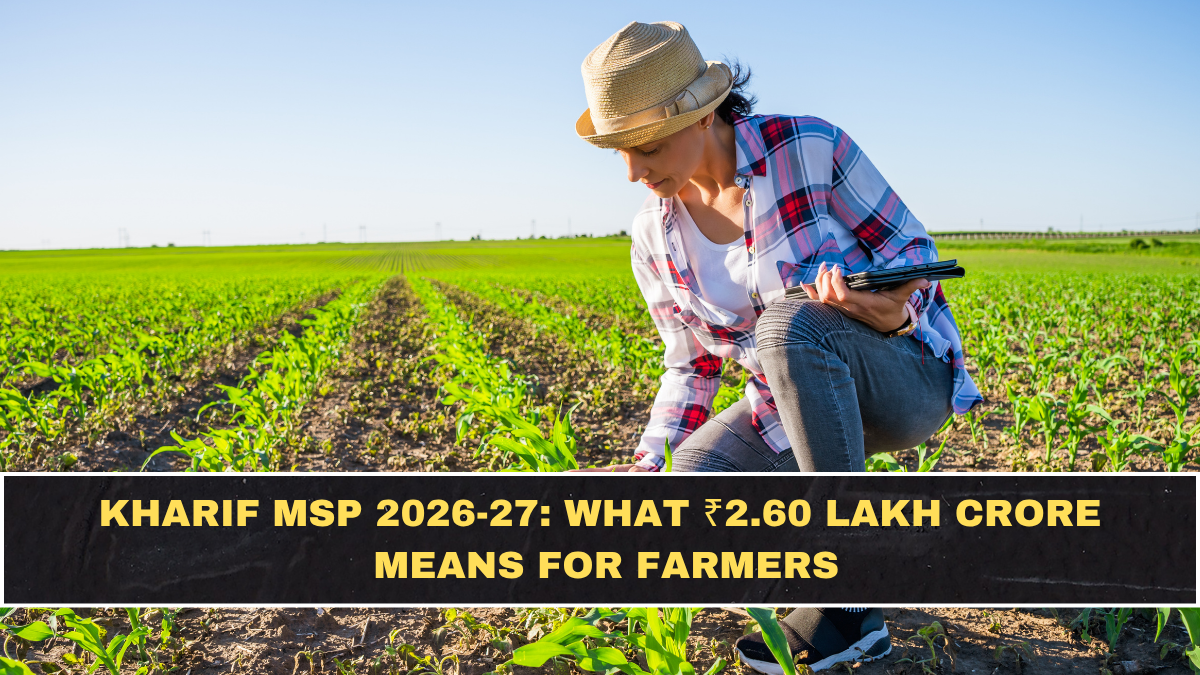
The Union Cabinet has approved higher Minimum Support Prices for 14 Kharif crops for the 2026–27 marketing season, with the expected farmer payout estimated at around ₹2.60 lakh crore. This decision comes before the main Kharif sowing season, which depends heavily on the southwest monsoon and directly affects crops like paddy, maize, cotton, pulses and oilseeds.
This matters because MSP is not just a number printed in a government chart. For millions of farmers, it works as a price signal before sowing and a safety net when market prices fall below fair value. The real question is whether this higher MSP will actually reach farmers through procurement, or remain a headline figure that benefits only those with access to mandis and government buying systems.
Which Crops Got The Biggest MSP Hike?
The highest absolute increase has been approved for sunflower seed, with a rise of ₹622 per quintal. Cotton has received a ₹557 per quintal increase, followed by nigerseed at ₹515 and sesamum at ₹500 per quintal. Paddy, the most important Kharif crop by scale, has been increased by ₹72 per quintal to ₹2,441 for common grade paddy.
| Crop Category | Major MSP Signal | Why It Matters? |
|---|---|---|
| Paddy | ₹2,441 per quintal for common grade | Directly affects large farmer base |
| Sunflower seed | Highest hike of ₹622/quintal | Push for oilseed production |
| Cotton | Hike of ₹557/quintal | Supports cash-crop farmers |
| Nigerseed | Hike of ₹515/quintal | Helps oilseed diversification |
| Sesamum | Hike of ₹500/quintal | Encourages non-paddy crop options |
Why Is The Government Pushing Oilseeds And Pulses?
The sharper MSP hikes for oilseeds, pulses and cotton show that the government is trying to push farmers beyond paddy-heavy cultivation. Business Standard reported that pulses, oilseeds and cotton received steeper hikes than paddy, with the move aimed at encouraging crop diversification and reducing import dependency.
This is a smart policy direction, but it has one big weakness. Farmers do not shift crops just because MSP is higher on paper. They shift only when procurement, storage, market access, irrigation and payment systems are reliable. If a farmer grows oilseeds but later sells below MSP due to weak procurement, the “diversification” promise collapses.
How Much Margin Over Cost Is Being Promised?
The government has said the revised MSP follows the policy of fixing MSP at least 1.5 times the all-India weighted average cost of production. According to reported government estimates, the margin over cost is highest for moong at 61%, followed by bajra and maize at 56% each, and tur/arhar at 54%; for remaining crops, the margin is estimated at 50%.
That sounds strong, but farmers will judge it through ground reality, not policy language. If input costs for diesel, labour, fertiliser, transport and rent rise faster than MSP gains, the actual benefit may feel smaller. MSP must protect income, but it also needs procurement strength and timely payment to become meaningful.
What Does ₹2.60 Lakh Crore Actually Mean?
The ₹2.60 lakh crore figure reflects the estimated payout to farmers under the MSP framework for the Kharif season. Reports also said annual procurement is projected at about 824.41 lakh metric tonnes, which shows the scale of government buying expected under the system.
But do not confuse “approved MSP” with guaranteed income for every farmer. MSP benefit is strongest where government procurement is active, especially in crops like paddy. Farmers growing crops with weak procurement or selling to private traders may still struggle if market prices fall below MSP and no buyer steps in.
What Should Farmers Watch Now?
Farmers should not look only at the MSP headline. They should track monsoon progress, local procurement rules, mandi prices, input costs and state-level buying arrangements before finalising crop decisions. A higher MSP is useful only when the farmer can actually sell at or above that price.
Key things to watch this season include:
- State-wise procurement centres and crop coverage
- Actual mandi prices compared with MSP
- Monsoon progress and sowing advisories
- Fertiliser, diesel and labour cost movement
- Payment timelines after crop procurement
- Whether oilseeds and pulses get real buying support
What Is The Conclusion?
The Kharif MSP 2026–27 decision is important because it promises better price support for 14 crops and an estimated farmer payout of ₹2.60 lakh crore. The larger hikes for sunflower, cotton, nigerseed and sesamum also show a clear push toward crop diversification and reduced import dependence.
The blunt truth is that MSP announcements alone do not change farmers’ lives. Procurement, payments, local market access and input-cost control will decide whether this becomes real income support or just another attractive government headline. Farmers need price protection, not just price promises.
What Are The FAQs?
What Is The Kharif MSP 2026–27 Decision?
The Cabinet has approved increased MSP for 14 Kharif crops for the 2026–27 marketing season. The estimated payout to farmers is around ₹2.60 lakh crore, according to government-linked reports.
What Is The MSP Of Paddy For 2026–27?
The MSP for common grade paddy has been increased by ₹72 per quintal to ₹2,441 for the 2026–27 Kharif season. Paddy remains one of the most important crops covered under the MSP system.
Which Crop Got The Highest MSP Increase?
Sunflower seed received the highest absolute MSP increase, with a hike of ₹622 per quintal. Cotton, nigerseed and sesamum also received major increases compared with the previous year.
Will Every Farmer Benefit From MSP?
No, not automatically. Farmers benefit most when procurement is available and payments are timely. If a crop has weak government buying or local market prices stay below MSP, many farmers may not receive the full benefit.