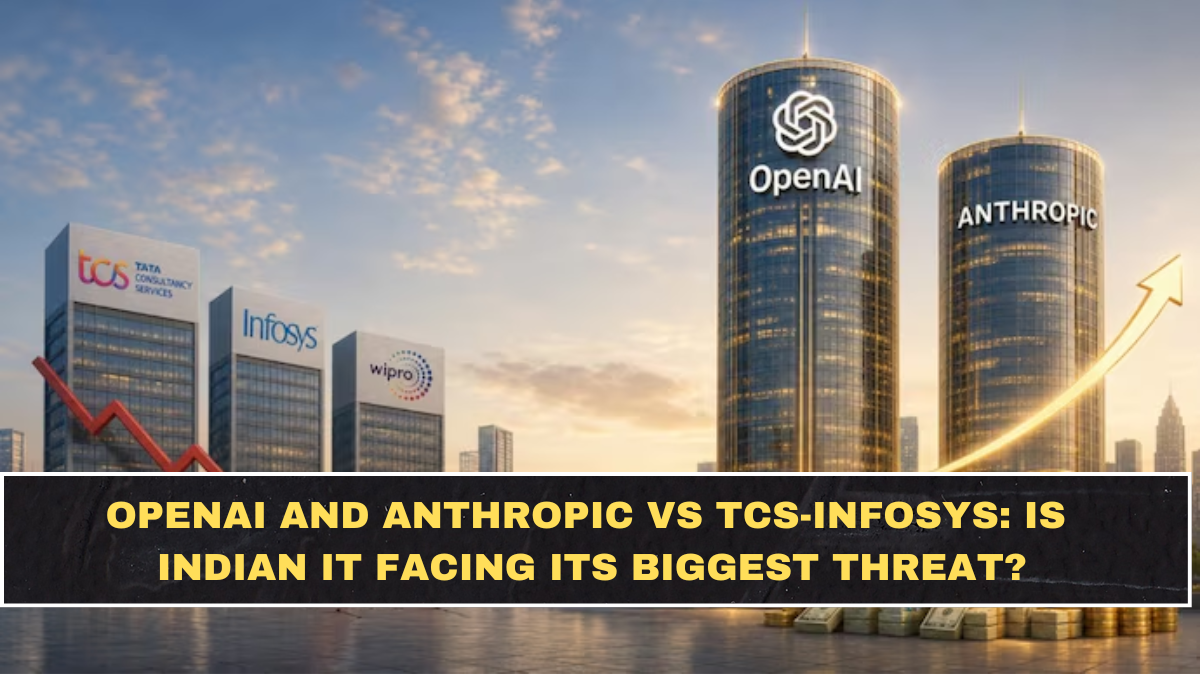
OpenAI and Anthropic are no longer behaving like only AI model companies. They are moving deeper into enterprise AI services, where companies need help using AI inside coding, customer support, finance, compliance and internal workflows. That is exactly the territory where Indian IT giants like TCS, Infosys, Wipro and Cognizant have built decades of business.
Reuters reported that OpenAI is expanding partnerships with global consulting firms for Codex and launching Codex Labs, where OpenAI specialists will work directly inside customer organisations. Anthropic has also announced a major AI-services push with Wall Street firms through a $1.5 billion venture focused on helping businesses adopt AI at scale.

Why Is This A Big Threat?
The threat is simple: AI companies are trying to move closer to the client’s actual work, not just sell software licenses. If OpenAI or Anthropic can provide models, tools, specialists and implementation playbooks together, they may reduce the need for large traditional IT teams on some projects. That does not kill Indian IT overnight, but it attacks the old manpower-heavy outsourcing model.
Infosys already felt this pressure earlier in 2026 when Indian IT stocks were hit by fears that AI tools could disrupt traditional services. Reuters reported that Infosys later announced a partnership with Anthropic to build and deploy AI agents, starting with telecom and expanding into financial services, manufacturing and software development.
What Is Changing Fast?
| Area | Old IT Services Model | New AI Services Model |
|---|---|---|
| Coding | Large developer teams | AI-assisted coding and review |
| Support | Human-heavy ticket handling | AI agents resolving repeat tasks |
| Consulting | Long transformation projects | Faster AI workflow deployment |
| Pricing | Headcount and billing hours | Outcome and productivity-based value |
| Skills | Generic IT delivery | AI, cloud, data and workflow automation |
This shift is uncomfortable because Indian IT grew on a simple formula: more client work usually meant more people. AI breaks that link. If one AI-enabled engineer can do more work, clients may demand smaller teams, faster delivery and lower cost, which directly pressures margins and hiring models.
Are TCS And Infosys Sleeping?
No, and this is where lazy panic articles get it wrong. TCS and Infosys are not sitting helplessly. TCS said its annualised AI revenue crossed $2.3 billion in Q4 FY26, driven by faster AI-solution deployment. Reuters earlier reported that AI services contributed about 5.8% of TCS’s total revenue in Q3 FY26, showing the company is already monetising enterprise AI.
Infosys is also pushing hard. Reuters reported that Infosys’s AI services accounted for 5.5% of its December-quarter revenue, while the company was handling 4,600 AI projects and had developed more than 500 AI agents. Infosys and Anthropic also said their colles and agentic AI solutions.
Where Can Jobs Get Hit?
The biggest risk is not to every IT job. The real risk is to repetitive, low-complexity work that clients believe AI can automate. Basic testing, simple coding, L1 support, documentation, ticket triage, report generation and routine maintenance may face pressure first. That is where AI can reduce effort quickly and visibly.
Times of India reported that India’s top five IT firms reduced headcount by nearly 7,000 employees in FY26, reflecting a shift away from the old model where revenue growth depended heavily on adding more people. The report linked the change to AI-driven delssure and client demand for outcome-based work.
What Should Indian IT Fear Most?
- AI-native consulting: OpenAI and Anthropic can build services around their own models.
- Client-side AI teams: Big companies may build internal AI capability instead of outsourcing everything.
- Lower billing hours: AI can reduce time needed for coding, testing and support tasks.
- Margin pressure: Clients will ask why they should pay old rates for AI-assisted delivery.
- Skill mismatch: Employees with generic skills may struggle if they do not move into AI workflows.
The brutal truth is that “experience in IT” alone is no longer enough protection. Workers who only execute repetitive tasks are exposed. Companies that still sell bodies instead of outcomes are exposed. The safe side is not seniority; the safe side is AI fluency, domain depth and ability to solve business problems.
Can Indian IT Still Win?
Yes, Indian IT can still win because enterprise transformation is messy. Large banks, telecom firms, healthcare companies and manufacturers do not simply plug in an AI model and transform overnight. They need data cleaning, system integration, compliance, cloud migration, security, change management and long-term support. That is where TCS, Infosys and other Indian firms still have strong advantages.
Cognizant’s $600 million Astreya acquisition shows where the market is going: AI infrastructure, data-centre support and platform-led delivery. The firms that combine AI tools with deep enterprise execution can survive. AI is only another buzzword will get punished.
What Is The Final Conclusion?
OpenAI and Anthropic entering AI services is a serious warning for Indian IT, but it is not an instant death sentence for TCS and Infosys. The threat is real because AI-native companies can attack coding, support, consulting and workflow automation directly. But Indian IT still has enterprise relationships, delivery scale and integration experience.
The blunt takeaway is simple: Indian IT will not be destroyed by AI, but the old outsourcing comfort zone is dying. TCS and Infosys must become AI-led execution engines, not manpower suppliers with AI slides. For workers, the message is harsher: upgrade now, because generic IT roles will be the first to feel the squeeze.
Frequently Asked Questions
Why are OpenAI and Anthropic a threat to TCS and Infosys?
OpenAI and Anthropic are a threat because they are moving beyond AI models into enterprise services, implementation and workflow automation. That brings them closer to the kind of work Indian IT firms do for global clients. If AI companies can deliver faster automation with smaller teams, traditional outsourcing models may face pressure.
Will AI replace Indian IT jobs?
AI will not replace all Indian IT jobs, but it can reduce demand for repetitive and low-complexity roles. Basic coding, testing, documentation, support tickets and routine maintenance are more exposed. Jobs requiring domain knowledge, AI implementation, cloud, cybersecurity, data engineering and client-facing problem solving are safer.
Are TCS and Infosys already earning from AI?
Yes, both companies are already earning from AI services. TCS said its annualised AI revenue crossed $2.3 billion in Q4 FY26. Infosys reported AI services at 5.5% of December-quarter revenue and said it was handling thousands of AI projects with hundreds of AI agents.
What should Indian IT employees learn now?
Indian IT employees should learn AI-assisted coding, cloud platforms, data engineering, cybersecurity, MLOps, workflow automation and domain-specific problem solving. The dangerous mistake is thinking normal coding or support experience is enough.
Click here to know more