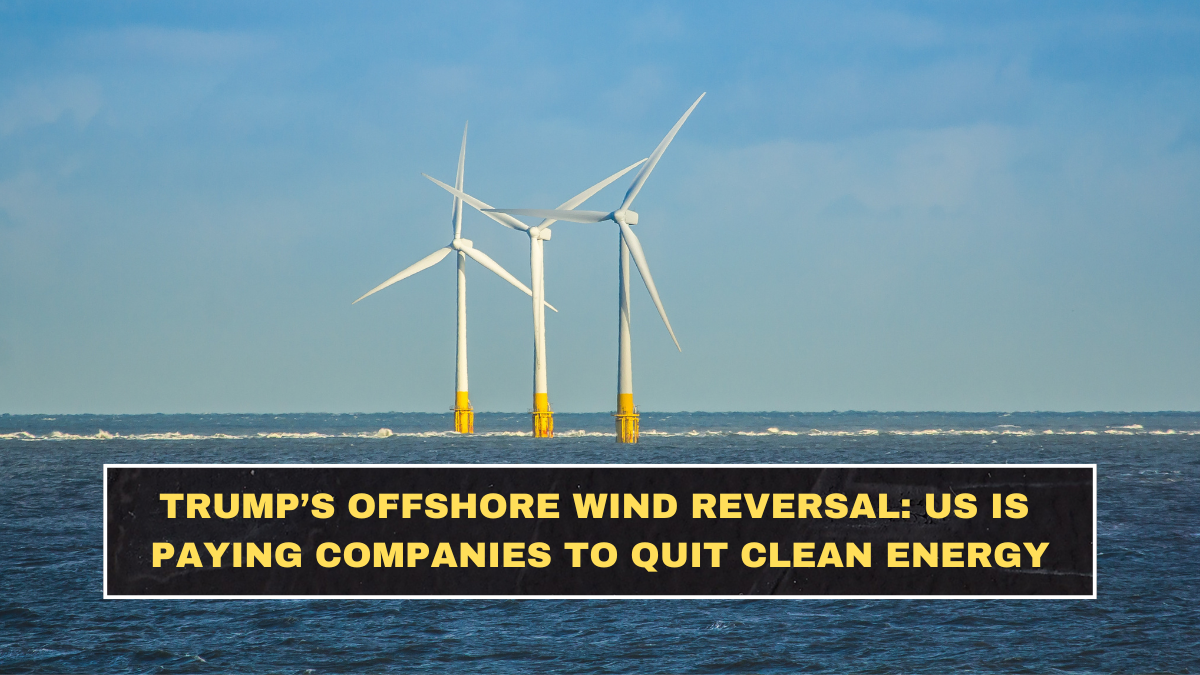
The Trump administration is paying offshore wind developers to walk away from US projects because it wants to shift energy policy back toward fossil fuels. The Interior Department has now announced deals to end two more offshore wind leases, one in the Atlantic and one in the Pacific, in exchange for major fossil fuel investment commitments. This is not a normal policy adjustment. It is a direct reversal of America’s clean-energy direction.
Reuters reported that the administration reached a deal to end two more US offshore wind leases in return for $885 million in pledged investments in domestic fossil fuel infrastructure. The projects involved Bluepoint Wind off New York and New Jersey, and Golden State Wind off California’s central coast. This follows a similar deal involving TotalEnergies, which was offered around $1 billion to walk away from offshore wind plans and redirect investment toward fossil fuel projects.
Which Offshore Wind Projects Are Being Cancelled?
The latest cancellations involve Bluepoint Wind and Golden State Wind. Bluepoint Wind was in the early stages of development off the coasts of New Jersey and New York, while Golden State Wind was planned as a floating offshore wind project off California. Both companies agreed to end their leases and not pursue new offshore wind projects in the United States under the current deal structure.
AP reported that the reimbursements total nearly $900 million, with the Interior Department saying both companies will redirect investment away from offshore wind and into fossil fuel infrastructure. Bluepoint Wind’s partner Global Infrastructure Partners is expected to redirect its $765 million winning bid toward a US liquefied natural gas facility, while Golden State Wind will reclaim $120 million in lease fees for equivalent traditional-energy investment.
| Project | Location | Reported Deal | New Direction |
|---|---|---|---|
| Bluepoint Wind | New York and New Jersey coast | $765 million redirected | LNG infrastructure |
| Golden State Wind | California central coast | $120 million reclaimed | Traditional energy investment |
| TotalEnergies projects | New York and North Carolina coast | About $928 million to $1 billion | Fossil fuel infrastructure |
| Policy effect | US offshore wind sector | Major rollback | Fossil-fuel priority |
Why Does Trump Oppose Offshore Wind So Strongly?
Trump has long criticised wind energy, arguing that turbines are expensive, inefficient, visually unattractive, and bad for certain industries. His administration is now turning that political dislike into direct federal policy. Interior Secretary Doug Burgum has argued that offshore wind projects depend too heavily on taxpayer subsidies and that the US should focus on affordable and reliable energy through fossil fuels.
That argument has supporters, especially among fossil fuel companies, some coastal opponents of wind farms, and politicians who argue that renewable projects are too costly or unreliable. But the weakness in the argument is obvious: paying companies to cancel clean-energy leases is also government intervention. Calling wind subsidies wasteful while spending public or redirected funds to kill wind projects is not free-market discipline. It is political energy picking.
Why Are Critics Calling This A Climate And Energy Mistake?
Critics say the policy is damaging because it reduces future clean-power capacity just as electricity demand is rising from artificial intelligence, data centres, industry, electric vehicles, and household use. Offshore wind is not perfect, but it can provide large-scale power near major coastal population centres. Killing projects now may make the US more dependent on gas, coal, and oil during a period of global fuel-price volatility.
AP reported that critics, including Senate Minority Leader Chuck Schumer, called the move economically and environmentally harmful. Industry advocates also warned that cancelling offshore wind projects makes it harder to meet rising electricity demand and weakens a broader energy mix. The concern is not just climate symbolism. It is whether the US is narrowing its energy options when it should be expanding them.
Is This Really Saving Taxpayers Money?
Not necessarily. Supporters argue that offshore wind projects rely on subsidies and that cancelling them avoids future costs. But if the government is reimbursing companies for lease payments and pushing money into fossil fuel infrastructure, taxpayers and consumers may still carry the burden in different ways. The question is not only how much offshore wind costs. It is what the replacement costs.
The TotalEnergies case shows the scale. Reuters reported that the US was preparing a settlement of about $1 billion, including around $928 million linked to lease payments for projects off New York and North Carolina. In exchange, the company would stop wind development and invest in fossil fuel infrastructure, including natural gas projects. That is not a cheap exit. It is an expensive policy reversal.
Why Is This Happening After Legal Setbacks?
The Trump administration has also faced court challenges over its attempts to slow or block renewable energy projects. Reuters reported that a US judge recently blocked administration actions that had hindered wind and solar projects nationwide, finding that certain permitting restrictions lacked justification and likely violated federal administrative law. That ruling was a setback for the administration’s broader anti-renewables agenda.
This helps explain the strategy shift. If the government cannot easily block every project through permitting or suspension orders, it can pressure companies into settlements, refunds, and exit deals. That may be more legally manageable in some cases, but it still sends a chilling signal to renewable developers: even if you win a lease, a future administration may make the project politically impossible.
What Does This Mean For Offshore Wind Jobs?
The offshore wind rollback could hurt jobs tied to ports, vessels, construction, grid upgrades, turbine components, engineering, and long-term maintenance. Offshore wind projects are not just turbines in the ocean. They create supply chains around coastal manufacturing, electrical infrastructure, marine services, and specialised labour.
The problem is that many of those jobs depend on project certainty. Companies will not build factories, train workers, or upgrade ports if they think federal policy may cancel projects after leases are awarded. That uncertainty can be as damaging as cancellation itself. Investors hate political whiplash, and offshore wind is already capital-intensive enough without policy chaos.
Could Fossil Fuel Investment Help Energy Security?
Yes, fossil fuel investment can support short-term energy security, especially for gas supply, LNG exports, industrial demand, and grid reliability. The US still uses fossil fuels heavily, and pretending they can disappear overnight is unserious. Natural gas will remain part of the energy system for years.
But the real question is balance. A serious energy strategy would add reliable clean power while maintaining backup and grid stability. Trump’s policy looks less like balance and more like a deliberate campaign to weaken one sector while rewarding another. That may please fossil fuel allies, but it creates long-term risk if gas prices rise, climate damage worsens, or clean-tech investment moves overseas.
What Could This Mean For Consumers?
Consumers may not notice the impact tomorrow morning, but they could feel it over time. If future clean-power projects are cancelled, electricity supply may become tighter in high-demand regions. If the US relies more heavily on gas, power prices may become more exposed to fuel-price swings. If offshore wind supply chains collapse, rebuilding them later will be expensive.
This is the part politicians usually hide. Energy policy decisions made today shape prices years later. Cancelling offshore wind may look like a win to voters who dislike turbines, but it could reduce future competition in the power market. Less competition usually does not help consumers.
Conclusion
Trump’s offshore wind reversal is not just a climate-policy story. It is a major energy-power fight over who gets federal support, which industries shape America’s future grid, and whether clean-energy investment can survive political turnover. The administration is now paying or reimbursing companies to walk away from offshore wind leases while steering investment toward fossil fuels.
The blunt truth is that this is not neutral energy policy. It is a fossil-fuel-first strategy dressed up as affordability. Offshore wind has real cost and permitting problems, but paying companies to quit clean energy while electricity demand rises is a risky bet. If the US later needs that clean power, rebuilding trust with developers will not be easy.
FAQs
What is Trump doing with offshore wind leases?
The Trump administration is ending offshore wind leases by reimbursing or settling with developers and encouraging them to redirect money into fossil fuel infrastructure. Recent deals involve Bluepoint Wind and Golden State Wind, worth about $885 million combined.
Which offshore wind projects are affected?
The latest affected projects are Bluepoint Wind off New York and New Jersey, and Golden State Wind off California’s central coast. A previous deal also involved TotalEnergies projects off New York and North Carolina.
Why are critics angry about the offshore wind cancellations?
Critics say the cancellations weaken clean-energy development, hurt jobs, reduce future power supply options, and increase dependence on fossil fuels. They also argue that paying companies to cancel projects is itself a costly government intervention.
Could this affect US electricity prices?
Yes, over time. If offshore wind projects are cancelled while electricity demand rises, future supply may become tighter in some regions. Greater dependence on gas can also expose consumers to fuel-price volatility.