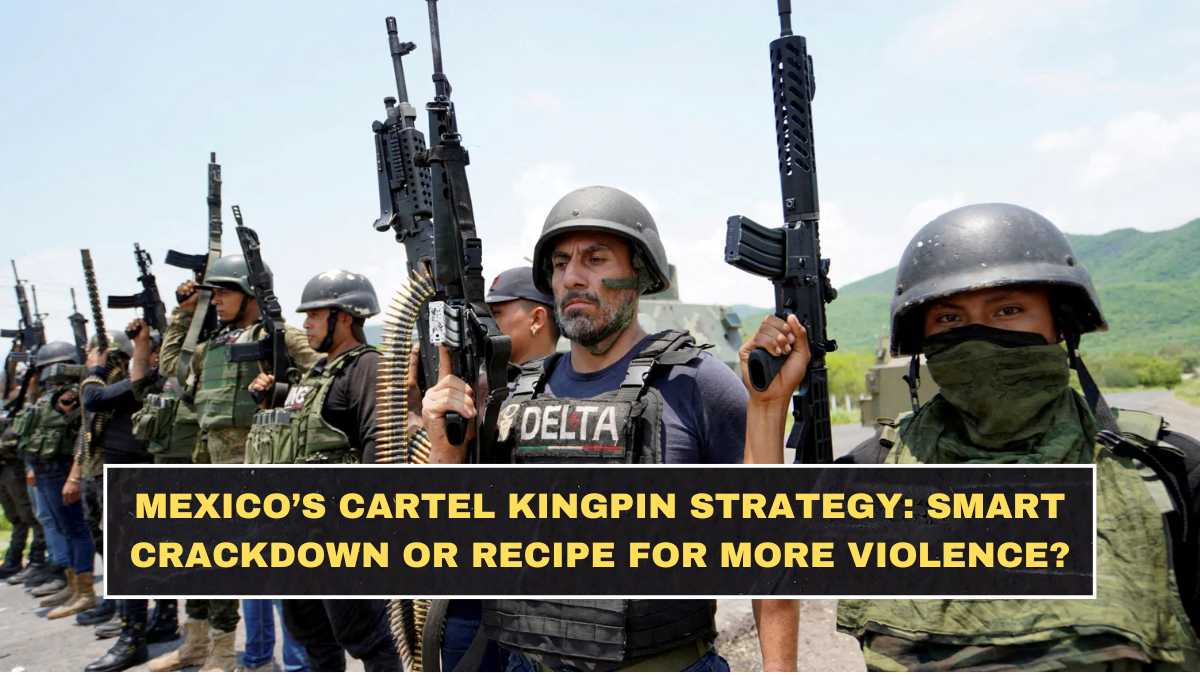
Mexico is again leaning into a “kingpin strategy,” meaning security forces are targeting top cartel leaders instead of only arresting lower-level members. The latest major example is the arrest of Audias Flores, known as “El Jardinero,” a senior commander in the Jalisco New Generation Cartel, or CJNG. Mexican officials said special forces captured him in Nayarit after a long intelligence operation supported by US aerial surveillance.
The strategy looks strong on paper. Remove the boss, weaken the cartel, disrupt trafficking routes, and show the public that the government is taking control. But Mexico has already tried this playbook before, and the results were messy. Capturing or killing cartel leaders can weaken one group temporarily, but it can also trigger power struggles, revenge attacks, splinter groups, and more violence in local communities.
What Is The Kingpin Strategy In Simple Terms?
The kingpin strategy is a security approach that focuses on removing cartel leaders, commanders, financiers, and logistics chiefs. Instead of fighting every small cell, authorities try to cut off the head of the organisation. The idea is that cartels depend on leadership, money, discipline, and networks, so hitting top figures should create disruption.
But criminal organisations are not normal companies. When a CEO leaves a company, a board appoints a replacement. When a cartel leader is killed or captured, armed factions may fight for territory, drug routes, extortion income, and loyalty. That is why the strategy can produce quick headlines but unstable long-term outcomes.
| Strategy Element | Possible Benefit | Possible Risk |
|---|---|---|
| Arrest cartel leaders | Weakens command structure | Creates violent succession battles |
| Use US intelligence | Improves tracking and surveillance | Raises sovereignty concerns in Mexico |
| Target trafficking routes | Disrupts fentanyl and drug flows | Cartels adapt through new routes |
| Show strong enforcement | Reassures public and Washington | Can look reactive under US pressure |
| Hit finances | Weakens cartel operations | Money networks may re-form quickly |
Why Is The US Pressuring Mexico So Hard?
The US is pressuring Mexico because fentanyl trafficking, cartel violence, and cross-border crime are major political issues in Washington. President Donald Trump has repeatedly pushed for stronger action against Mexican cartels, including threats of more direct US involvement. Reuters reported that Trump’s administration has run a pressure campaign demanding Mexico ramp up its anti-cartel crackdown, while also raising the possibility of direct intervention.
This puts Claudia Sheinbaum in a difficult position. If she does too little, Washington accuses Mexico of failing to control cartels. If she allows too much US involvement, she looks weak on national sovereignty. That tension became sharper after two CIA officers were killed in a car crash in Chihuahua while reportedly involved in an anti-narcotics operation that Mexico said was not properly authorised.
What Happened With “El Jardinero”?
“El Jardinero” was considered a major CJNG figure and a possible successor to the cartel’s late leader Nemesio Oseguera, known as “El Mencho.” Reuters reported that Flores oversaw operations along Mexico’s Pacific coast and managed drug labs, trafficking routes, and distribution networks linked to the US. He was captured after a 19-month operation involving more than 500 troops, and the US had placed a $5 million bounty on him.
The operation matters because it shows Mexico is willing to pursue high-value targets again. It also shows how closely US and Mexican intelligence can still work together despite public disputes. But the real test is not the arrest itself. The test is what happens after: whether CJNG weakens, fragments, retaliates, or simply replaces him.
Why Can Taking Out Cartel Leaders Make Violence Worse?
Taking out cartel leaders can make violence worse because it creates a power vacuum. Rival factions may fight to control territory, drug labs, trafficking corridors, extortion networks, and local police influence. Smaller groups can split away and become more unpredictable. That is one reason Mexico’s earlier war-on-drugs years saw repeated fragmentation rather than clean victory.
Al Jazeera’s recent analysis warned that Mexico’s renewed focus on decapitating cartels may come at a cost, especially because leadership arrests can destabilise criminal groups without solving the corruption, poverty, weapons flows, and impunity that allow them to survive. The point is uncomfortable but true: killing or arresting a boss does not automatically kill the business model.
Is Sheinbaum Really Returning To A War-On-Drugs Model?
Sheinbaum says no, but her actions show a tougher security turn. She has rejected the language of a “war on drugs,” yet Mexico has increased military operations against cartel figures. The Los Angeles Times reported that the killing of “El Mencho” signalled a shift toward more aggressive tactics, even as Sheinbaum insisted Mexico was not returning to a militarised drug war.
This is political balancing. Sheinbaum wants to avoid the failed image of past militarised crackdowns, but she also needs to show strength to Washington, Mexican voters, and international audiences before the 2026 FIFA World Cup, which Mexico is co-hosting. The result is a strategy that sounds different from the old drug war but may look similar on the ground.
Why Is US Involvement So Sensitive In Mexico?
US involvement is sensitive because Mexico has a long history of resisting foreign security operations on its soil. Many Mexicans see unauthorised US intelligence activity as a violation of sovereignty. After the Chihuahua crash involving two CIA officers, Sheinbaum warned that US anti-drug operations without federal knowledge or approval must not happen again.
This matters because cooperation is necessary, but uncontrolled cooperation is politically dangerous. Mexico needs US intelligence, technology, and financial-tracking help. The US needs Mexico’s territory, arrests, and policing power. But if Washington acts like Mexico is only a staging ground for US operations, Sheinbaum risks domestic backlash and cartel policy becomes even more explosive.
Can The Kingpin Strategy Actually Work?
It can work only if it is part of a larger strategy. Arresting cartel leaders can disrupt operations, reduce coordination, and weaken key networks. But by itself, it is not enough. Mexico also needs financial investigations, anti-corruption prosecutions, local police reform, witness protection, port controls, gun-trafficking enforcement, and serious development in areas where cartels recruit.
The biggest mistake would be confusing arrests with victory. A cartel can lose a leader and still keep earning money from fentanyl, extortion, fuel theft, migrant smuggling, illegal mining, and protection rackets. If the money stays intact, someone else will eventually step into the leadership role.
What Should Mexico Do Differently This Time?
Mexico needs to target cartel ecosystems, not just cartel celebrities. That means following the money, punishing corrupt officials, protecting prosecutors, freezing assets, disrupting chemical supply chains, and making local communities less dependent on cartel-controlled economies. The kingpin strategy should be one tool, not the whole plan.
Sheinbaum also needs to be honest with the public. Saying there is “no war” while deploying heavy military force creates confusion. If the government is escalating, it should explain the goal, the limits, and the plan to prevent retaliation. Otherwise, Mexico risks repeating the same old mistake: dramatic arrests followed by local chaos.
Conclusion
Mexico’s renewed kingpin strategy may deliver headline victories, but it is not a magic solution. The arrest of “El Jardinero” is a serious blow to CJNG, and US intelligence support clearly helped. But Mexico’s history shows that removing cartel leaders can also trigger fragmentation, revenge, and more violence if the deeper criminal economy remains untouched.
The blunt truth is that Mexico cannot arrest its way out of cartel power. It needs arrests, yes, but also financial warfare, anti-corruption work, local security reform, and strict control over foreign involvement. If Sheinbaum treats kingpin takedowns as proof of success, she is fooling herself. If she treats them as only the opening move, Mexico has a better chance.
FAQs
What is Mexico’s kingpin strategy?
The kingpin strategy focuses on capturing or killing top cartel leaders to weaken criminal organisations. The goal is to disrupt command structures, trafficking routes, finances, and cartel coordination.
Who is “El Jardinero”?
“El Jardinero,” whose real name is Audias Flores, is a senior CJNG figure arrested by Mexican special forces in Nayarit. He was linked to Pacific coast operations, drug labs, trafficking routes, and US distribution networks.
Why is the US pressuring Mexico on cartels?
The US is pressuring Mexico because fentanyl trafficking and cartel violence are major political and security issues. Trump’s administration has pushed Mexico to intensify cartel crackdowns and has threatened more direct US involvement.
Can arresting cartel leaders reduce violence?
Sometimes it can disrupt cartel operations, but it can also increase violence if rival factions fight for control. Arrests work best when combined with financial investigations, anti-corruption action, local policing reform, and long-term community security.