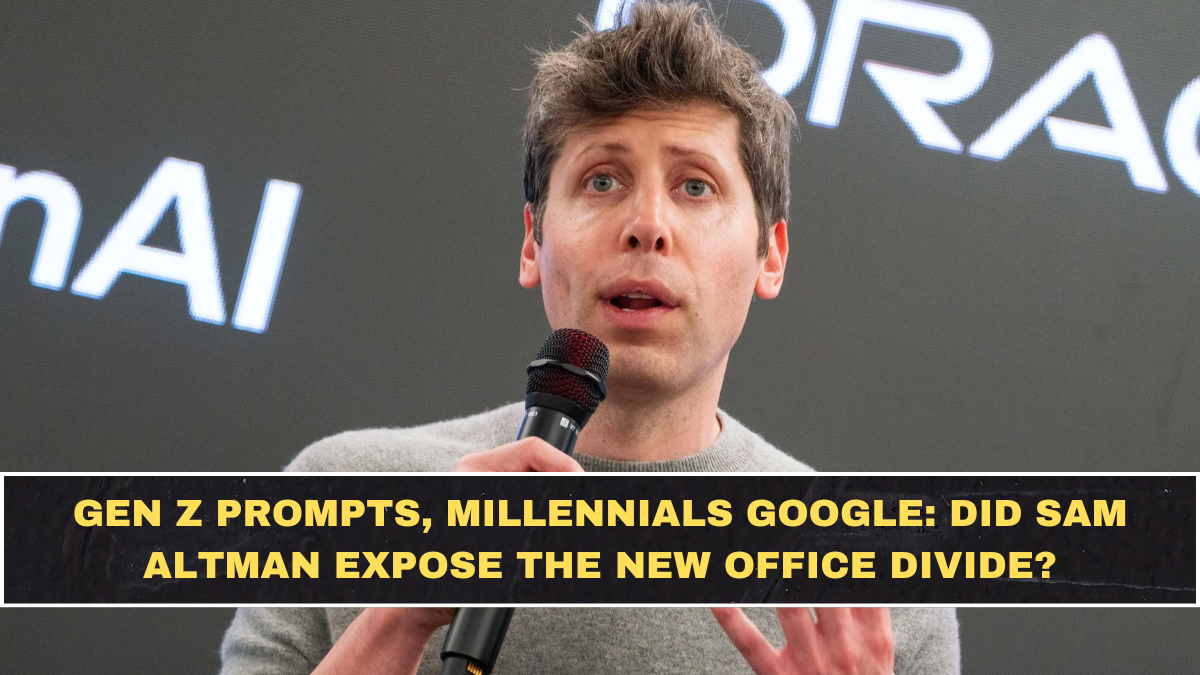
Sam Altman’s reported observation that older users treat ChatGPT more like Google while younger users treat it like a personal operating system has triggered a fresh workplace debate. India Today framed it sharply as “Gen Z prompts, millennials Google,” and that line went viral because it feels painfully true in many offices. Millennials still search, scan links and cross-check tabs, while younger workers often begin with AI prompts.
This is not just a funny generational meme. It shows a real shift in how people solve problems at work. One generation learned to search the internet like detectives, while another is learning to instruct AI like a co-worker. The office divide is no longer only about age; it is about workflow, speed, trust and how comfortable people are with machine-generated answers.
What Did Sam Altman Actually Suggest?
Altman has said younger users use ChatGPT very differently from older users. Fortune reported that young people use it almost like an operating system, with complex setups, saved prompts and connected files, while some do not make life decisions without asking ChatGPT. Moneycontrol also reported Altman’s point that college students are integrating ChatGPT into decision-making more deeply than older users.
The “millennials Google, Gen Z prompts” line is a simplified version of that broader idea. It is not perfectly true for every person, and Altman himself has earlier called such generational comparisons a gross oversimplification. But oversimplified does not mean useless. It captures a real workplace behaviour shift happening right now.
| Work Habit | Millennials Often Do | Gen Z Often Does |
|---|---|---|
| Starting research | Google keywords and compare links | Ask AI with a detailed prompt |
| Drafting work | Write first, then edit | Generate draft, then refine |
| Learning tools | Search tutorials and guides | Ask AI for step-by-step help |
| Decision support | Read reviews and opinions | Ask AI to compare options |
| Risk area | Slow research loops | Overtrusting confident AI answers |
| Strength | Verification habit | Prompt fluency and speed |
Why Does This Matter At Work?
This matters because AI is changing the definition of productivity. A worker who knows how to prompt clearly can draft emails, summarise documents, create plans, generate ideas and troubleshoot faster. That does not automatically make them smarter, but it can make them faster if they also know how to verify outputs.
The weak spot is obvious: speed without judgment is dangerous. Gen Z workers may be faster with AI, but if they accept every answer blindly, they will make polished mistakes. Millennials may be better at cross-checking sources, but if they refuse to learn AI workflows, they will look slow in teams where automation is becoming normal.
Is Prompting Actually A Skill?
Yes, prompting is becoming a real workplace skill. A research paper on prompt patterns describes prompts as instructions that guide large language models and says prompt engineering is an increasingly important skill for effectively working with tools like ChatGPT. That means prompting is not just typing random questions; it is learning how to give context, constraints, examples and desired output clearly.
But let’s not overglorify it. Prompting alone is not expertise. If someone knows how to ask AI for a financial report but cannot understand the numbers, they are not skilled; they are dependent. The future belongs to people who combine domain knowledge with AI fluency, not people who outsource thinking completely.
What Are The Risks Of AI-First Work?
The biggest risk is overconfidence. AI answers can sound clean, professional and convincing even when they are wrong, outdated or missing context. In workplace settings, that can lead to bad emails, wrong reports, poor legal assumptions, fake citations or weak strategic decisions.
Altman has also previously warned that relying too much on ChatGPT for life decisions can be “bad and dangerous,” especially when users treat the tool as if it deeply understands everything about them. That warning matters because AI can assist thinking, but it should not replace judgment.
How Should Millennials Adapt?
Millennials should stop acting like Google search is the final form of digital intelligence. Search skills are still useful, but AI can reduce wasted time when used properly. If you are still manually opening ten tabs for every routine task while your colleague creates a structured summary in minutes, you are not being thorough; you may be being inefficient.
Millennials should learn:
- How to write clear prompts with context and constraints
- How to use AI for first drafts, not final truth
- How to verify AI output with credible sources
- How to automate repetitive writing and planning tasks
- How to combine search habits with AI workflows
- How to protect confidential work data while using tools
How Should Gen Z Be Careful?
Gen Z should not confuse AI comfort with professional maturity. Being fast with prompts is useful, but workplaces reward accuracy, ownership and judgment. If your AI-generated answer fails, your manager will not blame the chatbot; they will blame you.
Younger workers need to build verification discipline. Ask AI, but also check primary sources. Generate drafts, but edit with human sense. Use AI to accelerate learning, but do not let it become a crutch that prevents deep understanding. The workers who win will be the ones who prompt well and think better.
Conclusion?
The “Gen Z prompts, millennials Google” debate is viral because it exposes a real workplace shift. Millennials grew up mastering search engines, while Gen Z is growing into AI-assisted workflows. Neither side is automatically superior. One has stronger search and verification instincts; the other often has stronger prompt fluency and speed.
The real office divide is not age. It is adaptability. Workers who refuse AI will become slower, while workers who blindly trust AI will become risky. The smartest professionals will use both: Google-style verification and AI-style acceleration. That combination is where the future of work is clearly heading.
FAQs?
What Does “Gen Z Prompts, Millennials Google” Mean?
It means younger workers are increasingly using AI prompts to get answers, drafts and guidance, while millennials often rely more on Google searches, tabs and manual comparison. The phrase became viral after reports linked it to Sam Altman’s comments on generational ChatGPT usage.
Did Sam Altman Say Gen Z Uses ChatGPT Differently?
Yes, Altman has said younger users, especially college students, use ChatGPT more deeply than older users, sometimes like an operating system or life advisor. Reports say older users often treat it more like a search replacement.
Is Prompting A Real Job Skill?
Yes, prompting is becoming a workplace skill because clear instructions help AI tools produce better outputs. However, prompting is useful only when combined with subject knowledge, verification and good judgment.
Should Workers Use ChatGPT Instead Of Google?
No, workers should not blindly replace Google with ChatGPT. AI is useful for drafting, summarising and structuring ideas, while search engines remain important for checking sources, dates, official information and facts. The best approach is to use both intelligently.