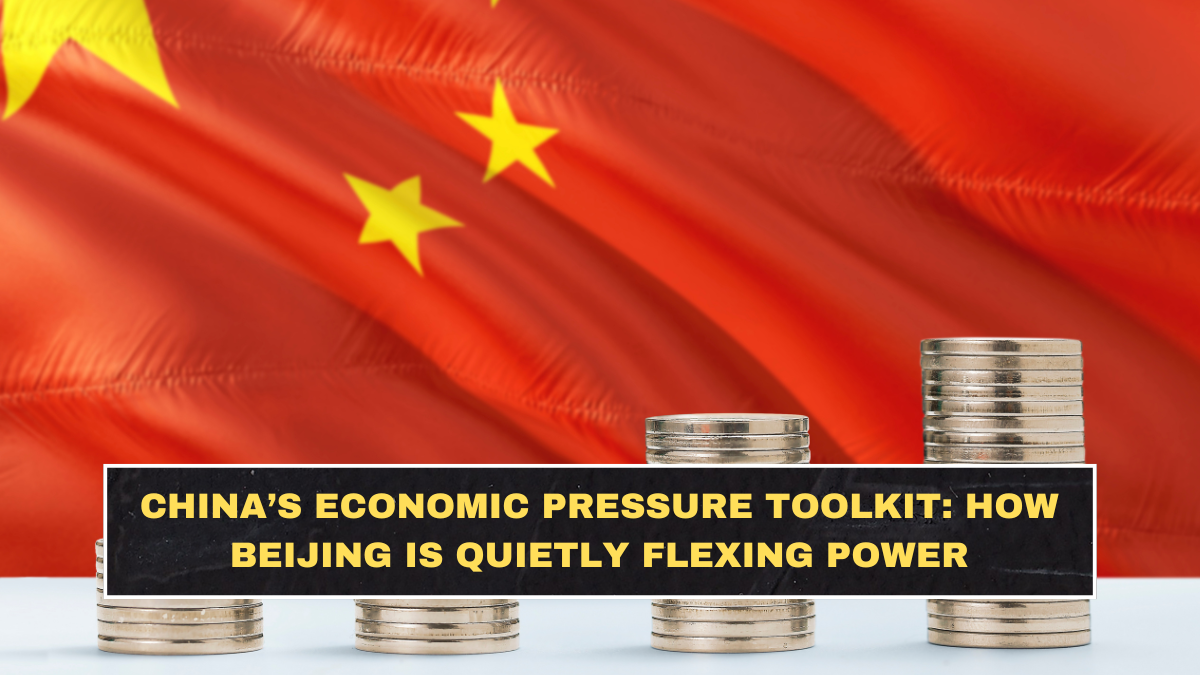
China’s economic pressure toolkit is back in focus because Beijing is expanding the ways it can punish, pressure or warn other countries without firing a shot. Reuters reported that China has broadened its economic tools during a trade truce with Trump, giving Beijing more leverage even while formal US-China trade talks continue. That is the part many people miss: a truce does not mean pressure has stopped.
This matters because China is not only a major exporter. It is also a huge consumer market, a manufacturing hub, a critical minerals supplier and a powerful regulator. That gives Beijing many quiet ways to influence companies and governments. Smaller countries especially need to worry because they may depend heavily on Chinese trade, tourism, investment or supply chains.
What Does Economic Pressure Mean In Simple Terms?
Economic pressure means using trade, investment, supply chains, customs rules, tourism flows, market access or regulatory action to push another country or company into changing behaviour. It does not always look like an official sanction. Sometimes it appears as delayed customs clearance, sudden inspections, cancelled tourism, blocked imports or pressure on private companies.
The European Parliament has described Chinese coercion as often happening “behind the curtains,” where both the coercer and the target may avoid openly admitting that pressure is being applied. That makes it harder to prove, harder to challenge and easier for Beijing to deny. This is why China’s toolkit is powerful: it can create pain without always leaving a clean fingerprint.
| Tool | How It Works? | Who Feels The Pain? |
|---|---|---|
| Customs delays | Goods get stuck at ports or face inspections | Exporters and farmers |
| Market access pressure | Companies fear losing Chinese consumers | Global brands |
| Tourism restrictions | Group travel slows or stops | Airlines, hotels and cities |
| Critical mineral controls | Export permits or limits affect supply | Tech, EV and defence firms |
| Corporate investigations | Firms face probes, fines or approvals risk | Multinationals |
| Consumer boycotts | Nationalist campaigns hurt sales | Brands and retailers |
Why Are Rare Earths And Critical Minerals So Powerful?
Rare earths and critical minerals are powerful because they sit inside modern technology. Electric vehicles, wind turbines, smartphones, defence systems, batteries and semiconductors all depend on materials where China has strong processing dominance. That gives Beijing leverage far beyond ordinary trade goods.
The US and EU recently signed a memorandum to deepen cooperation on critical minerals, aiming to reduce reliance on China for materials used in semiconductors, electric vehicles and defence systems. Reuters reported that the agreement targets over-concentration and non-market practices in mineral supply chains. That shows Western governments understand the risk: if China controls the choke point, it can turn supply into pressure.
How Does China Use Market Access As A Weapon?
China’s domestic market is one of its strongest tools. Foreign companies want access to Chinese consumers, factories, licences and local partnerships. That gives Beijing leverage because many companies fear losing sales or approvals if they offend Chinese political sensitivities around Taiwan, Xinjiang, Hong Kong, Tibet or the South China Sea.
This pressure does not always need an official order. A company may self-censor before being punished. A government may soften language to protect exports. A brand may apologize quickly to avoid consumer anger. This is the hidden power of market access: the threat can work before any formal penalty is imposed.
Why Are Smaller Countries More Vulnerable?
Smaller countries are more vulnerable because they often depend on a few export sectors. If China blocks wine, seafood, minerals, fruit, tourism or education flows, the pain can be concentrated and politically explosive. A large economy can absorb the shock more easily. A smaller economy may face immediate pressure from farmers, universities, hotels, exporters and local businesses.
Lithuania became one of the clearest examples after it allowed Taiwan to open a representative office under the name “Taiwanese,” triggering intense economic pressure from China. CSIS described the case as a textbook example of Chinese economic coercion, with trade disruptions and pressure on companies connected to Lithuanian supply chains.
Why Does China Prefer Quiet Pressure Over Open Sanctions?
China often prefers quiet pressure because it is flexible, deniable and cheaper. Formal sanctions invite legal challenges and political backlash. Quiet restrictions can be presented as normal regulatory action, safety inspections, consumer choice or technical customs issues. That gives Beijing room to escalate or reduce pressure without admitting a political link.
This approach also creates fear beyond the direct target. Other countries watch what happens and adjust their own behaviour. The message becomes clear without needing a public threat: challenge China on sensitive issues, and your economy may suffer. That is how economic pressure becomes a warning system for others.
How Does The Trump Trade Truce Fit Into This?
The Trump trade truce matters because it creates a public appearance of calm while both sides continue preparing for leverage. Reuters reported that US-China trade tensions remain central ahead of the Trump-Xi summit, with tariffs, fentanyl, negotiation tone and broader strategic disputes still shaping talks. A ceasefire in trade is not the same as trust.
China’s pressure toolkit gives Beijing options if talks with Trump become hostile again. Instead of only responding with tariffs, China can use export controls, investigations, procurement choices, market access and supply-chain leverage. That makes the next US-China confrontation more complex than a simple tariff fight.
Why Should Companies Be Worried?
Companies should be worried because political risk is now part of China exposure. A business may think it is only selling cars, phones, cosmetics, food or software. But if the company’s home government crosses a Chinese red line, that business can suddenly face consumer boycotts, regulatory pressure or supply disruption.
This is especially dangerous for companies that rely heavily on China for both sales and production. If China is your biggest customer and your main factory base, you do not have much room to resist pressure. That is why serious companies are now talking about “de-risking,” not fully leaving China, but reducing the damage if political pressure hits.
What Is The Bottom Line?
China’s economic pressure toolkit is powerful because it is broad, quiet and difficult to fight. Beijing can use market access, customs delays, tourism, investigations, critical minerals and consumer pressure to influence countries and companies. It does not always need loud sanctions. Sometimes the threat alone is enough.
The blunt reality is that smaller countries and China-dependent companies are exposed if they pretend trade is separate from politics. It is not. China’s economy is not just an economy. It is also a geopolitical instrument. Anyone building strategy around Chinese access without a backup plan is taking a risk they may not survive.
FAQs
What Is China’s Economic Pressure Toolkit?
China’s economic pressure toolkit refers to the trade, regulatory, supply-chain and market-access tools Beijing can use to pressure countries or companies into changing behaviour.
How Does China Use Economic Coercion?
China can use customs delays, import restrictions, tourism cuts, corporate investigations, consumer boycotts, export controls and critical mineral restrictions to create pressure without always announcing formal sanctions.
Why Are Critical Minerals Important In This Strategy?
Critical minerals matter because they are essential for semiconductors, electric vehicles, batteries and defence technology. China’s strong role in processing gives Beijing major leverage over global supply chains.
Why Are Smaller Countries More At Risk?
Smaller countries are more at risk because they may depend heavily on a few exports or sectors. If China targets those sectors, the economic and political pain can be immediate.
Is The US-China Trade Truce Real Peace?
No. It is better understood as a pause in open tariff escalation, not a full reset. Both sides are still building leverage before deeper negotiations.