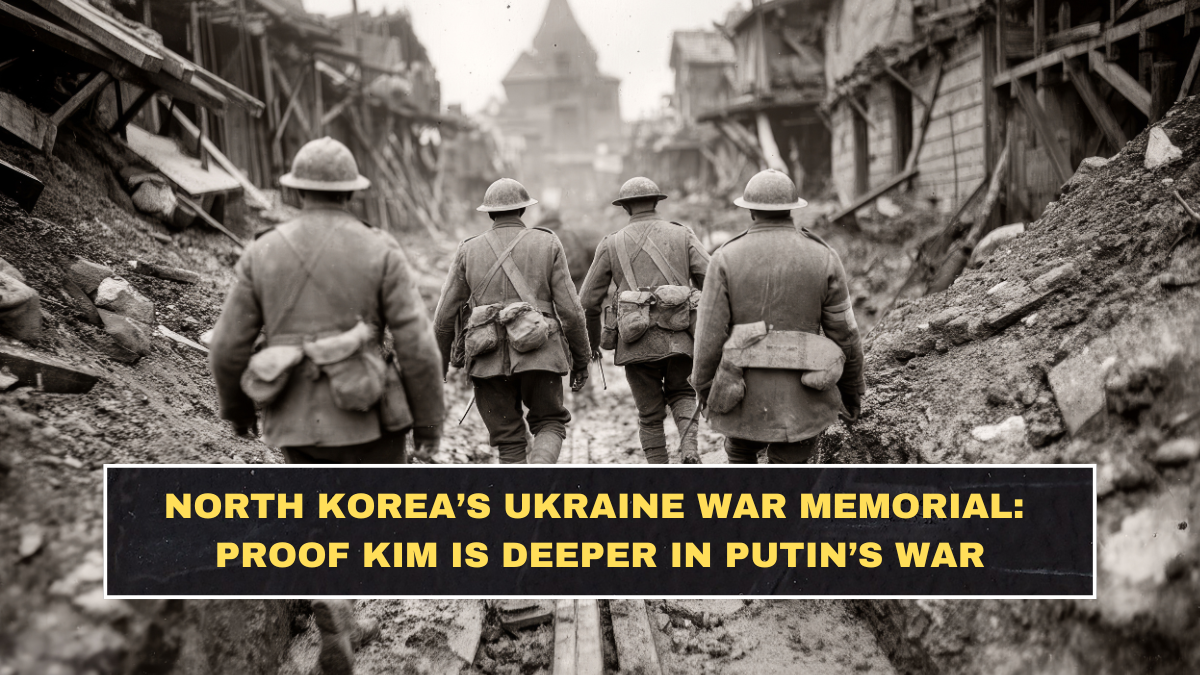
North Korea has opened a memorial museum in Pyongyang for soldiers killed while fighting for Russia against Ukraine. This is not a minor propaganda display. It is a public admission that North Korean troops have been directly involved in Russia’s war, something Pyongyang and Moscow once treated much more carefully. Now, Kim Jong Un is not hiding the sacrifice. He is turning it into state mythology.
AP reported that Kim attended the inauguration of the memorial museum alongside senior Russian officials, including Russian Defence Minister Andrei Belousov and State Duma speaker Vyacheslav Volodin. The ceremony marked the one-year anniversary of Russia’s recapture of the Kursk region, where North Korean troops reportedly fought alongside Russian forces.
What Does The Memorial Prove About North Korea’s Role?
The memorial proves that North Korea’s role in the war is no longer limited to weapons shipments, ammunition supplies, or quiet military backing. It shows Pyongyang is publicly embracing the deaths of its own soldiers in a foreign war. That is a major escalation in political messaging, even if the military deployment had already been reported before.
Reuters reported that Volodin visited Pyongyang to attend the opening of a memorial honouring North Korean soldiers who died fighting in Ukraine, according to North Korean state media. The same report said the visit highlighted Russian gratitude and solidarity under the 2024 Russia-North Korea comprehensive strategic treaty, which includes a mutual defence pact.
| Key Detail | What It Shows |
|---|---|
| Memorial opened in Pyongyang | North Korea is publicly owning its Ukraine role |
| Kim Jong Un attended | The war role has top-level political approval |
| Russian officials attended | Moscow is openly thanking Pyongyang |
| Kursk region highlighted | North Korean troops were tied to a major Russian battlefield claim |
| Military treaty backdrop | Russia-North Korea cooperation is becoming structural |
How Many North Korean Soldiers Have Been Sent To Russia?
Exact numbers remain disputed because both North Korea and Russia tightly control information. AP reported that South Korean intelligence estimated around 15,000 North Korean troops had been deployed to assist Russia, with roughly 2,000 casualties. These figures are not independently confirmed by Pyongyang, but they show the scale Seoul believes is involved.
Reuters’ picture report carried an even sharper Western estimate, saying Western officials believe more than 6,000 North Korean soldiers have been killed in the fighting. That figure is dramatically higher than South Korea’s reported casualty estimate, so readers should treat the numbers carefully. The safe conclusion is that North Korea’s human cost is real, but the exact death toll remains contested.
Why Would Kim Send Troops To Fight For Putin?
Kim has several reasons. First, Russia can offer North Korea food, fuel, money, diplomatic cover, and advanced military technology. Second, North Korean troops gain real battlefield experience, especially in drone warfare, artillery, trench fighting, logistics, and modern battlefield survival. Third, Kim gets to present North Korea as a loyal military partner to a major power.
This is not charity. Kim is not helping Putin because of friendship alone. He is trading blood for leverage. AP noted that experts worry North Korean troops, though initially inexperienced, are now gaining valuable combat knowledge. Western allies are also concerned that Russia may transfer advanced military technologies to North Korea in return for its support.
Why Is Russia Publicly Thanking North Korea?
Russia is publicly thanking North Korea because Pyongyang has become useful. Moscow needs manpower, ammunition, and political partners willing to defy Western pressure. North Korea offers all three. By sending senior officials to the memorial, Russia is signalling that this is not a disposable partnership. It wants the world to see the alliance as durable.
Reuters reported that diplomatic and military ties between Russia and North Korea have deepened since 2023 and were formalised further by the 2024 comprehensive strategic treaty. That treaty’s mutual defence element makes the relationship more serious than normal diplomatic friendship. It suggests both sides are building a long-term security partnership against Western pressure.
Why Is The Kursk Region Important In This Story?
The Kursk region matters because it became a symbol of North Korean combat involvement. AP reported that the memorial ceremony was linked to the one-year anniversary of the conflict’s conclusion in Kursk, where North Korean soldiers fought for Russia. For Moscow, Kursk became a victory narrative. For Pyongyang, it became proof that North Korean soldiers had sacrificed themselves in what Kim frames as an anti-Western struggle.
That symbolism is powerful domestically. North Korea can use the memorial to tell its people that their soldiers died in a heroic foreign mission, not as expendable manpower for another country’s war. This is propaganda, but it is also state-building. Regimes use memorials to turn losses into loyalty.
What Does This Mean For Ukraine?
For Ukraine, North Korea’s role means Russia has found another manpower and weapons source outside its own population. Even if North Korean troops are not decisive alone, they help Moscow sustain pressure. They can be used in high-risk operations, defensive lines, or attritional battles where Russia wants to preserve its own forces.
Al Jazeera reported that Ukrainian military and intelligence officials assessed that North Korean troops later gained crucial battlefield experience and became central to Russia’s effort to overwhelm Ukrainian forces by deploying large numbers of soldiers in the region. That means Ukraine is not only fighting Russia’s army. It is increasingly facing a coalition of support behind Moscow.
Why Should South Korea And Japan Be Worried?
South Korea and Japan should be worried because battlefield experience can travel home. North Korean troops who survive Ukraine may return with knowledge of drones, electronic warfare, artillery coordination, trench assaults, and modern air-defence problems. That experience could improve North Korea’s military readiness on the Korean Peninsula.
There is also the technology-transfer fear. If Russia gives North Korea better missile, satellite, submarine, air-defence, or electronic-warfare technology, the regional balance becomes more dangerous. Kim may be using Ukraine as a training ground and bargaining chip. That is far more serious than a symbolic memorial.
Is This A New Russia-North Korea Military Bloc?
It is not a NATO-style bloc, but it is clearly becoming a deeper military alignment. Russia needs help for Ukraine. North Korea needs technology, resources, and international protection. Both oppose US-led pressure. That shared interest is enough to create real cooperation even without a fully integrated alliance structure.
AP reported that Russia and North Korea aim to deepen cooperation further, including discussion of a proposed military cooperation plan for 2027–2031. That detail matters because it shows the relationship is not only about the current battlefield. Moscow and Pyongyang are planning for the next phase too.
Conclusion
North Korea’s Ukraine war memorial is more than a ceremony. It is proof that Kim Jong Un is publicly tying his regime’s prestige to Putin’s war. The memorial turns dead soldiers into propaganda, strengthens the Russia-North Korea partnership, and signals that Pyongyang is willing to pay a human price for strategic gain.
The blunt truth is that Kim is not just supporting Russia from the sidelines anymore. He is using the war to train troops, earn Russian support, and build an anti-Western military identity. For Ukraine, South Korea, Japan, and the West, that should be taken seriously. A memorial may look symbolic, but in this case, the symbol confirms a much deeper battlefield reality.
FAQs
Why did North Korea open a memorial for troops killed in Ukraine?
North Korea opened the memorial to honour soldiers who died fighting for Russia in Ukraine and to turn their deaths into a state-backed symbol of loyalty, sacrifice, and anti-Western struggle. Kim Jong Un attended the ceremony with senior Russian officials.
Did North Korean soldiers really fight for Russia?
Yes. North Korea’s memorial itself publicly confirms that its soldiers died while fighting for Russia. Reuters also reported that Russian officials visited Pyongyang to attend the memorial opening honouring those troops.
How many North Korean troops were deployed to Russia?
South Korean intelligence estimated around 15,000 North Korean troops were deployed to assist Russia, with roughly 2,000 casualties, according to AP. Western estimates of deaths vary and remain difficult to verify independently.
Why is North Korea helping Russia in Ukraine?
North Korea gains money, food, fuel, diplomatic support, military technology, and battlefield experience. Russia gains manpower, ammunition support, and another partner willing to defy Western pressure.