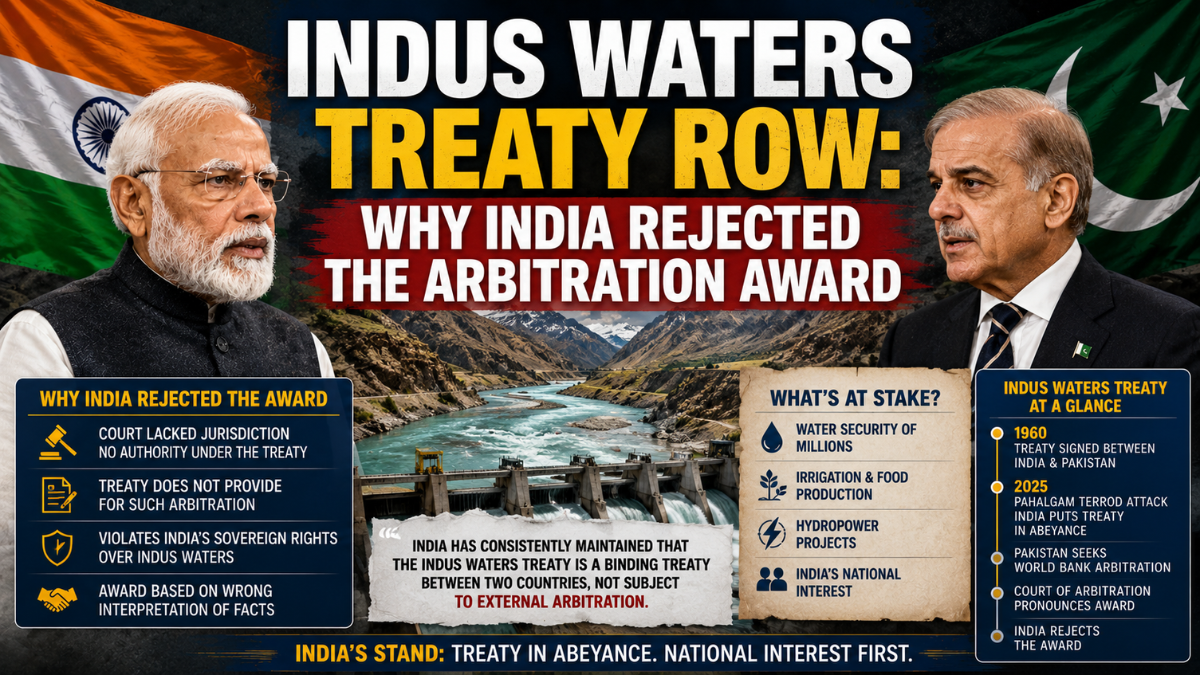
India has rejected the latest Court of Arbitration award linked to the Indus Waters Treaty, calling the tribunal “illegally constituted” and saying its decision is “null and void.” The Ministry of External Affairs said the award, issued on May 15, 2026, concerned “maximum pondage” and was supplemental to an earlier award on interpretation of the treaty.
This is not a small technical dispute. Water sharing between India and Pakistan is already one of the most sensitive diplomatic issues in South Asia, and any ruling around storage limits, hydropower projects or treaty interpretation can quickly become political. India’s rejection shows that the dispute is now as much about jurisdiction as it is about water.
What Is Maximum Pondage?
Maximum pondage refers to the amount of water that can be stored temporarily in hydropower projects for operational use. Economic Times reported that the Hague-based tribunal’s May 15 ruling dealt with permissible storage limits for India’s hydroelectric projects on the Indus river system.
| Key Issue | What It Means |
|---|---|
| Award Date | May 15, 2026 |
| India’s Response | Rejected on May 16, 2026 |
| Main Subject | Maximum pondage |
| India’s Position | CoA is illegally constituted |
| Treaty Status | India says IWT remains in abeyance |
This matters because pondage affects how hydropower projects operate, especially during changing water flows. Pakistan has historically raised objections around Indian projects on western rivers, while India argues it has rights under the treaty for permitted uses. The dispute is technical on paper, but politically loaded in practice.
Why Is India Calling Court Illegal?
India says it has never recognised the establishment of the current Court of Arbitration. The MEA’s official statement says any proceeding, award or decision issued by it is null and void, and India’s decision to hold the Indus Waters Treaty in abeyance remains in force.
The blunt issue is simple: India is not only disagreeing with the award; it is rejecting the authority of the body that issued it. That makes compromise harder because the disagreement is no longer limited to technical interpretation. It has become a dispute over whether the arbitration process itself is valid.
What Is Indus Waters Treaty?
The Indus Waters Treaty was signed between India and Pakistan on September 19, 1960, in Karachi, with World Bank mediation. Under the agreement, the eastern rivers Ravi, Beas and Sutlej were allocated primarily to India, while the western rivers Indus, Jhelum and Chenab were allocated largely to Pakistan, with limited usage rights under specific conditions.
This treaty survived wars and decades of hostility, which is why its current tension is so important. For years, it was seen as one of the few working arrangements between India and Pakistan. Now, with India saying the treaty remains in abeyance, the future of water diplomacy looks far more uncertain.
Why Is Treaty In Abeyance?
India has stated that its decision to hold the Indus Waters Treaty in abeyance remains in force. New Indian Express reported that India placed the treaty in abeyance after the Pahalgam terror attack and said it would remain so until Pakistan credibly and irrevocably abjures support for cross-border terrorism.
This is where the water dispute becomes a security dispute. India is linking treaty obligations with terrorism concerns, while Pakistan is likely to continue framing water as a treaty-protected right. That gap is massive, and no technical award can easily bridge it if political trust stays broken.
What Happens Next?
The next phase could involve more diplomatic statements, legal arguments and pressure through international channels. Pakistan may continue relying on arbitration mechanisms, while India may continue rejecting the present CoA’s authority. That means the dispute may stay stuck between legal procedure and geopolitical confrontation.
Key points to watch now:
- Whether Pakistan responds formally to India’s rejection
- Whether the World Bank faces renewed pressure
- Whether India changes project operations on western rivers
- Whether more legal awards are issued by the CoA
- Whether bilateral talks restart at any level
The uncomfortable reality is that water disputes do not stay theoretical forever. If river flows, dam operations or project approvals become more contested, the issue can affect agriculture, power generation, diplomacy and public sentiment on both sides.
Conclusion?
India has rejected the latest Indus Waters Treaty arbitration award, calling the Court of Arbitration illegally constituted and its award null and void. The award concerned maximum pondage, but India’s response makes clear that the bigger fight is over legitimacy, treaty status and Pakistan-linked arbitration proceedings.
The blunt takeaway is that the Indus Waters Treaty row is no longer only about water sharing. It is now tied to terrorism, sovereignty, legal jurisdiction and India-Pakistan trust. Unless political conditions improve, technical arbitration may keep producing headlines without solving the deeper conflict.
FAQs?
What Is Indus Waters Treaty Arbitration?
Indus Waters Treaty arbitration refers to legal proceedings related to disputes over treaty interpretation, river use and hydropower project rules. The latest rejected award concerned maximum pondage under the treaty framework.
Why Did India Reject The Arbitration Award?
India rejected the award because it says the Court of Arbitration was illegally constituted. The MEA said India has never recognised the body and considers its proceedings, awards and decisions null and void.
What Is Maximum Pondage In Indus Treaty?
Maximum pondage refers to the permissible temporary water storage capacity linked to hydropower project operations. It is important because it affects how projects manage river flows while generating power.
Is The Indus Waters Treaty Still Active?
India says its decision to hold the Indus Waters Treaty in abeyance remains in force. That means New Delhi’s position is that treaty obligations are currently suspended from its side.