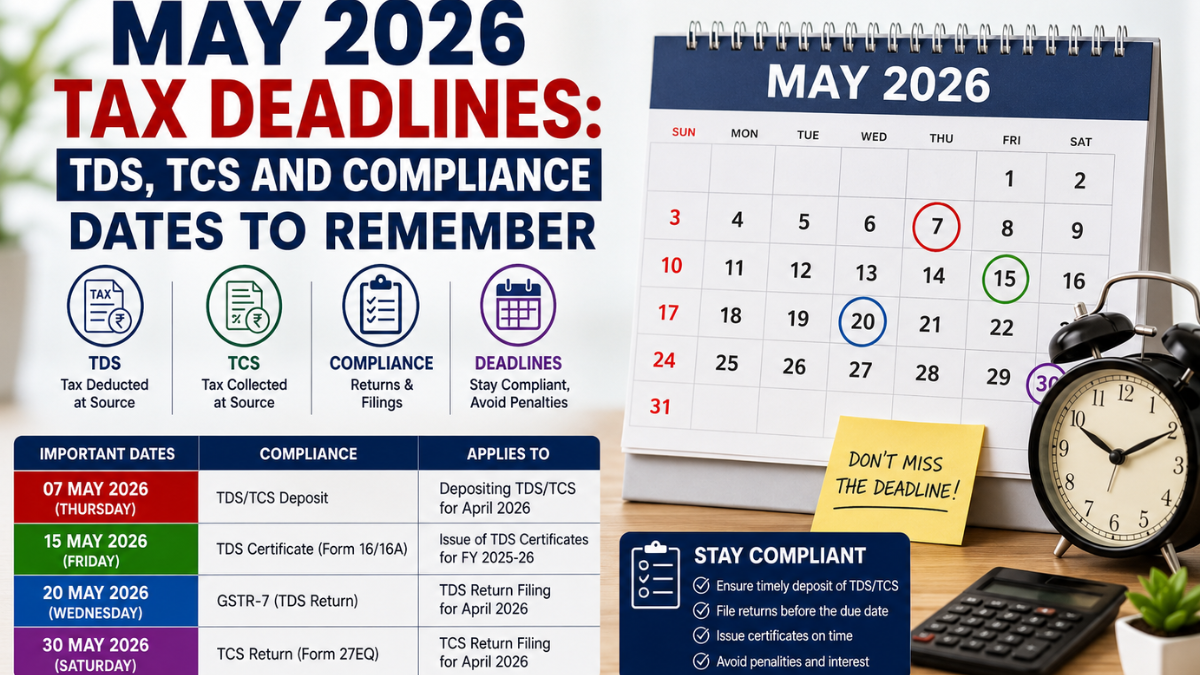
May 2026 is an important compliance month for businesses, deductors, collectors, government offices and some taxpayers because several TDS, TCS and income-tax form deadlines fall during this period. Economic Times reported that May 2026 includes due dates for TDS/TCS deposits, certificates, statements and challan-cum-statement filings under the Income-tax framework.
This is not a month to handle casually. Missing a tax deadline can lead to interest, late fees, penalties and mismatch problems in Form 26AS or AIS. The blunt truth is simple: if your business deducts or collects tax and you still manage compliance through memory or WhatsApp reminders, you are asking for trouble.

Which Dates Matter Most?
The most important May 2026 tax dates include May 7, May 15, May 30 and May 31. May 7 was the deadline for depositing TDS/TCS for April 2026, while May 15 covered TDS certificates, Form 24G and other statements. May 30 is important for TCS certificates and challan-cum-statement compliance, while May 31 is the usual due date for Q4 TDS return filing.
| Due Date | Compliance Requirement |
|---|---|
| May 7, 2026 | TDS/TCS deposit for April 2026 |
| May 15, 2026 | TDS certificates and Form 24G |
| May 15, 2026 | Quarterly TCS statement for quarter ending March 31, 2026 |
| May 30, 2026 | TCS certificates for Q4 FY 2025-26 |
| May 31, 2026 | Q4 TDS return filing deadline |
These dates are especially important for employers, companies, firms, government agencies, property buyers, tenants and professionals handling tax deduction obligations. Individuals who are not deductors may still need to watch these dates because TDS reporting affects their tax credit, AIS, Form 26AS and ITR filing accuracy.
What Was Due On May 7?
May 7, 2026, was the deadline for depositing tax deducted or collected during April 2026. Mint reported that the date applied to the mandatory deposit of TDS and TCS for April, and government offices had to credit sums to the central government on the same day where payment was made without a challan.
This date matters because deposit delay directly creates interest exposure. ClearTax explains that late deposit after deduction can attract interest at 1.5% per month or part of a month from the date of deduction to the actual deposit date. That is why deductors should not wait until return filing to fix payment delays.
What Was Due On May 15?
May 15, 2026, carried multiple compliance requirements. It was the due date for issuing TDS certificates for tax deducted in March 2026 under Sections 194-IA, 194-IB and 194M. It was also the deadline for government agencies to submit Form 24G where April 2026 TDS/TCS was paid without presentation of a challan.
Several other statements were also due on May 15, including monthly statements by stock exchanges for client-code modifications and the quarterly TCS statement for the quarter ending March 31, 2026. This is where many businesses get sloppy because they focus only on TDS deposit and ignore certificate or statement deadlines.
What Is Due On May 30 And 31?
May 30, 2026, is the due date for issuing TCS certificates for the fourth quarter of FY 2025-26. It is also the deadline for furnishing information required under Section 285B of the Income-tax Act, 1961, and for filing the challan-cum-statement for tax deduction under Section 393(1) of the Income-tax Act, 2025.
May 31 is equally important because Q4 TDS returns are generally due by May 31 of the next financial year. ClearTax notes that the last quarter, January to March, has a May 31 return-filing deadline. Deductors should not treat this as optional paperwork because incorrect or late filing can damage tax-credit visibility for deductees.
What Should Businesses Check Now?
Businesses should immediately check whether all April TDS/TCS deposits, March TDS certificates, Form 24G, Q4 TCS statements and Q4 TDS return work have been completed. If anything is pending, they should fix it before the delay becomes larger. The worst approach is waiting for a notice and then pretending the issue was minor.
Quick compliance checklist:
- Reconcile TDS/TCS deducted or collected with challans
- Check PAN details before filing statements
- Match books, challans and return data
- Issue certificates within the deadline
- Verify Form 26AS and AIS credit impact
- Keep acknowledgement copies safely
The real danger is not only penalty. Wrong reporting can create mismatch problems for employees, vendors, sellers and deductees when they file ITR. If your mistake blocks someone else’s tax credit, you are not just late; you are creating financial trouble for another person.
Conclusion?
May 2026 tax deadlines are important because they cover TDS/TCS deposit, certificates, Form 24G, TCS statement, TCS certificates, challan-cum-statement filing and Q4 TDS return compliance. The biggest dates to remember are May 7, May 15, May 30 and May 31. Missing them can create interest, late fees and tax-credit mismatch issues.
The honest advice is simple: do not manage tax compliance casually. Businesses and deductors should use a proper calendar, reconcile data early and keep proof of every filing. Tax compliance is boring only until a notice arrives; after that, it becomes expensive.
FAQs?
What Are The Main May 2026 Tax Deadlines?
The main May 2026 tax deadlines include May 7 for April TDS/TCS deposit, May 15 for TDS certificates and Form 24G, May 30 for TCS certificates and challan-cum-statement filing, and May 31 for Q4 TDS return filing.
What Was Due On May 7, 2026?
May 7, 2026, was the deadline for depositing TDS and TCS deducted or collected during April 2026. Government offices had special rules for same-day credit where tax was paid without a challan.
Why Is May 31 Important For TDS?
May 31 is important because the TDS return for the January to March quarter is generally due by this date. Late filing can create fees, penalties and tax-credit mismatch issues.
What Happens If TDS Compliance Is Missed?
Missing TDS compliance can lead to interest, late filing fees, penalties and mismatch problems in Form 26AS or AIS. Deductors should correct pending issues quickly instead of waiting for a tax notice.