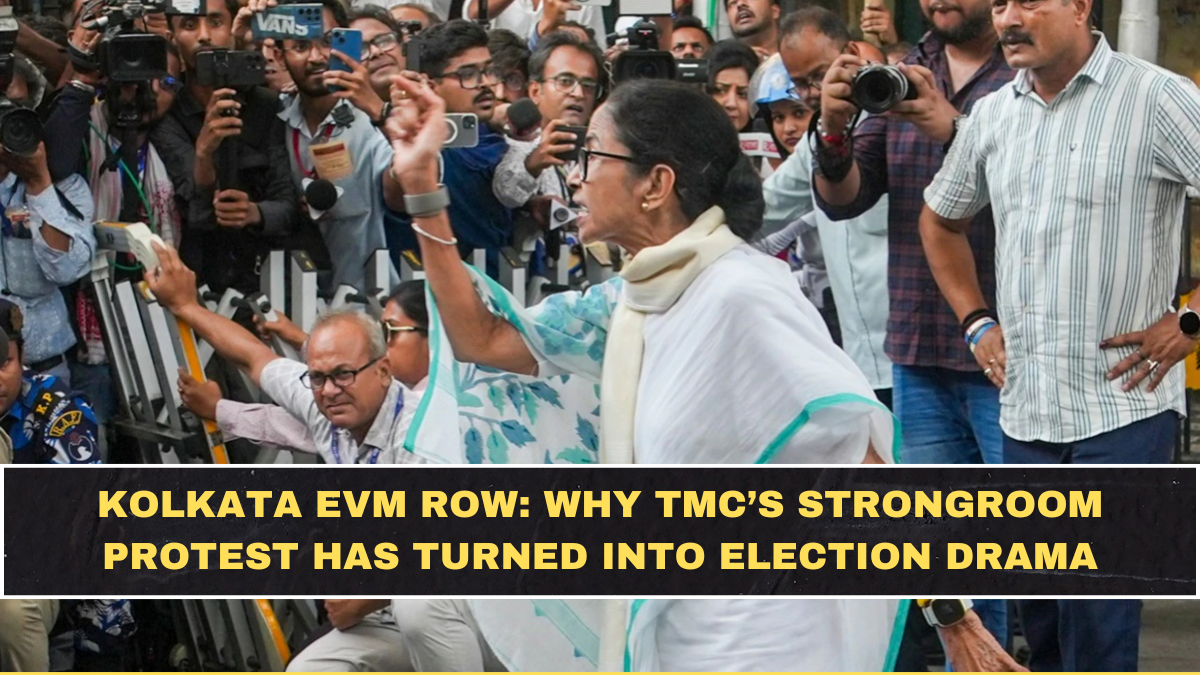
The Kolkata EVM row has exploded because the Trinamool Congress has alleged possible tampering and irregularities at strongrooms just days before vote counting in the West Bengal Assembly elections. Chief Minister Mamata Banerjee visited the Bhabanipur strongroom at Sakhawat Memorial School and raised concerns over the security of stored voting machines and ballot materials. NDTV reported that Trinamool alleged boxes were opened without authorised party representatives present.
The Election Commission, however, has denied wrongdoing and said the boxes were secure. That is why the story has turned into a full political drama. TMC is presenting the issue as a fight to protect democracy, while the poll body and BJP are rejecting the allegations as politically motivated. With counting scheduled for May 4, the timing has made the controversy even more sensitive.
What Exactly Did TMC Allege In Kolkata?
TMC alleged that suspicious activity took place around EVM strongrooms and that ballot boxes or stored election material were handled without proper authorised presence. Reports said Mamata Banerjee raised concerns after visiting the Bhabanipur facility, while party workers protested at counting centres. The party has described the alleged activity as a serious threat to the fairness of the election process.
According to India Today, Kolkata saw high drama after TMC alleged strongroom irregularities, leading Mamata Banerjee to spend more than three hours inside a Bhabanipur facility. She warned against any attempt to manipulate the counting process and said she would fight over EVM concerns. The allegation remains disputed, and no official finding has proven tampering so far.
| Key Detail | What Happened? | Why It Matters? |
|---|---|---|
| Main allegation | TMC claimed possible EVM or ballot-material irregularities | Raises trust concerns before counting |
| Location | Kolkata strongrooms, including Bhabanipur and Khudiram Anushilan Kendra | High-stakes urban constituencies involved |
| Mamata’s role | Visited strongroom and raised concerns | Turned issue into major political flashpoint |
| EC response | Said boxes were secure and procedures were followed | Official denial challenges TMC’s claim |
| Counting date | May 4, 2026 | Allegations came just before results |
| Police action | Gatherings restricted near counting areas | Shows administration expects tension |
What Did The Election Commission Say?
The Election Commission rejected the claim that EVM tampering had taken place. Reports said the EC clarified that the activity seen at the counting centre was related to lawful segregation of postal ballots and that strongrooms remained secured under standard protocol. The poll body also said political parties had been informed in advance about procedures.
This response matters because election credibility depends on process clarity. If officials were handling postal ballots or election material under procedure, then the EC must explain it clearly and publicly. If party representatives believed something was wrong, the EC must document who was present, what was moved, why it was moved and whether CCTV or logs support the official version.
Why Did Mamata Banerjee Visit The Strongroom?
Mamata Banerjee’s strongroom visit was a political and symbolic move. She wanted to show that TMC was directly monitoring the security of votes before counting. Times of India reported that she spent time at a Kolkata strongroom and instructed TMC candidates to maintain a 24-hour watch over strongrooms to prevent possible tampering or irregularities.
This kind of move is not only about security. It is also about messaging to party workers: stay alert, do not trust the process blindly, and be physically present where votes are stored. Whether one agrees with her allegation or not, the political effect is obvious. It energises party workers and puts pressure on election officials.
Why Are Strongrooms So Sensitive During Elections?
Strongrooms are sensitive because they store EVMs, VVPATs and other election material after polling and before counting. Once voting ends, the security of these rooms becomes central to public trust. If people believe stored machines can be accessed or altered, confidence in the result takes a serious hit.
That is why strongrooms usually have strict security, CCTV monitoring, sealing procedures and access restrictions. Political parties are also allowed to monitor the area through authorised representatives. The problem starts when any activity around the strongroom is not explained quickly and clearly. In a charged election, even confusion can become a political firestorm.
Why Is BJP Rejecting TMC’s Charge?
BJP has rejected TMC’s charge because it sees the allegation as a political attempt to create suspicion before counting. In West Bengal, BJP and TMC have been locked in a high-voltage contest, so any strongroom controversy quickly becomes a party-versus-party fight. Times of India reported that the issue led to a TMC-BJP face-off around strongrooms ahead of counting.
This is also a familiar pattern in Indian elections. Parties that fear a tight result often increase pressure around EVM security before counting. Sometimes concerns are genuine, and sometimes they are political positioning. The only way to separate the two is through transparent documentation, CCTV review, access logs and clear communication from the Election Commission.
Why Has Police Security Been Tightened?
Police security has been tightened because the allegations created tension around counting centres. NDTV reported that Kolkata Police banned gatherings in seven areas where votes are being counted after the strongroom drama and TMC protests. The move was aimed at preventing crowd pressure, clashes and unauthorised access near sensitive election sites.
This is necessary but not enough. Security restrictions can prevent immediate disorder, but they do not solve trust issues. If people believe the process is suspicious, simply pushing crowds away can increase political anger. The better approach is security plus transparency: show the process, explain the procedure and allow authorised representatives to observe what the law permits.
Is There Proof Of EVM Tampering In Kolkata?
At this stage, no publicly verified proof of EVM tampering has been established in the reports reviewed. TMC has made serious allegations, while the Election Commission has denied wrongdoing and said the boxes were secure. That distinction is critical. An allegation is not proof, and an official denial is not automatically the end of the matter either.
The honest position is this: the claim needs evidence. If TMC has CCTV footage, access records or witness statements, those should be formally submitted and examined. If the EC’s explanation is correct, it should release enough procedural detail to remove doubt. In election disputes, vague shouting from either side helps nobody.
What Could This Mean For Counting Day?
The row could make counting day more tense because party workers will be extra suspicious of every movement inside and outside counting centres. Candidates may demand closer monitoring, faster clarifications and stricter access control. Any delay, technical issue or procedural confusion could be politicised immediately.
That does not mean counting will automatically be disrupted. But the Election Commission now has to manage not only vote counting, but also perception management. If the process looks opaque, accusations will grow. If the process is visibly documented and calm, the row may lose force after results are declared.
Conclusion
The Kolkata EVM row has become major election drama because it combines strongroom security, TMC allegations, Mamata Banerjee’s direct intervention and the Election Commission’s denial. The timing, just before May 4 counting, has made the issue politically explosive. TMC says it is guarding democracy; the EC says procedures were followed and boxes were secure.
The blunt truth is that election trust cannot survive on slogans from either side. TMC must present evidence if it alleges tampering, and the Election Commission must explain procedures clearly enough for voters to trust the result. Until then, the Kolkata strongroom row will remain less about one room and more about public confidence in the entire counting process.
FAQs
What is the Kolkata EVM row about?
The Kolkata EVM row is about TMC’s allegation of possible tampering or irregularities around strongrooms where election material is stored before counting. Mamata Banerjee visited the Bhabanipur strongroom and party workers protested, claiming suspicious activity. The Election Commission has denied wrongdoing and said boxes were secure.
Did the Election Commission confirm EVM tampering?
No, the Election Commission did not confirm EVM tampering. Reports said the EC rejected the allegations and clarified that the activity involved lawful segregation of postal ballots, with strongrooms remaining secure. The allegations remain disputed and unproven at this stage.
Why did Mamata Banerjee visit the strongroom?
Mamata Banerjee visited the strongroom after TMC raised concerns about possible irregularities before counting. Reports said she instructed party candidates and workers to maintain strong vigilance around strongrooms. Her visit turned the issue into a major political flashpoint before results.
When is counting scheduled in the West Bengal election?
Counting is scheduled for May 4, 2026, according to reports on the Kolkata strongroom controversy. The EVM row became sensitive because the allegations surfaced just days before counting. That timing has increased political tension around strongroom security and election transparency.