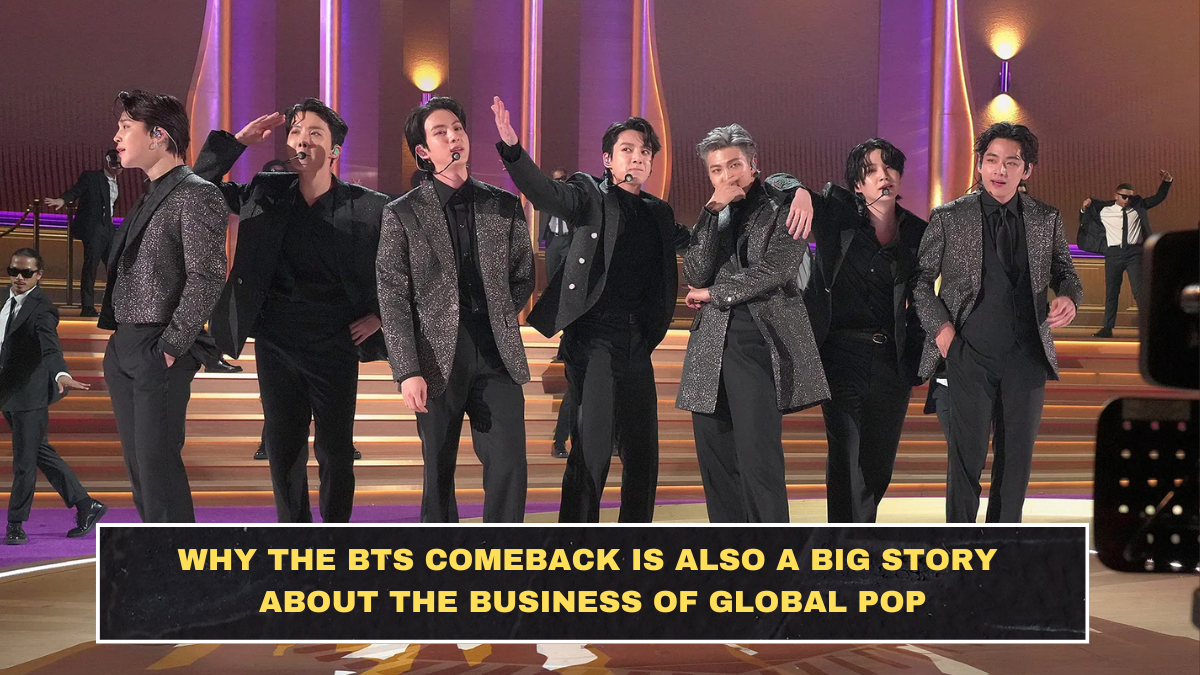
BTS’s comeback is not just a music story. It is a business story about how global fandom now moves money, attention, travel, streaming, advertising, and tourism all at once. Reuters reported that BTS returned with its 10th studio album, Arirang, after a hiatus tied to military service, and that the group’s new world tour begins in April 2026. That alone would be major pop news, but the scale of the rollout makes it much bigger than that.

Why this comeback matters beyond fans
The easiest mistake is to treat BTS as just another successful touring act. That is lazy. Reuters reported that the ARIRANG world tour is scheduled to run from April 2026 through March 2027, covering 34 cities and 82 concerts. Reuters also reported projected revenue of about 2.7 trillion won, or roughly $1.8 billion, which would put it in range of the biggest tours ever staged. That is not normal fandom. That is an international demand engine.
The rollout is already showing how big the demand is
The comeback did not begin quietly. Reuters reported that BTS held a high-profile concert at Seoul’s Gwanghwamun Square in March, their first major group performance in more than three years, and the event was streamed live by Netflix to 190 countries. Netflix later said the livestream drew 18.4 million viewers worldwide, ranked in its Top 10 in 80 countries, and hit No. 1 in 24 countries. That means BTS is not just selling tickets. The group is also driving platform-scale live viewing across borders.
The album numbers show the commercial force behind the tour
This part matters because tours do not run on hype alone. Reuters reported that Arirang sold nearly 4 million copies on its first day, and HYBE’s own investor-linked reporting placed the number at 3.98 million. Reuters also reported that the album topped the UK albums chart, the vinyl albums chart, and that the single “Swim” reached No. 1 on the UK singles chart, the group’s first such achievement there. That kind of chart-and-sales combination tells you the comeback is not just nostalgic. It is commercially live right now.
The economics in simple terms
| Area | Confirmed detail | Why it matters |
|---|---|---|
| Tour scale | 34 cities, 82 concerts from April 2026 to March 2027 | This is one of the largest K-pop tour plans ever reported. |
| Revenue estimate | About 2.7 trillion won ($1.8 billion) projected | Puts the tour in the highest-grossing conversation globally. |
| Tour launch | Starts April 9, 2026 in Goyang, South Korea | The comeback quickly converts into live-event revenue. |
| Streaming scale | Seoul comeback livestream drew 18.4 million viewers worldwide | BTS can monetize attention beyond stadium seats. |
| Album traction | Nearly 4 million first-day album sales | Shows immediate buying power, not just passive streaming interest. |
Why fandom economics are the real story
Reuters described the BTS fan base as bringing huge spending power, and that is the part people keep underestimating. Fans are not just buying songs. They travel for concerts, fight for presale access, buy merchandise, stream live events, and create instant global chart momentum. Reuters also reported that tickets for South Korean, North American, and European dates sold out rapidly. That means BTS’s business model is diversified across physical attendance, digital reach, merchandise, and brand value, which is exactly why the comeback matters so much to HYBE and to any company chasing global entertainment scale.
The business story is not perfectly clean
Here is the part softer articles avoid. Massive demand does not mean every event lands perfectly. Reuters reported that HYBE shares fell 14.5% after a weaker-than-expected turnout at the comeback concert in Seoul. That matters because it shows how inflated expectations can become around BTS. When a group is treated like an economic superpower, anything below the most extreme forecast gets read as disappointment. That is the downside of scale: even very strong results can look weak if the market expected something absurd.
What this says about global pop now
A few things are clear:
- global pop is now built around tour economics as much as music sales
- streaming platforms want event-scale music content, not just catalog listening
- fandom behaves more like a cross-border consumer market than a simple audience
- BTS remains one of the clearest proof points that K-pop is a global business system, not a niche export category
Conclusion
The BTS comeback is a big story about global pop because it shows how modern music stardom really works. The album is selling, the tour is massive, the livestream numbers are huge, and the revenue projection is at blockbuster scale. That is not just fan excitement. It is proof that the biggest acts now operate like multinational entertainment businesses with revenue streams spread across tickets, streaming, merch, charts, and tourism. BTS is still a band, obviously. But pretending this is only a band story misses the whole point.
FAQs
When does the BTS world tour start?
Reuters reported that the ARIRANG world tour begins on April 9, 2026, in Goyang, South Korea.
How big is the BTS 2026–27 tour?
Reuters reported the tour covers 34 cities and 82 concerts, running through March 2027.
How much revenue could the tour generate?
Reuters reported projected revenue of about 2.7 trillion won, or roughly $1.8 billion.
How successful was the comeback concert livestream?
Netflix said the Seoul concert livestream drew 18.4 million viewers worldwide and ranked in the Top 10 in 80 countries.
Why is this comeback a business story too?
Because the rollout combines album sales, global touring, live streaming, fan travel, ticket demand, and platform-scale reach in a way few acts in the world can match.