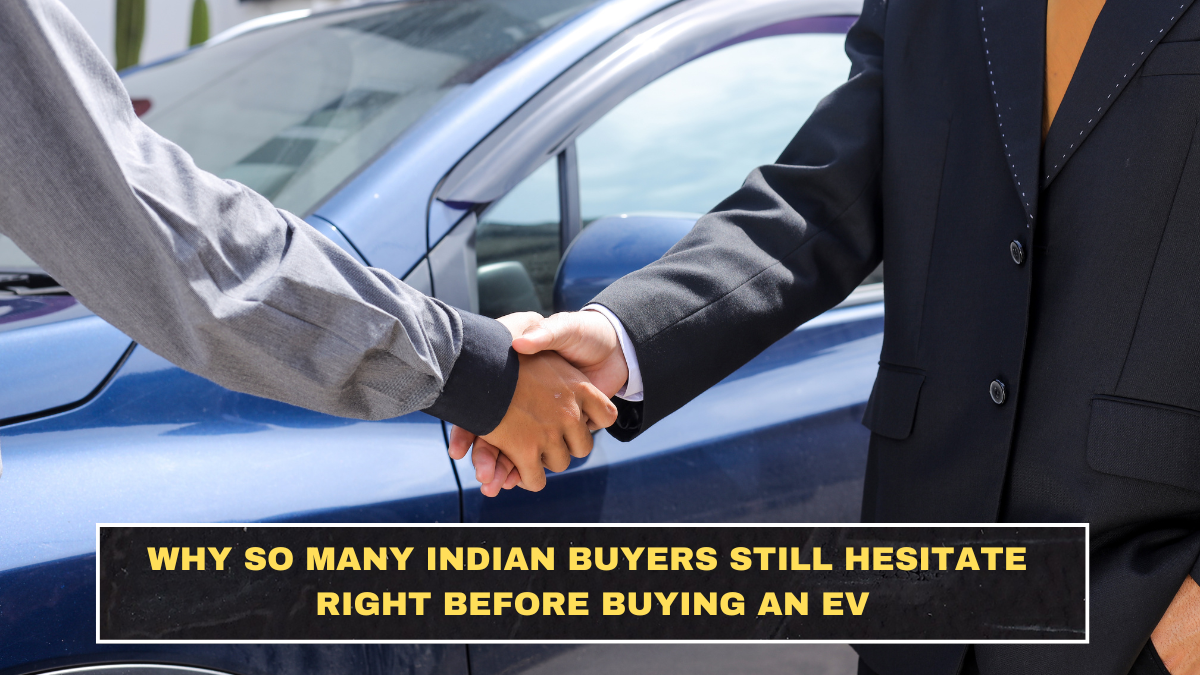
Indian buyers are clearly interested in EVs, but interest is not the same as purchase confidence. Deloitte’s 2025 India automotive consumer study says barriers such as charging infrastructure, upfront costs, and battery longevity still shape consumer decisions. That matters because it shows hesitation is not anti-EV bias. It is a practical trust problem.
The market is growing, but buyer nerves are growing too. Economic Times reported in April 2025 that nearly 2 million EVs were sold in India in 2024, yet it also highlighted persistent worries around range anxiety, limited charging access, battery replacement cost, and faster depreciation. That is the contradiction many lazy EV articles ignore: adoption is rising, but doubts have not gone away.
The biggest reasons buyers pull back
| Concern | What the data/reporting says | Why it stops purchases |
|---|---|---|
| Charging access | India had 29,151 public EV charging stations installed as of February 10, 2026, according to PIB | Buyers still worry whether chargers will be available when needed |
| Battery longevity | Deloitte says battery longevity remains a key consideration | Buyers fear long-term ownership risk |
| Resale value | ET reported financing and resale remain major weak points because residual value is hard to judge | Families do not want to get trapped in a poor resale cycle |
| Hidden cost risk | ET reported battery replacement can cost up to 60% of a car’s value in some cases | Even interested buyers pause when downside risk looks too large |
Charging anxiety is still doing damage
Yes, charging infrastructure is improving. PIB said on February 10, 2026 that India had 29,151 public EV charging stations installed, with support coming from both FAME-II and PM E-DRIVE. But improvement is not the same as convenience. Buyers do not think in national totals; they think in terms of their building, their commute, and their highway route. That is why charging anxiety still survives even when the network is expanding.
This is where many EV pitches collapse. A buyer may like the savings and cleaner image of an EV, but if they are not sure about overnight charging, apartment access, or emergency charging on a family trip, the purchase gets delayed. That hesitation is rational, not outdated.
Battery trust and resale are the uglier issues
Charging gets the headlines, but resale and battery trust are often the deeper psychological barriers. Economic Times reported in August 2025 that India’s EV success depends not only on technology, but also on accessible financing and reliable resale values. The same report said lenders still struggle to assess battery health, range degradation, and residual value. That uncertainty pushes up risk and weakens buyer confidence.
This is where families get cold feet. They are not just asking, “Can I charge it?” They are asking, “What happens after four or five years?” If the answer is vague, they hesitate. That is the real gap between EV interest and EV commitment.
Why families hesitate at the last minute
For many Indian households, a car is still a high-stakes purchase, not a tech experiment. The hesitation usually comes down to four practical questions:
- Will charging fit daily life without stress?
- Will the battery age badly?
- Will resale value collapse?
- Will repairs or replacement costs wipe out fuel savings?
That last point is especially important. ET reported that battery replacement alone can cost up to 60% of the car’s value in some cases. Even if that is not every case, the fear is enough to slow decisions. Buyers do not need certainty of loss; they only need enough uncertainty to postpone the purchase.
What buyers should actually compare
Before buying an EV, compare these first:
- your home or routine charging setup
- battery warranty and service support
- expected resale risk
- actual use case: city commute or frequent highway travel
That is the adult way to evaluate an EV. The dumb way is to get hypnotized by one range figure and ignore ownership friction. Indian buyers are hesitating because they are doing the math more seriously now, and frankly, that is smarter than blind enthusiasm.
Conclusion
Indian buyers still hesitate right before buying an EV because the doubts are practical, not emotional. Charging access is improving, but convenience is still uneven. Battery longevity remains a trust issue. Resale value is still hard to judge. And hidden cost fear has not disappeared. EV adoption in India is real, but the last-mile hesitation will stay until ownership feels financially predictable, not just environmentally attractive.
FAQs
Are Indian buyers still worried about EV charging?
Yes. Public charging infrastructure is expanding, but buyers still worry about convenience in daily life and on longer trips. PIB said India had 29,151 public EV charging stations installed as of February 10, 2026.
Is battery life still a major concern for EV buyers?
Yes. Deloitte’s 2025 India study specifically identified battery longevity as one of the key considerations affecting EV adoption.
Why is resale such a big issue for EVs in India?
Because lenders and buyers still lack confidence in how to value battery health, degradation, and long-term residual value, which makes resale pricing less predictable.
What is the main reason buyers delay an EV purchase?
Usually it is not one reason. It is a mix of charging access, battery trust, hidden cost fear, and resale uncertainty.