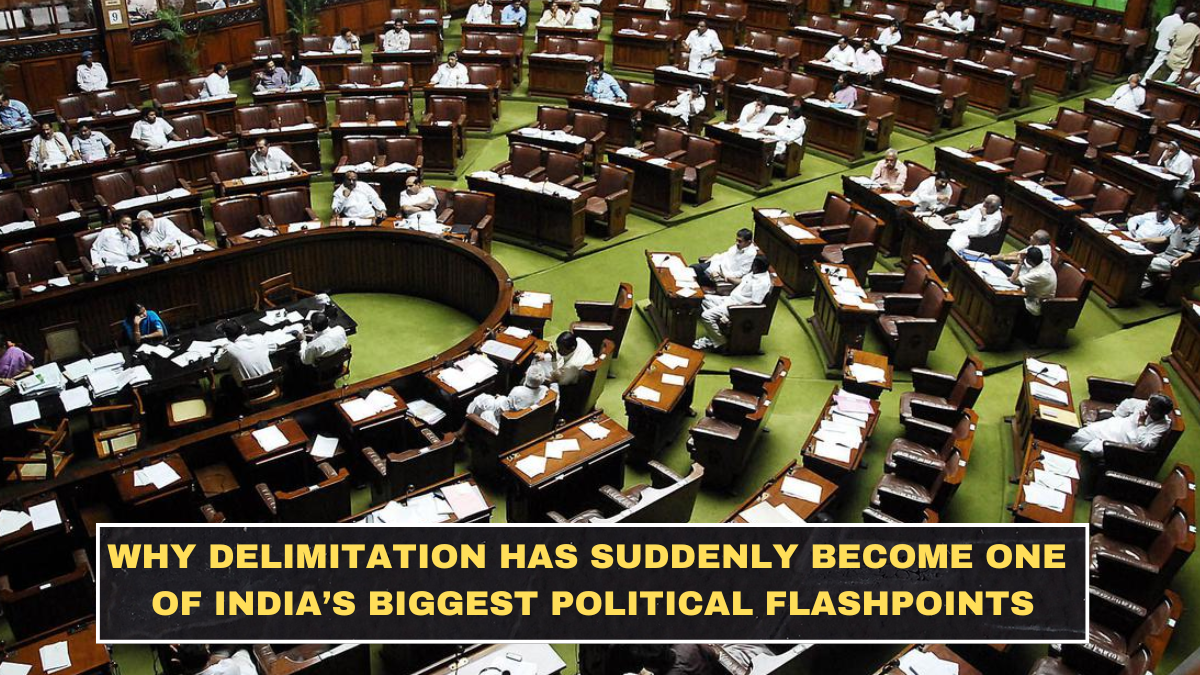
Delimitation used to sound like a dry constitutional process. Now it is one of India’s biggest political flashpoints because it could reshape parliamentary power between states. The core issue is simple: delimitation redraws constituencies and can also readjust seat allocation based on population. Since seat reallocation has been frozen for decades, states that controlled population growth fear they could lose relative political weight if seats are redistributed after the freeze ends.
This is why the debate has become explosive, especially in southern states. The fear is not abstract. If Lok Sabha seats are reallocated mainly by population, faster-growing northern states could gain more seats, while southern states that invested more in population control could see their influence diluted relative to their economic contribution and governance record. That is exactly why leaders in the South have made delimitation a live political issue rather than a technical one.
What the Freeze Actually Means
The current seat distribution is heavily shaped by an old constitutional freeze. A PIB background note and PRS material explain that the freeze on readjustment was first tied to the 1971 Census and later extended until after the first census conducted after 2026. In plain English, India has been using an outdated population base for seat allocation for a very long time.
That freeze had a political purpose: states were not supposed to be punished in representation terms for succeeding at population control. But once the freeze period approaches its end, the old compromise starts breaking down. The moment people realised that post-2026 census-linked changes could reopen seat allocation, the argument stopped being procedural and became existential for many states.
Why Southern States Are Alarmed
Southern states are alarmed for three main reasons:
- lower fertility and better population control could become a political disadvantage
- relative Lok Sabha influence could shift northward if population alone drives seat allocation
- fiscal and federal tensions already exist, so delimitation adds to a larger trust problem
This is why the debate is not just about numbers. It is about whether federal fairness means strict one-person-one-vote population logic, or whether India should also protect states that performed better on social development and demographic transition. That tension is the heart of the fight.
The Numbers and Constitutional Reality
| Issue | What the record shows | Why it matters |
|---|---|---|
| Seat readjustment freeze | Extended until after the first census taken after 2026 | Delimitation after that point becomes politically sensitive |
| Basis of concern | Current Lok Sabha representation still reflects an old population base | States know a new formula could change the balance sharply |
| Southern political response | Major southern leaders raised the issue publicly in 2025 | Shows the issue has already moved into frontline politics |
| Competing ideas | Freeze seats longer, increase total seats, or redesign representation safeguards | There is no settled consensus yet |
Why This Became a Flashpoint Now
The timing is obvious. As India gets closer to the post-2026 census window, politicians, scholars, and states are trying to shape the rules before the process hardens. Indian Express reporting from March 2025 showed the debate intensifying around alternatives such as increasing the total number of Lok Sabha seats, linking formulas to more than raw population, or designing safeguards for states that fear being penalised.
There is also a broader political reason. Delimitation now sits inside an already tense conversation about federalism, devolution, taxation, and representation. So the South is not reacting to delimitation in isolation. It is reacting to the possibility that one more major national system could shift power away from it. That is why the argument feels emotional as well as constitutional.
What the Possible Solutions Look Like
The main options being discussed are:
- keep or extend some form of protection against sharp seat-loss effects
- increase the total Lok Sabha strength so growing states gain seats without others losing relative clout as harshly
- redesign federal balance through stronger Rajya Sabha or fiscal safeguards
- use a mixed formula instead of pure population logic alone
None of these options is politically painless. That is the brutal truth. Someone will call any compromise unfair.
Conclusion
Delimitation has become one of India’s biggest political flashpoints because it is really a fight over future power, not just constituency boundaries. The constitutional freeze that kept seat allocation stable is nearing its critical post-2026 stage, and states now see the stakes clearly. Southern states fear that demographic success could translate into reduced parliamentary weight, while others argue representation must reflect population more honestly.
The real issue is not whether delimitation should happen. It is whether India can redesign representation without blowing up federal trust. If that balance is mishandled, this will not remain a technical reform debate. It will become a much deeper national political rupture.
FAQs
What is delimitation in India?
Delimitation is the process of redrawing constituency boundaries and, where applicable, readjusting the allocation of seats in legislatures based on population changes.
Why is delimitation controversial now?
It is controversial because the freeze on seat readjustment is tied to the first census after 2026, and many southern states fear a new population-based allocation could reduce their relative influence in the Lok Sabha.
Why are southern states worried about delimitation?
Because they argue they should not be politically penalised for achieving lower fertility and better population control, while faster-growing states gain more parliamentary power.
What are the proposed solutions to the delimitation problem?
Ideas include increasing the total number of Lok Sabha seats, extending protections, using formulas beyond raw population, and strengthening other parts of federal representation.
Click here to know more