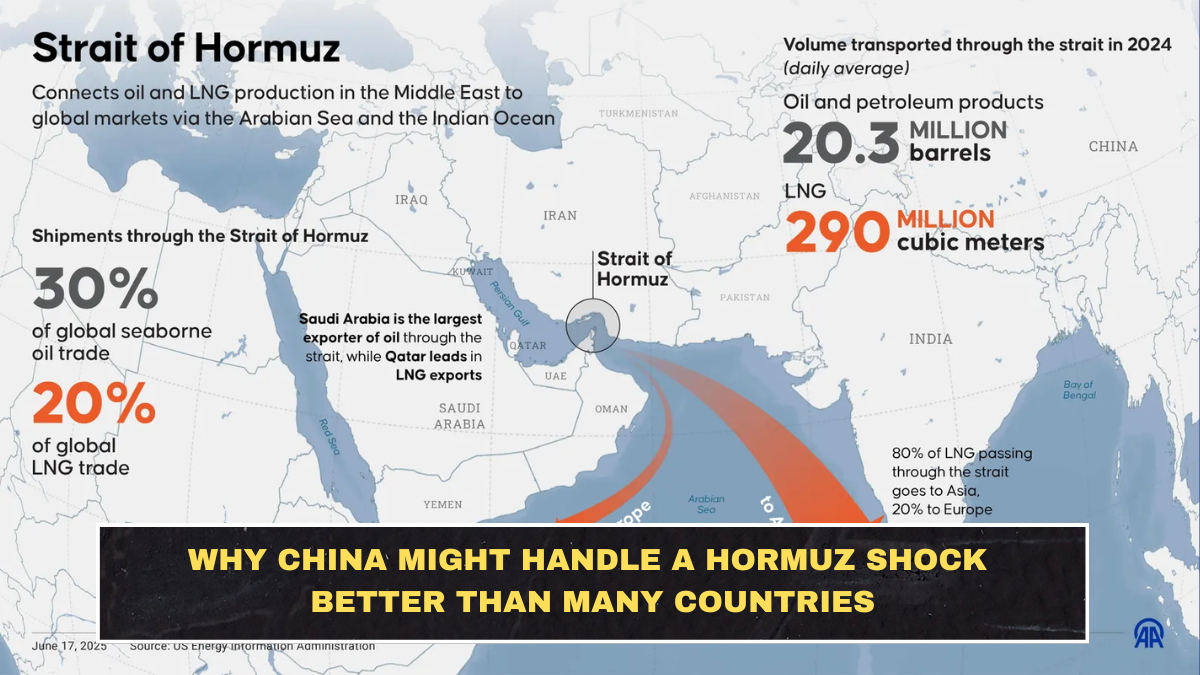
A Hormuz shock would hurt China. Pretending otherwise would be stupid. China is the world’s biggest crude importer, and the Strait of Hormuz is still one of the most important energy chokepoints on earth. But China may still be better positioned than many countries to absorb the disruption because it has built buffers that a lot of import-dependent economies simply do not have. Reuters reported on March 31 that China’s resilience comes from a mix of strategic reserves, diversified suppliers, pipeline links, and lower oil intensity thanks to renewables and electric vehicles.
Why China is not as exposed as the headline suggests
The easy assumption is that any Hormuz disruption automatically crushes China because China buys so much oil. That is lazy thinking. The more serious question is how much of China’s supply actually depends on that route and how much flexibility it has elsewhere. Reuters reported on March 30 that PetroChina said only about 10% of its crude oil and natural gas supplies are tied to Hormuz, while roughly 90% of its crude processing and gas sales come from domestic production, pipeline imports, and non-Middle Eastern sources through long-term contracts and overseas assets.
That does not mean China is safe. It means China is less trapped than people assume.
The buffers China has already built
China’s resilience is not based on one single trick. It comes from several layers working together. Reuters said China has built substantial oil stockpiles, expanded pipeline connectivity with Russia and Central Asia, widened its supplier base beyond the Gulf, and reduced crude dependence through renewable energy growth and a large electric-vehicle fleet. Reuters also reported on April 1 that China has been able to resell record LNG cargoes because domestic demand is soft, heating season is over, inventories are available, and pipeline gas plus domestic output are helping cover demand.
That is what real resilience looks like. Not zero pain, but options.
What the data says
| Factor | Confirmed detail | Why it matters |
|---|---|---|
| Hormuz exposure | PetroChina said Hormuz accounts for about 10% of its crude and gas supplies | China’s biggest state producer is not overwhelmingly dependent on the strait. |
| Global chokepoint scale | Reuters reported Hormuz handles about 20% of global oil and LNG flows | Any disruption is still a major global shock. |
| LNG flexibility | China resold 8 to 10 LNG cargoes in March 2026, totaling 1.31 million metric tons so far this year | Suggests China had enough supply cushion to profit from tight markets rather than panic-buy. |
| Market resilience | Reuters reported China’s CSI300 fell less than markets in India, Japan, South Korea, and the U.S. during the shock | Investors are already treating China as relatively better positioned. |
| Demand-side buffer | Reuters cited EV adoption, renewables, and strong domestic electricity output as part of China’s resilience | Lower oil intensity reduces vulnerability. |
Why China may cope better than many others
Three things stand out.
- China has inventory and procurement depth, which gives it time rather than forcing instant panic buying.
- China has more supply diversity than smaller Asian importers that rely more heavily on Gulf cargoes. Reuters noted Beijing has expanded buying from places like Brazil and Angola and relies on pipeline flows from Russia and Central Asia.
- China’s economy is less oil-hungry than it used to be because more transport demand is being absorbed by EVs and more power demand by domestic electricity sources.
That last point matters more than most commentators admit. If your economy needs less imported crude per unit of activity, you can survive a supply shock better even when prices still hurt.
Where the weakness still is
Now the uncomfortable part. China is not invulnerable. Reuters reported that Chinese ships trying to exit Hormuz still turned back despite Iranian safe-passage assurances, which shows actual physical shipping risk remains serious. Reuters also reported that smaller independent refiners in China are already cutting output because higher crude prices are squeezing margins, with some expected to lower processing rates to around 50% from 55%.
So yes, Beijing may be better prepared than many countries. But better prepared is not the same as untouched. A prolonged Hormuz disruption would still raise input costs, pressure refiners, and hit trade flows.
What this means in plain language
If Hormuz disruption worsens, China is more likely to bend than break. It has reserves, supplier diversity, pipelines, LNG flexibility, and lower oil intensity than in earlier decades. That gives Beijing room to manage the shock while others scramble. But the pain would still show up through higher prices, shipping disruptions, and refining stress, especially if the closure drags on. Barclays told Reuters that a prolonged disruption could remove 13–14 million barrels per day from global supply, which would be too large for any importer to ignore.
Conclusion
China might handle a Hormuz shock better than many countries because it spent years building exactly the kind of buffers this crisis now rewards. Strategic stocks, pipeline links, diversified imports, strong domestic energy capacity, and weaker oil intensity all matter. But this is not a victory lap story. China is relatively resilient, not immune. If the disruption becomes prolonged, even Beijing’s advantages will be tested by the scale of the global supply hit and the reality of disrupted shipping.
FAQs
Would a Hormuz disruption still hurt China?
Yes. China would still face higher prices, shipping risk, and refining pressure, even if it may cope better than many countries.
Why is China seen as relatively resilient?
Because Reuters reported China has strategic reserves, diversified suppliers, pipeline infrastructure, and lower oil intensity from EVs and renewables.
How exposed is PetroChina to Hormuz?
PetroChina said Hormuz accounts for about 10% of its crude oil and gas supplies.
Is China already using its flexibility in energy markets?
Yes. Reuters reported China has been reselling record LNG cargoes in 2026 because domestic supply and demand conditions gave it extra room.
What is the biggest remaining vulnerability?
A prolonged disruption that keeps tankers blocked and oil prices elevated would still hit Chinese refiners and trade flows, even with reserves and supply diversification.