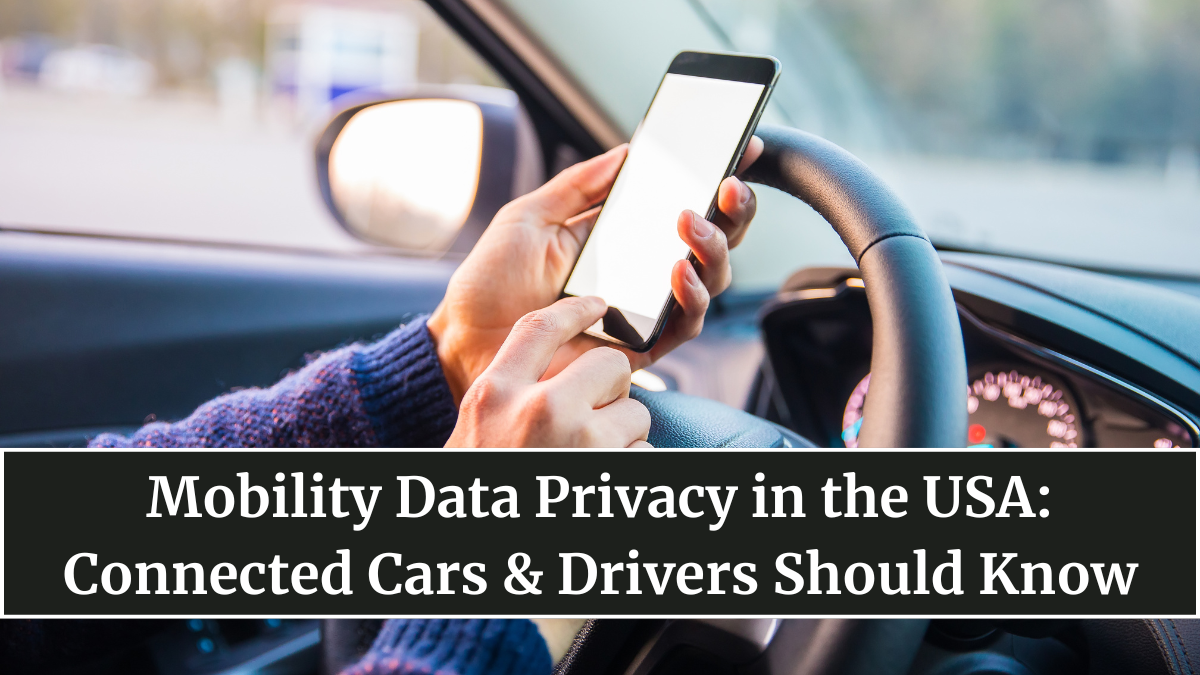
Your car now knows more about you than your smartphone. From GPS locations and voice commands to driving habits and seat preferences, modern vehicles are becoming data-gathering machines on wheels. The rise of connected vehicles has made driving more convenient and safer — but it has also raised an urgent question: who controls your mobility data? The USA mobility data privacy landscape is entering a crucial phase, with regulators, automakers, and drivers all navigating the fine line between innovation and surveillance.
How Connected Cars Collect and Use Your Data
Today’s vehicles are equipped with hundreds of sensors and multiple communication modules — including GPS, Wi-Fi, Bluetooth, and 5G. These technologies continuously gather data such as:
-
Location history and driving routes
-
Speed, braking, and steering behavior
-
Voice commands, call logs, and infotainment use
-
Camera and radar feeds from ADAS systems
-
Personal preferences, like temperature settings and radio stations
Automakers claim this data helps improve safety features, enhance customer experiences, and optimize maintenance. However, much of it is also used for marketing, insurance analytics, and third-party partnerships, often without the driver’s full understanding or explicit consent.
The Growing Privacy Concerns
Several investigations and studies have revealed troubling practices around how mobility data is stored and shared:
-
A 2023 Mozilla Foundation report found that 84% of car brands sold or shared driver data with third parties.
-
Some automakers reportedly collect data even after the engine is off, using background systems linked to mobile apps.
-
Law enforcement agencies have requested driver data from connected vehicles during investigations — sometimes without warrants.
These revelations have sparked major debates about whether drivers actually own the data their vehicles produce, and how much privacy one can expect in the era of intelligent mobility.
The Legal and Regulatory Framework
Unlike Europe’s GDPR, the U.S. lacks a single, unified data privacy law. Instead, data protection in connected cars is governed by a mix of state and sectoral regulations:
| Region / Law | Focus Area | Impact on Automakers |
|---|---|---|
| California Consumer Privacy Act (CCPA) | Consumer data access and deletion rights | Requires manufacturers to disclose data use and allow opt-outs |
| Virginia & Colorado Privacy Acts | Broader consent and data control provisions | Extends GDPR-like rights to residents |
| FTC Act (Federal) | Regulates deceptive or unfair data practices | Holds companies accountable for misleading privacy disclosures |
| NHTSA Guidelines | Focuses on vehicle cybersecurity and driver safety | Encourages voluntary compliance on privacy and transparency |
However, privacy experts argue that these laws still lag behind the speed of automotive innovation, leaving drivers exposed to opaque data-sharing networks that involve insurers, advertisers, and data brokers.
Automakers’ Response: Building Trust with Transparency
To maintain public confidence, several automakers are proactively strengthening their data governance frameworks:
-
General Motors has launched a “Data Transparency Center” allowing customers to view and manage collected data.
-
Ford and Toyota have introduced in-car privacy dashboards where users can disable certain tracking features.
-
Tesla offers limited data export controls, though privacy advocates continue to question its telemetry practices.
-
Rivian and Lucid Motors are exploring encrypted data pipelines to prevent unauthorized access by third parties.
These steps indicate a growing recognition that data privacy is becoming a competitive advantage in the connected car market.
The Role of Telematics, Insurers, and Third Parties
Telematics — systems that record driving patterns for insurance and fleet management — play a huge role in this ecosystem. While telematics can reward safe drivers with discounts, it also enables continuous behavioral monitoring, raising ethical concerns.
Insurers now analyze metrics like:
-
Speeding frequency
-
Time of day driven
-
Acceleration and braking intensity
-
Average trip length
The challenge lies in balancing risk-based pricing with data ethics. Without strict oversight, such data can be misused, leading to profiling or discriminatory premiums.
How Drivers Can Protect Their Mobility Data
While full control may not yet be possible, drivers can take practical steps to minimize exposure:
-
Review privacy settings in your car’s infotainment system and mobile app.
-
Disconnect unnecessary integrations, such as social media or calendar syncing.
-
Use guest mode when sharing your vehicle with others.
-
Avoid linking sensitive accounts like email or payment apps.
-
Regularly clear stored navigation and call history.
Consumers should also favor brands with transparent privacy policies and strong cybersecurity practices.
The Road Ahead: Privacy by Design
The U.S. auto industry is moving toward “privacy by design”, where data protection is built into the engineering process rather than added later. This includes:
-
Edge computing to process data inside the car instead of cloud servers.
-
Encrypted communication channels between vehicle and manufacturer.
-
Anonymized data sharing for analytics and urban planning.
-
Blockchain-based ownership verification for driver data.
By 2030, connected vehicles are expected to generate over 25 terabytes of data per hour, making privacy protection not just a legal issue but a technological imperative.
As vehicles evolve into intelligent digital ecosystems, the balance between convenience and control will define the next decade of mobility. For now, the message is clear — in the connected car era, your data drives more than your car.
FAQs
What kind of data do connected cars collect?
They collect location, driving behavior, voice commands, and sensor data through onboard systems and mobile apps.
Can car manufacturers share my driving data?
Yes, but under state laws like CCPA, you have the right to opt-out or request data deletion in many states.
Are insurers using my telematics data?
Many insurers now use driving behavior data to determine premiums, though consent is typically required before data collection begins.
How can I protect my data privacy in a connected car?
Adjust privacy settings, disable unnecessary connections, and regularly clear stored history from your infotainment system.
Will stronger privacy laws come to the U.S. soon?
Yes, federal policymakers are drafting frameworks similar to GDPR, and several states are passing auto-specific privacy legislation to safeguard consumers.
Click here to know more.