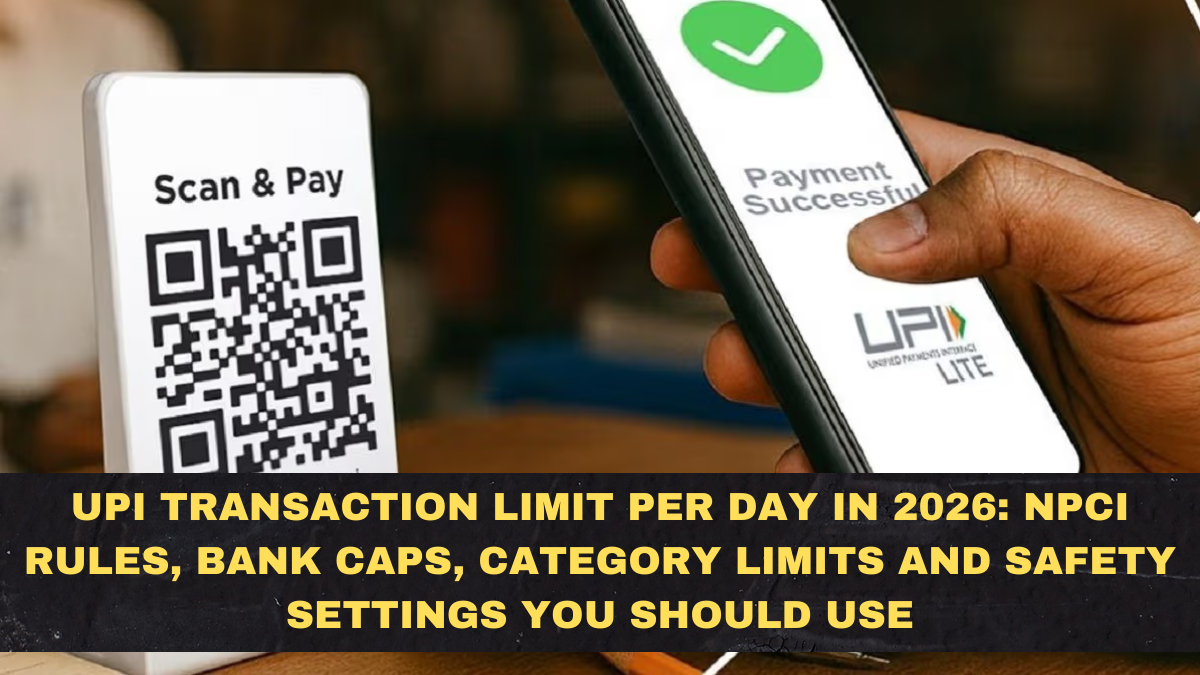
The UPI transaction limit per day in 2026 is one of the most misunderstood and silently dangerous parts of India’s digital payment system.
People assume:
“UPI toh unlimited hai.”
“Bas bank balance hona chahiye.”
“Mera app chalega toh payment ho jaayega.”
Then one day:
A big payment fails.
A hospital bill gets stuck.
A property token amount doesn’t go through.
A business transfer bounces.
And suddenly people realize:
UPI is not unlimited.
And the rules are not simple.
This guide explains exactly what the UPI transaction limit per day looks like in 2026, what NPCI actually allows, how banks quietly impose their own caps, how category limits work, and what safety settings you should enable to avoid fraud disasters.
No tech jargon.
No banking PR.
Only money reality.
Why UPI Limits Matter More in 2026 Than Ever
UPI is no longer used only for chai and groceries.
In 2026, people use UPI for:
-
Rent payments
-
School fees
-
Hospital bills
-
Business payments
-
Property token amounts
-
Vehicle bookings
-
Investment transfers
That means:
Transaction sizes are much larger now.
So limits that didn’t matter earlier now break real-life payments.
What NPCI Actually Allows as the UPI Transaction Limit
NPCI is the rule-maker for UPI.
In 2026, NPCI defines two core ceilings:
-
Per-transaction limit
-
Per-day cumulative limit
For most normal users:
-
Per transaction cap is around ₹1 lakh
-
Per day cumulative cap is around ₹1 lakh
But here’s the catch.
These are maximum allowed ceilings.
Not guaranteed entitlements.
The Brutal Truth: Your Bank Can Set Lower Limits Than NPCI
This is where people get shocked.
NPCI sets the upper limit.
Your bank sets the real limit.
Banks are legally allowed to impose:
-
Lower per-transaction limits
-
Lower daily limits
-
Extra caps for new users
-
Extra caps for suspicious activity
So two people using the same UPI app can have completely different limits.
Because their banks are different.
Why Your UPI Payment Fails Even When You Are “Within Limit”
This is the rage moment.
People see:
“My limit is ₹1 lakh.”
“I am sending ₹40,000.”
“Why did it fail?”
Because:
Your bank may have a ₹25,000 daily cap.
Or a ₹10,000 per-transaction cap.
Or a temporary security cap.
Apps don’t always show real limits clearly.
So you hit invisible walls.
Category-Based UPI Limits in 2026
This is new and important.
In 2026, UPI has category-based limits.
Different transaction types have different caps.
Common categories include:
-
Person-to-person transfers
-
Merchant payments
-
Educational payments
-
Healthcare payments
-
IPO and investment payments
Some categories allow higher limits.
Others are restricted.
So your ₹1 lakh hospital payment might go through.
But your ₹1 lakh friend transfer might fail.
This feels illogical.
But it is how fraud risk is managed.
Why Merchant Payments Sometimes Allow Higher Limits
This confuses users.
Why does UPI allow:
₹1 lakh to a hospital
But not ₹1 lakh to a friend?
Because:
Merchant accounts are KYC-verified.
They are traceable.
They are regulated.
Friend accounts are high fraud risk.
So NPCI and banks restrict those harder.
How New UPI Users Get Punished With Tiny Limits
This hurts new users.
If you:
-
Recently activated UPI
-
Changed your phone
-
Changed SIM
-
Reset your UPI PIN
Your limits get temporarily reduced.
Why?
Because fraud spikes during account changes.
So banks throttle you.
Even if your balance is high.
How Banks Quietly Change Your UPI Limits Without Telling You
This is the creepiest part.
Banks can dynamically adjust your limits based on:
-
Transaction behavior
-
Location changes
-
Failed attempts
-
Suspicious patterns
-
Device changes
They don’t send alerts.
They just silently cap you.
You only discover it when payment fails.
Why UPI Has a Daily Limit Instead of Monthly
This is risk engineering.
Daily limits reduce:
-
Fraud losses
-
Account draining
-
Scam impact
If a scammer gets your PIN:
They can only steal up to your daily cap.
Not your entire balance.
That is why UPI is daily-limited by design.
The Hidden Limit Nobody Talks About: Number of Transactions Per Day
This one shocks power users.
UPI also limits:
Number of transactions per day.
So even if each payment is small:
After a certain number of transactions:
Payments start failing.
This is anti-bot protection.
What Happens When You Hit Your Daily UPI Limit
When you hit your limit:
-
Payments fail
-
Error messages appear
-
No partial success happens
You cannot override it.
You must wait till next day.
At midnight, limits reset.
How to Check Your Real UPI Limit
This is harder than it should be.
You can:
-
Check in your UPI app settings
-
Check your bank app
-
Call bank customer care
But:
Many apps show NPCI limits.
Not your bank’s real cap.
So the only guaranteed way is:
Test with a small transaction.
Safety Settings You Must Enable in 2026
This is non-negotiable now.
You should:
-
Set a low self-limit
-
Enable app lock
-
Enable SIM binding
-
Turn on transaction alerts
-
Use daily cap lower than NPCI max
This reduces fraud damage massively.
Why Setting a Lower Self-Limit Is Smart
This feels counter-intuitive.
But it saves your life.
If your phone is compromised:
The thief can only steal up to your self-limit.
Not your bank’s full UPI cap.
This one step saves lakhs.
The Dark Side of High UPI Limits
People love high limits.
Until they get scammed.
High limits = high blast radius.
That is why fraud victims lose huge sums in minutes.
Lower limits reduce blast damage.
When You Actually Need High UPI Limits
High limits make sense only if:
-
You run a business
-
You pay large bills regularly
-
You invest via UPI
-
You book vehicles or property
Normal users do not need ₹1 lakh daily limits.
Smart Workarounds When UPI Limit Blocks You
When your payment fails:
You can:
-
Split into multiple payments
-
Use net banking
-
Use debit card
-
Use cheque or NEFT
UPI is not the only rail.
Do not get emotionally stuck on it.
Conclusion: The Real Truth About UPI Transaction Limits in 2026
The UPI transaction limit per day in 2026 is not a single number.
It is a moving target.
It depends on:
-
NPCI ceilings
-
Your bank’s internal caps
-
Transaction category
-
Your account behavior
-
Security risk flags
So if your payment fails:
It is not always a bug.
It is usually a rule you didn’t know existed.
The smart move in 2026 is:
-
Know your real limits
-
Set your own lower self-limit
-
Use UPI wisely for big payments
-
Keep backup payment methods ready
Because UPI is powerful.
But it is not unlimited.
And treating it like it is will eventually burn you.
FAQs
What is the UPI transaction limit per day in 2026?
NPCI allows up to around ₹1 lakh per day, but banks can set lower limits.
Why does my UPI payment fail even within limit?
Because your bank may have a lower internal cap or category-based restriction.
Do different payments have different UPI limits?
Yes. Merchant, healthcare, education, and person-to-person payments can have different caps.
Can banks change my UPI limit without telling me?
Yes. Banks dynamically adjust limits based on risk signals.
Should I set my own lower UPI limit?
Yes. It reduces fraud damage significantly.
When do UPI daily limits reset?
At midnight each day.