Technology is evolving at a pace that continuously reshapes how humans interact with digital systems. One of the most groundbreaking advancements in this field is the development of tactile hologram interfaces, which integrate advanced imaging, sensory feedback, and real-time responsiveness. These interfaces bridge the gap between physical and digital worlds, allowing users to touch and feel holograms that once existed only as visual projections. As this futuristic technology progresses, it is poised to transform the entire landscape of human–machine communication, creating new pathways for interaction, learning, and productivity.
For decades, people relied on keyboards, touchscreens, and gesture-based devices to communicate with machines. However, tactile holography introduces a new era where digital interactions no longer require physical surfaces. By offering touch-sensitive virtual objects, tactile hologram interfaces have the potential to revolutionize industries such as healthcare, education, engineering, and entertainment. As researchers refine these innovative systems, the future of human–machine communication becomes more immersive, intuitive, and interconnected.
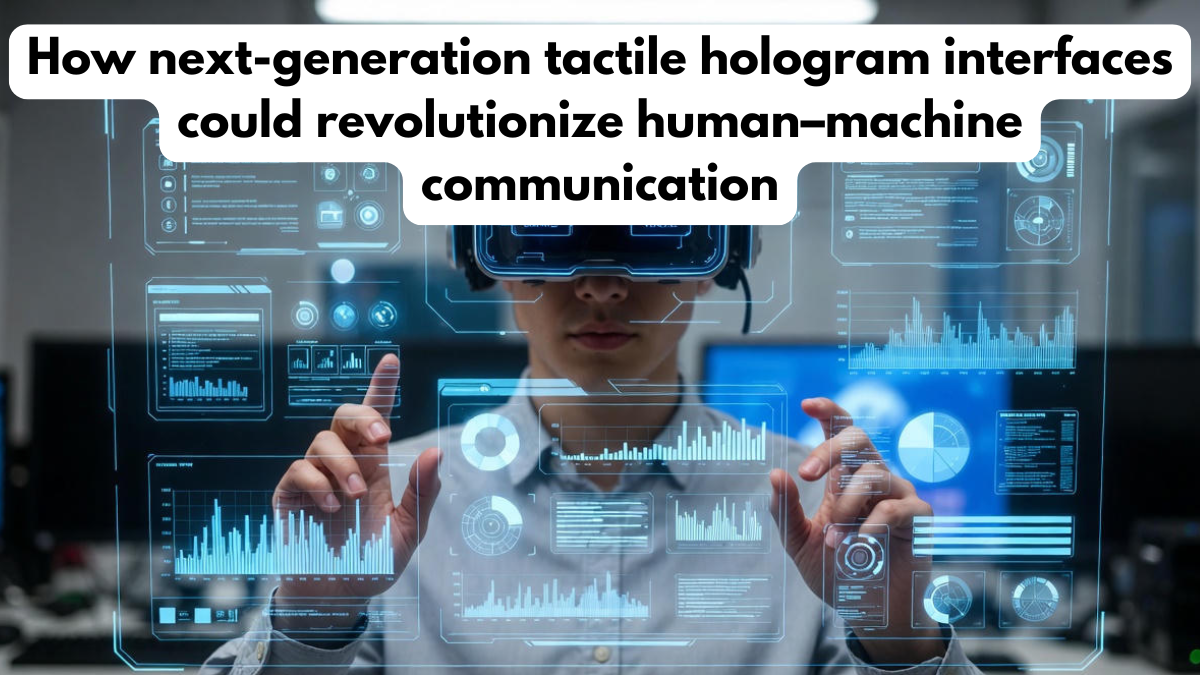
How Tactile Hologram Interfaces Work
The core principle behind tactile hologram interfaces lies in their ability to merge holographic imaging with tactile feedback technologies. Unlike traditional holograms, which are purely visual, tactile holograms respond to user interactions by simulating the sensation of touch. This effect is achieved through ultrasonic waves, air pressure fields, or electromagnetic responses that mimic physical contact without the need for physical surfaces.
These interfaces analyze user movements through sensors and cameras, adjusting holographic shapes and feedback in real time. The technology behind human–machine communication becomes significantly enhanced when users can feel and manipulate virtual objects. From rotating 3D models to pressing virtual buttons, tactile holography allows interactions that feel natural and intuitive. As the technology matures, improved precision and responsiveness are expected to redefine how people engage with digital environments, strengthening the role of tactile hologram interfaces across multiple industries.
Applications in Healthcare, Education, and Engineering
One of the biggest advantages of tactile hologram interfaces is their versatility. In healthcare, surgeons can practice operations on lifelike holographic organs before performing procedures on real patients. This reduces risk, improves accuracy, and enhances medical training. Such advancements contribute significantly to human–machine communication, helping professionals understand complex structures through real-time touch-based simulations.
In education, tactile holography allows students to interact with virtual models of molecules, planets, historical artifacts, and more. This interactive learning approach increases comprehension, engagement, and retention. In engineering and architecture, professionals can touch virtual prototypes, test designs, and identify structural issues without building physical models. These applications highlight how tactile hologram interfaces are transforming professional industries and enabling more meaningful communication between humans and digital systems.
Table: Key Advantages of Tactile Hologram Interfaces
| Feature | Benefit | Impact on Human–Machine Communication |
|---|---|---|
| Touch-Sensitive Interaction | Realistic sensation of objects | Enhances immersion and user control |
| No Physical Hardware Needed | Reduces reliance on devices | Enables hands-free digital interaction |
| Real-Time Responsiveness | Instant feedback | Improves precision and user engagement |
| Multi-User Capability | Shared holographic environments | Supports collaborative communication |
| High Accuracy Visualization | Detailed 3D models | Strengthens understanding of complex information |
This table demonstrates how tactile hologram interfaces significantly elevate the capabilities of human–machine communication, allowing deeper and more intuitive interactions.
Transforming Everyday Human–Machine Experiences
Beyond professional use, tactile hologram interfaces have the potential to revolutionize daily life. Virtual assistants could evolve into holographic companions capable of interacting physically with users. Imagine touching a floating holographic display to control home appliances, shop online, or navigate virtual worlds. These systems will make human–machine communication more seamless, natural, and accessible to people of all ages and abilities.
In entertainment, tactile holography could enhance gaming, filmmaking, and virtual reality experiences. Users may touch digital characters, manipulate virtual environments, and feel textures within immersive simulations. Social communication may also change, as holographic meetings become physically interactive, enabling participants to shake hands or share virtual objects. These possibilities showcase how deeply tactile hologram interfaces can influence human behavior and digital interaction.
Challenges and Future Potential of Tactile Holograms
Despite their promise, tactile hologram interfaces still face challenges. Creating accurate tactile sensations requires advanced sensors, large amounts of computational power, and precise calibration. Current systems also have limitations in terms of stability, energy consumption, and accessibility. These issues must be addressed before widespread adoption becomes possible.
However, ongoing research continues to push boundaries. As artificial intelligence, machine learning, and sensor technologies advance, tactile holography is expected to become more realistic, affordable, and reliable. These improvements will further strengthen human–machine communication, offering new tools for virtual collaboration, medical innovation, and digital creativity. In the near future, tactile holograms could become central components of smart homes, workplaces, and entertainment ecosystems, transforming how people interact with the digital world.
Conclusion
The rise of tactile hologram interfaces represents a monumental leap forward in digital technology. By making virtual objects feel real, they redefine what is possible in human–machine communication, offering new levels of immersion, accuracy, and efficiency. From healthcare simulations to interactive learning and advanced engineering design, tactile holography has the power to reshape industries and everyday experiences.
As research continues and new breakthroughs emerge, these interfaces will pave the way for an era where physical and digital worlds seamlessly merge. The promise of tactile hologram interfaces extends far beyond novelty; it opens the door to a future where technology becomes more intuitive, accessible, and deeply integrated into human life.
FAQs
How do tactile hologram interfaces work?
They use holographic imaging combined with ultrasonic or electromagnetic feedback to create the sensation of touching virtual objects.
What industries can benefit from tactile holography?
Healthcare, education, engineering, entertainment, and smart home technologies can all utilize tactile hologram interfaces.
Are tactile holograms part of the future of human–machine communication?
Yes, they significantly enhance digital interaction by adding touch-based feedback to virtual environments.
Will tactile hologram technology become mainstream?
As research advances and systems become more affordable, tactile holograms are expected to become widely used across multiple sectors.
Click here to know more.