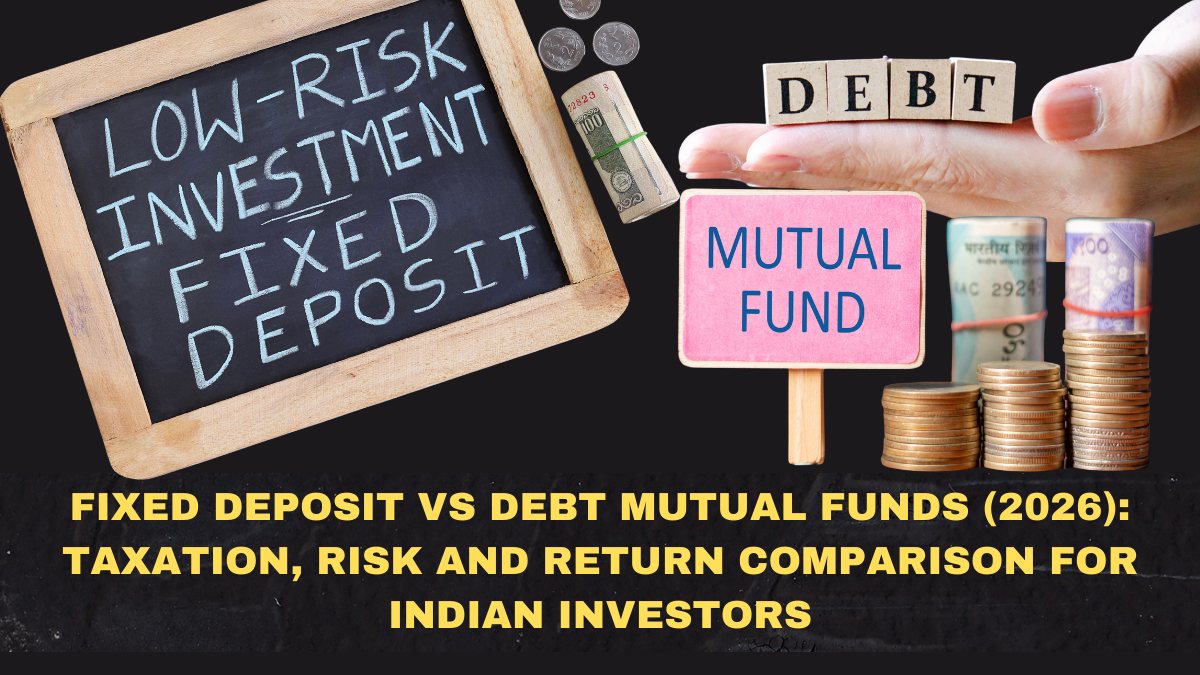
The fixed deposit vs debt mutual fund debate in 2026 is no longer a nerdy finance discussion that only wealth managers care about. It has quietly become one of the most financially dangerous decision points for ordinary Indian savers.
Why?
Because interest rates are unstable.
Tax rules have changed the game.
Inflation is eating real returns.
And millions of people are still choosing instruments based on outdated logic.
In 2026, blindly putting money into an FD just because “FD safe hota hai” is no longer intelligent.
And blindly putting money into a debt mutual fund just because “mutual funds give higher returns” is equally stupid.
This guide breaks down the fixed deposit vs debt mutual fund decision exactly as it exists in 2026 — taxation reality, real return math, risk truth, liquidity logic, and who should actually pick what.
No brochure advice.
No influencer nonsense.
Only financial survival logic.
Why This Comparison Matters More in 2026 Than Ever
This comparison used to be simple.
FD = safe, low return.
Debt fund = risky, higher return.
That mental model is now wrong.
In 2026:
-
FD taxation has become brutally inefficient
-
Debt fund taxation has lost its biggest historical advantage
-
Inflation has destroyed nominal returns
-
Liquidity needs have increased
-
Interest rate cycles are unpredictable
So the old rules no longer apply.
If you use 2018 logic in 2026:
You will lose money quietly.
What a Fixed Deposit Actually Is in 2026
A fixed deposit is still what it always was.
You give money to a bank.
The bank promises a fixed interest rate.
You get your money back after a fixed tenure.
Key traits in 2026:
-
Guaranteed nominal return
-
Zero market volatility
-
Simple to understand
-
High psychological comfort
-
Poor tax efficiency
-
Poor inflation protection
FDs feel safe.
But “feels safe” is not the same as “financially optimal.”
What a Debt Mutual Fund Actually Is in 2026
A debt mutual fund invests in:
-
Government bonds
-
Corporate bonds
-
Treasury bills
-
Money market instruments
Your return depends on:
-
Interest rate movement
-
Bond prices
-
Credit quality
-
Fund duration
-
Expense ratio
Key traits in 2026:
-
No guaranteed returns
-
Moderate volatility
-
Higher liquidity
-
Better flexibility
-
Complex risk structure
-
Taxation advantage mostly gone
Debt funds are not “safe alternatives to FD” anymore.
They are a different asset class.
The Brutal Taxation Reality in 2026
This is where most people still live in fantasy.
Fixed Deposit Taxation in 2026
FD interest is taxed as:
Normal income.
That means:
-
Added to your total income
-
Taxed at your slab rate
-
No indexation
-
No special benefit
So if you are in:
20% slab → You lose 20% of your interest
30% slab → You lose 30% of your interest
Your FD return is never what the bank advertises.
Debt Mutual Fund Taxation in 2026
This is where people are stuck in old memory.
Earlier:
Long-term debt funds had indexation benefit.
In 2026:
That benefit is gone for most categories.
Most debt mutual funds are now taxed like:
Normal income.
Just like FDs.
So the biggest historical advantage of debt funds is dead.
The Real Post-Tax Return Comparison
This is where illusions collapse.
Example:
FD interest rate: 7.5%
Your tax slab: 30%
Post-tax FD return:
7.5% × (1 – 0.30) = 5.25%
Now inflation:
Assume inflation = 6%
Your real return:
5.25% – 6% = –0.75%
That means:
You lost purchasing power.
Even though your money “grew.”
Debt fund scenario:
Return = 8%
Tax slab = 30%
Post-tax return:
8% × (1 – 0.30) = 5.6%
Real return:
5.6% – 6% = –0.4%
Still negative.
Slightly less bad.
But still bad.
The Risk Reality Nobody Explains Properly
People think:
FD = zero risk
Debt fund = risky
That is not fully true.
FD Risks in 2026
FD risks are invisible but real.
-
Inflation risk
-
Reinvestment risk
-
Interest rate risk
-
Bank failure risk beyond insurance limit
FDs protect nominal capital.
They do not protect purchasing power.
Debt Fund Risks in 2026
Debt fund risks are visible and emotional.
-
NAV volatility
-
Interest rate risk
-
Credit risk
-
Liquidity risk
When debt funds fall, people panic.
When FDs lose real value slowly, people don’t notice.
Both are dangerous in different ways.
Liquidity: The Silent Differentiator
This is where debt funds quietly win.
FD liquidity:
-
Premature withdrawal penalty
-
Interest rate reset
-
Paperwork or delays
Debt fund liquidity:
-
Sell anytime
-
Money in 1–2 working days
-
No penalty
-
Partial withdrawals allowed
In 2026, liquidity is no longer optional.
It is a survival feature.
Interest Rate Cycle Risk in 2026
This is critical now.
Interest rates are volatile.
If you lock into an FD:
And rates rise later:
You are stuck earning low returns.
Debt funds:
Benefit when rates fall.
Lose when rates rise.
So:
FDs lock your mistake.
Debt funds float your mistake.
Both hurt differently.
Who Fixed Deposits Actually Make Sense For in 2026
FDs are not dead.
They are just overused.
FDs make sense for:
-
Retirees needing predictable income
-
Emergency funds
-
Ultra-conservative investors
-
Short-term parking of money
-
People in 5% tax slab
FDs are income tools.
Not wealth tools.
Who Debt Mutual Funds Actually Make Sense For in 2026
Debt funds are not magic either.
They make sense for:
-
Medium-term goals
-
People needing liquidity
-
Investors who understand NAV volatility
-
People in lower tax slabs
-
Portfolio diversification
Debt funds are flexibility tools.
Not safety tools.
The Most Common Financial Mistake in 2026
This mistake is everywhere.
People put:
All emergency fund in debt funds
All long-term savings in FDs
Both are wrong.
Emergency fund belongs in:
Savings + short FDs
Medium-term money belongs in:
Short-duration debt funds
Long-term wealth belongs in:
Equity funds
Using FD or debt funds for long-term wealth is financial suicide.
Why Most Financial Influencers Mislead on This Topic
This is uncomfortable truth.
They still use:
Pre-tax returns
Old taxation rules
Cherry-picked periods
They sell debt funds as “better FD.”
That is false in 2026.
Debt funds are not superior FDs anymore.
They are different instruments.
The Psychological Comfort Trap
People love FDs because:
-
No daily NAV
-
No red numbers
-
No panic
That emotional comfort costs real money.
But that comfort is valuable for some people.
Not everyone needs to maximize returns.
Some people need sleep.
That is valid.
The Rational Decision Framework for 2026
This is the only framework that works.
Ask:
-
How long can I lock this money?
-
Do I need liquidity?
-
What is my tax slab?
-
Can I tolerate NAV volatility?
-
Is this money for safety or growth?
Then choose.
Not before.
The Ugly Truth Nobody Likes
Here it is.
Both FDs and debt funds are losing real value in 2026.
Because inflation is winning.
They are capital preservation tools.
Not wealth creation tools.
If you rely on them for long-term growth:
You are slowly getting poorer.