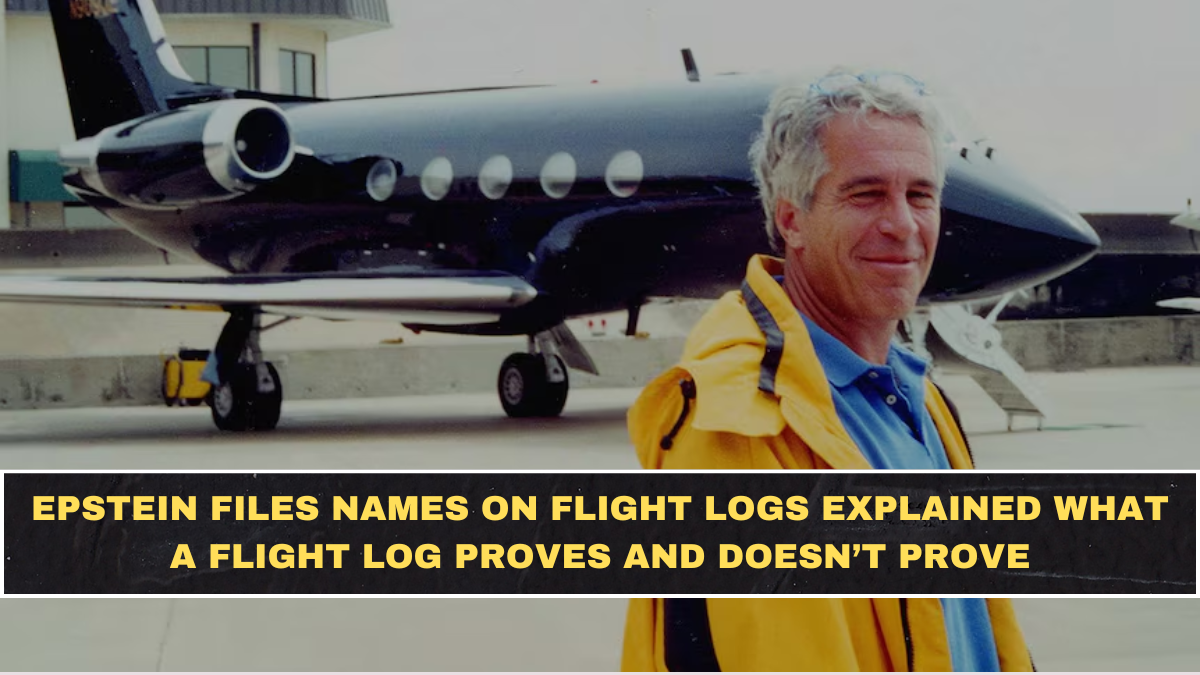
Flight logs connected to the Epstein case are among the most circulated documents whenever the topic trends. Screenshots of names, dates, and destinations are shared with certainty, often implying guilt by association. This reaction is understandable, but it is also where misunderstanding begins, because flight logs are technical records that serve a narrow purpose and say far less than people assume.
This article explains, in plain terms, what flight logs are designed to record, why names appear on them, what conclusions cannot be drawn from them, and how context is routinely stripped away online. The aim is not to minimize seriousness, but to prevent false certainty built on incomplete reading.

What Epstein Flight Logs Actually Are
Flight logs are operational aviation records. Their primary function is to document who boarded an aircraft, when it departed, where it landed, and sometimes who was listed as crew or passengers. These logs exist for safety, scheduling, and compliance, not as investigative summaries.
They do not record conversations, activities at destinations, reasons for travel, or interactions during trips. Treating them as narrative evidence misunderstands why such documents exist in the first place.
Why Names Appear on Flight Logs
A name can appear on a flight log for many routine reasons. Someone may have boarded for a short segment, accompanied others as part of a larger group, or been listed by staff based on manifests prepared in advance. In some cases, names appear because they were scheduled, not because they actually flew.
Crucially, being listed does not indicate purpose or behavior. It only confirms logistical association with a flight at a specific time.
What a Name on a Log Proves
At most, a name on a flight log shows that an individual was associated with a specific flight movement. It can support timelines in investigations when paired with other evidence, but on its own, it does not establish wrongdoing, consent, or awareness of illegal activity.
In legal settings, such logs are used as one data point among many, never as standalone proof of criminal conduct.
What a Name on a Log Does Not Prove
A flight log does not prove participation in crimes, knowledge of crimes, or presence at specific locations beyond the aircraft itself. It does not prove meetings occurred, nor does it prove actions taken once a destination was reached.
Assuming otherwise skips the evidentiary standards required in any serious legal process and replaces them with speculation.
Why Context Is Almost Always Missing Online
Online posts rarely include surrounding details such as who else was present, the nature of the trip, the time span involved, or corroborating evidence. Without this context, names become symbols rather than data points, which is misleading.
The removal of context is often unintentional but becomes harmful when repeated at scale, creating narratives that feel conclusive but are not.
How Flight Logs Are Used in Real Investigations
Investigators use flight logs to corroborate timelines, cross-check witness statements, and verify travel patterns. They are paired with testimony, communications, financial records, and physical evidence.
On their own, logs are insufficient to establish guilt or innocence. Their value lies in confirmation, not accusation.
Why Flight Logs Are So Easily Misused
Lists of names are powerful because they appear concrete and visual. When shared without explanation, they invite instant judgment. Social platforms amplify this effect by rewarding engagement, not nuance.
This environment makes flight logs an easy tool for misinformation, even when the original document is authentic.
How to Read Flight Logs Responsibly
Responsible reading means asking basic questions before drawing conclusions. What type of document is this? Who created it, and for what purpose? What other evidence would be required to support the claim being made?
If those questions cannot be answered clearly, the document should not be treated as proof of anything beyond travel association.
Why Misinterpretation Hurts More Than It Helps
Misreading flight logs harms public understanding and risks falsely implicating individuals without due process. It also weakens genuine accountability by flooding discourse with noise instead of focusing on substantiated findings.
Accuracy is not a defense of wrongdoing; it is a prerequisite for justice.
Conclusion: Travel Records Are Not Verdicts
Flight logs are logistical records, not moral judgments or legal conclusions. A name on a log tells us where a plane went and who was associated with it, nothing more. Treating these records as definitive proof distorts reality and fuels misinformation.
Understanding what flight logs can and cannot show is essential if discussions around the Epstein case are to remain grounded, fair, and meaningful.
FAQs
Do flight logs prove criminal activity?
No. They only document travel logistics.
Why do some names appear multiple times?
Repeated travel can reflect scheduling, business, or logistical reasons, not wrongdoing.
Can flight logs be inaccurate?
Yes. Names may appear based on manifests that do not reflect last-minute changes.
Why are flight logs shared so often online?
They are visual, name-based documents that feel conclusive even when they are not.
Should flight logs be ignored completely?
No. They are useful when interpreted alongside corroborating evidence.
What’s the biggest mistake readers make?
Assuming travel association equals guilt without supporting proof.