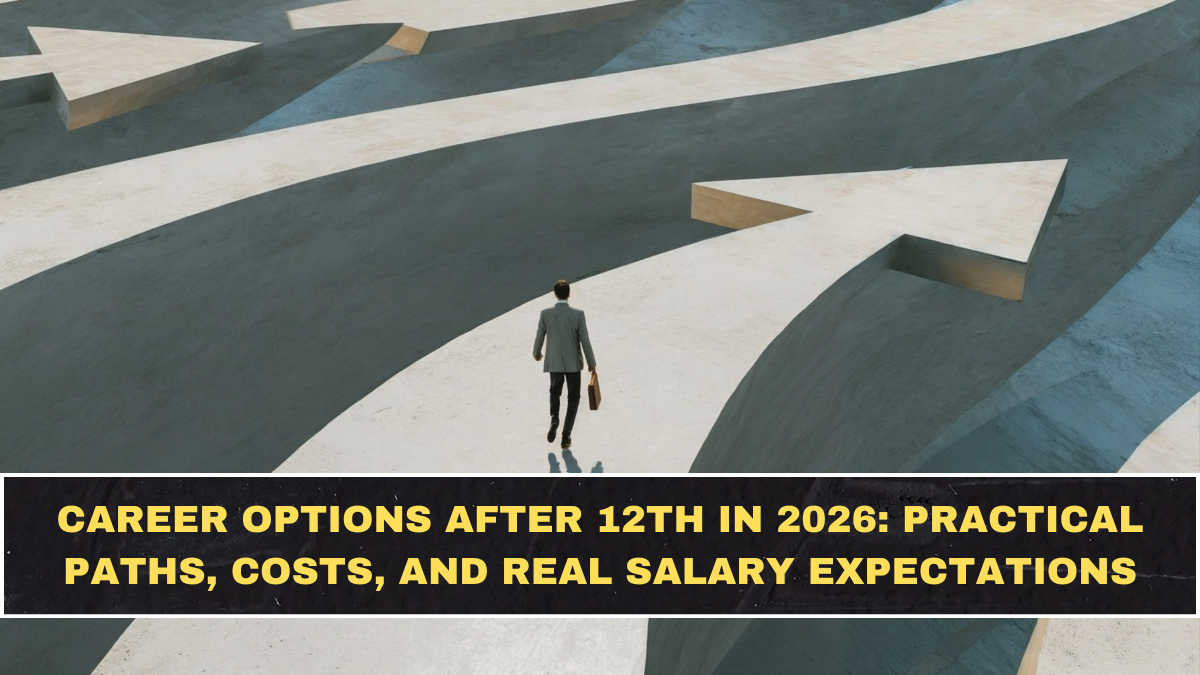
Choosing career options after 12th in 2026 feels heavier than it used to, because the consequences of a wrong decision are more visible now. Students see graduates struggling with low pay, delayed jobs, or complete career resets, and that fear drives rushed choices. Families often push for “safe” paths without understanding how the job market has changed.
The reality is that there are more options than ever after 12th, but fewer forgiving ones. Careers today demand clarity, skill alignment, and patience. This guide breaks down realistic career paths after 12th in 2026, explaining eligibility, cost, salary expectations, and most importantly, who should choose what and who should stay away.
Why Career Decisions After 12th Matter More in 2026
The job market has become less linear. Degrees alone no longer guarantee entry roles, and switching later often costs time and money.
At the same time, skill-based hiring has expanded, but only for those who plan early. Random experimentation without direction creates gaps that are hard to explain later.
In 2026, early clarity reduces long-term damage.
Science Stream: Beyond the Usual Assumptions
Science is no longer only about engineering or medicine. It opens doors to research, analytics, applied sciences, healthcare support roles, and technical operations.
However, science paths demand long timelines and sustained effort. Students who dislike academic rigor often burn out halfway.
In 2026, science works for disciplined learners, not default choices.
Commerce Stream: More Than CA or BCom
Commerce students have broader flexibility in 2026. Finance, analytics, operations, compliance, marketing, and management support roles are accessible with the right skill layering.
Math-heavy paths are not mandatory for all commerce careers. Some roles focus more on systems, process, and communication.
In 2026, commerce rewards adaptability more than rote learning.
Arts Stream: High Risk Without Skill Add-Ons
Arts and humanities degrees alone rarely convert into high-paying jobs. The value comes from pairing them with practical skills.
Content strategy, design research, policy analysis, education, HR, and communications benefit from arts backgrounds when combined with execution skills.
In 2026, arts careers succeed with intentional upskilling, not degree pride.
Professional Courses After 12th
Professional tracks like CA, CS, CMA, design schools, and law require early commitment and long-term patience.
They offer stability but come with high dropout rates. Many students underestimate the mental and time cost.
In 2026, professional courses suit endurance-driven personalities.
Skill-First Career Paths Gaining Ground
Skill-first careers focus on employability before degrees. Examples include digital roles, data support, operations, sales engineering, and creative production.
These paths require discipline and self-learning but reduce dependency on institutional brands.
In 2026, skills can compensate for pedigree, but not laziness.
Cost vs Salary Reality After 12th
Expensive education does not guarantee better outcomes. Many high-cost programs offer delayed or uncertain returns.
Affordable paths with focused skill development often outperform costly degrees in early career stages.
In 2026, ROI matters more than reputation.
What Students Commonly Get Wrong
Choosing streams based on peer pressure remains a major mistake. Another error is ignoring personal aptitude.
Many students also underestimate the importance of internships and early exposure.
In 2026, ignorance is more expensive than effort.
How to Choose the Right Path for You
Start with honest self-assessment. Look at learning style, patience level, financial buffer, and risk tolerance.
Match these factors with career requirements, not social expectations.
In 2026, alignment beats ambition.
When Taking a Drop Makes Sense
Dropping a year is not failure if used strategically. It becomes harmful only when wasted on confusion.
A structured plan with skill-building or exam preparation can justify a drop year.
In 2026, intent defines outcomes.
Careers That Look Attractive but Underperform
Some careers look glamorous online but offer limited entry roles or poor growth.
Blindly following trends without understanding competition leads to disappointment.
In 2026, visibility does not equal viability.
Conclusion: Career Options After 12th Require Strategy, Not Fear
Career options after 12th in 2026 are not about choosing the “best” path, but the right one for your context. The market rewards clarity, skill alignment, and consistency far more than labels.
Students who plan realistically avoid regret. Those who chase prestige without fit pay the price later.
In 2026, the smartest career decision is the one you can sustain.
FAQs
Is science still the best stream after 12th?
Only for students comfortable with long academic commitment and pressure.
Can arts students earn well in 2026?
Yes, with strong skill add-ons and role clarity.
Are skill-based careers risky after 12th?
They require discipline but can outperform traditional paths when executed well.
Should salary be the main decision factor?
No. Sustainability and growth matter more long term.
Is taking a drop year after 12th a bad idea?
Not if used with a clear, structured plan.
How early should career planning start?
Ideally during 11th and 12th, not after results.