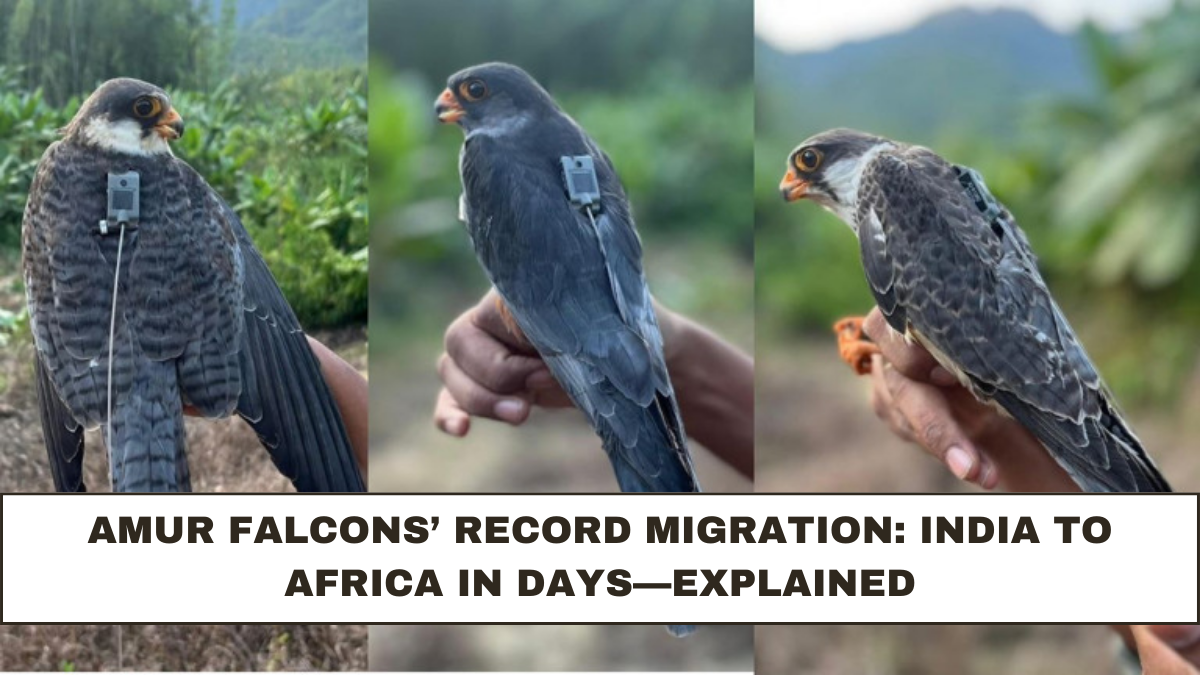
Every year, one of nature’s most astonishing feats unfolds as the Amur falcon migration India to Africa takes place. These small raptors, barely the size of a pigeon, cover thousands of kilometers during their annual journey, showcasing endurance, precision, and the marvel of avian navigation. This migration is not only a wildlife spectacle but also a critical conservation story, highlighting human intervention and ecological balance.
The Amur falcons breed in northeastern Asia, primarily in Mongolia and eastern China, before traveling through India to reach their wintering grounds in southern Africa. The journey spans continents, seas, and varied climates, often completed in just a few days, depending on weather and wind conditions.
The Extraordinary Journey of Amur Falcons
Amur falcons are known for their long-distance migration, covering roughly 22,000 kilometers annually. Key stages of the journey include:
• Breeding grounds: Mongolia, eastern Russia, and northeastern China
• Stopover in India: Predominantly Nagaland and Manipur, where they rest and feed
• Crossing the Indian Ocean: A nonstop flight of over 3,000 kilometers to Africa
• Wintering grounds: Southern Africa, including South Africa, Botswana, and Zimbabwe
Their ability to traverse such distances relies on favorable wind patterns, high-altitude flights, and stopover sites to refuel. India, particularly Nagaland, plays a crucial role as a safe resting point before the birds undertake the challenging ocean crossing.
Nagaland: The Safe Haven
Nagaland, a state in northeastern India, is internationally recognized for hosting millions of Amur falcons during their migration. Historically, these birds were threatened by hunting and habitat loss, but conservation initiatives have transformed the region into a protected corridor.
Key conservation measures include:
• Community awareness programs: Local villages actively participate in protecting the falcons.
• Hunting bans and enforcement: Strict regulations have reduced poaching drastically.
• Habitat preservation: Maintaining forest cover and roosting sites ensures safe rest and feeding areas.
The Nagaland stopover has become a global example of how community-driven conservation can support migratory species and safeguard biodiversity.
Tracking the Migration with Satellites
Modern technology has enhanced our understanding of the Amur falcon migration India to Africa. Satellite telemetry and GPS tracking help scientists monitor their routes, stopovers, and behavior patterns.
Benefits of satellite tracking include:
• Accurate mapping of long-distance routes
• Identification of critical stopover sites in India and beyond
• Monitoring environmental threats such as storms or habitat destruction
• Data collection for research on migration timing, speed, and survival rates
Satellite data confirm that these falcons can fly nonstop over large expanses of the Indian Ocean, sometimes covering more than 3,000 kilometers in a single flight.
Why the Migration Matters
The migration of Amur falcons is ecologically significant for several reasons:
-
Insect population control: The birds consume vast quantities of insects during stopovers, helping maintain ecological balance.
-
Biodiversity indicators: Migration patterns reflect the health of ecosystems along the route.
-
Conservation awareness: Highlighting these journeys educates the public about the importance of protecting migratory species.
-
Scientific research: Understanding migration supports global efforts in climate studies, habitat preservation, and species management.
By tracking and protecting the Amur falcons, India contributes to global conservation efforts and reinforces its role in international biodiversity initiatives.
Challenges Faced by Migratory Falcons
Despite progress, Amur falcons face several challenges:
• Climate change: Altered wind patterns and extreme weather can affect timing and survival.
• Habitat loss: Urbanization, deforestation, and agricultural expansion reduce safe stopover sites.
• Poaching risks: While reduced, illegal hunting still poses localized threats in some regions.
• Food scarcity: Pesticides and environmental changes may reduce insect prey availability during stopovers.
Conservationists continue to emphasize education, legal enforcement, and habitat restoration to mitigate these risks.
How India Supports Conservation
India’s role in the Amur falcon migration includes:
• Community-led protection initiatives in Nagaland and Manipur
• Legal frameworks banning hunting and penalizing poaching
• Research collaborations with international organizations for tracking and monitoring
• Awareness campaigns highlighting the ecological significance of the species
These efforts have transformed India into a crucial guardian of the Amur falcon migration route.
Observing the Migration Safely
For wildlife enthusiasts in India:
• The best observation period is between October and November in Nagaland.
• Use binoculars or zoom lenses to avoid disturbing the birds.
• Support local conservation initiatives through donations or volunteering.
• Document observations responsibly, sharing knowledge to raise awareness.
This careful approach ensures that human interaction does not disrupt the delicate migratory process.
Conclusion
The Amur falcon migration India to Africa is one of nature’s most impressive journeys, demonstrating endurance, precision, and ecological interdependence. With India, particularly Nagaland, serving as a vital stopover, these small raptors complete a migration of thousands of kilometers each year. Satellite tracking, conservation programs, and community participation have enhanced understanding and protection of this extraordinary wildlife story.
By observing, studying, and protecting Amur falcons, India not only preserves a unique ecological phenomenon but also contributes to global conservation efforts, inspiring future generations to value biodiversity and sustainable practices.
FAQs
What is the route of Amur falcons from India to Africa?
They breed in Mongolia and China, stopover in Nagaland and Manipur, and cross the Indian Ocean to winter in southern Africa.
Why is Nagaland important for Amur falcons?
It serves as a safe resting and feeding site, critical before the birds undertake long oceanic flights.
How do satellites help in tracking falcon migration?
Satellites provide real-time data on flight routes, stopover sites, speed, and environmental challenges.
What threats do Amur falcons face during migration?
Climate change, habitat loss, hunting, and food scarcity are major threats to their survival.
How can India contribute to conservation?
Through community-led protection, legal enforcement, habitat preservation, research, and awareness campaigns.