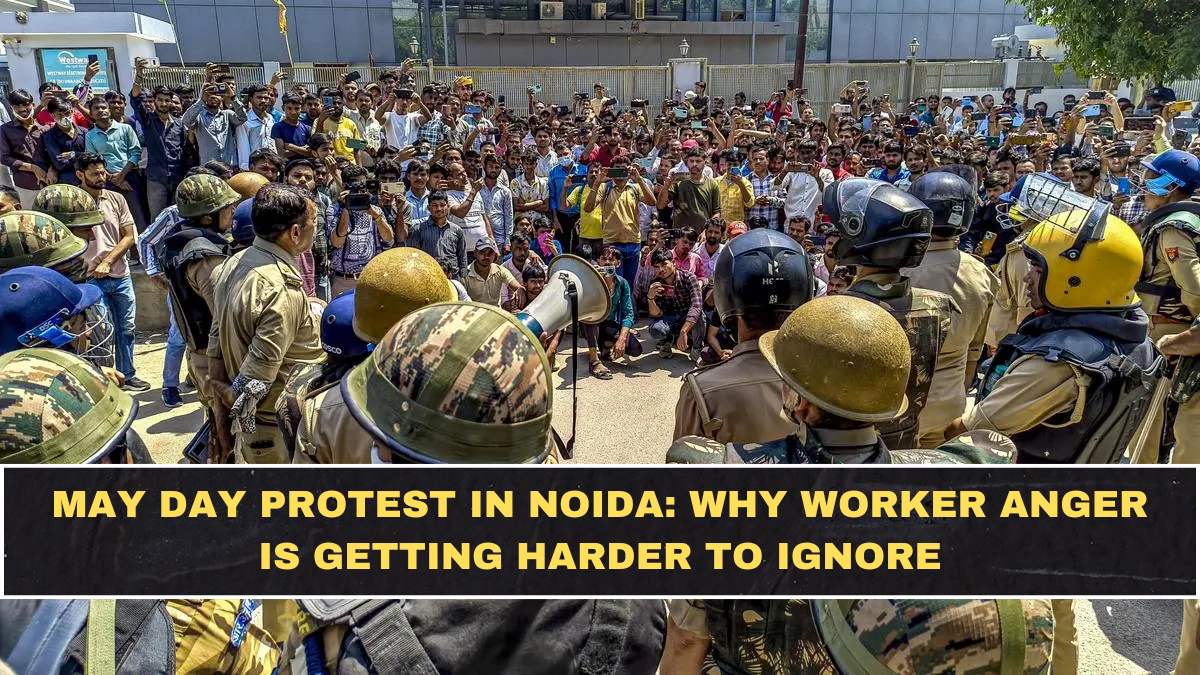
Noida is on high alert on Labour Day because authorities are trying to prevent a repeat of recent worker protests that turned violent. Security has been tightened across Gautam Buddh Nagar, with Section 163 imposed from April 30 to May 8 to restrict unlawful gatherings and processions without permission. Business Standard reported that the move came after widespread protests by workers over pay hikes and flexible working hours.
This is not just a routine police arrangement for May Day. Noida is one of India’s major industrial and manufacturing hubs, and worker anger there can quickly become a law-and-order issue. When thousands of factory workers feel ignored over wages and work conditions, the protest is not just noise. It is a warning that industrial peace is weaker than it looks.
What Happened Before The May Day Security Clampdown?
The security clampdown followed earlier workers’ protests in Noida that escalated into violence. India Today reported that a violent workers’ protest broke out on April 13 over the demand for a wage hike, after a three-day mostly peaceful labour-union strike. Workers blocked key roads, including routes affecting the Delhi-Noida border, causing major traffic disruption.
Reports also said police had to use force to disperse protesters after the situation worsened. That background explains why the administration did not treat Labour Day casually. It expected gatherings, slogans and possible tension around industrial areas, so it placed the district under tight surveillance before May 1.
| Key Issue | What Happened In Noida? | Why It Matters? |
|---|---|---|
| Main trigger | Workers demanded wage hike and flexible hours | Shows pressure over pay and working conditions |
| Earlier protest date | April 13, 2026 | Labour anger had already turned visible |
| Security order | Section 163 imposed till May 8 | Restricts unlawful gatherings and processions |
| Police deployment | Over 1,600 personnel and PAC companies | Shows administration expected serious tension |
| Surveillance | Drones and CCTV in sensitive areas | Industrial zones were closely monitored |
| Bigger concern | Worker anger in industrial Noida | Labour unrest can affect factories, traffic and politics |
How Tight Is The Security In Noida?
Security has been extremely tight. India Today reported that the Gautam Buddh Nagar Police Commissionerate divided the district into 11 zones and 49 sectors for law-and-order management. The deployment included more than 1,600 personnel, 10 companies of the Provincial Armed Constabulary, and surveillance through drones and CCTV cameras across more than 50 sensitive areas.
Times of India also reported the deployment of drones and PAC companies ahead of Labour Day. That level of preparation shows the administration was not merely expecting a symbolic protest. It was preparing for the possibility of large gatherings and fresh unrest in industrial belts.
What Are Workers Actually Demanding?
Workers have mainly been demanding better wages, improved working conditions and more reasonable working hours. Business Standard reported that the earlier protests were linked to demands for a pay hike and flexible working hours. These are not abstract ideological demands. They are daily-life issues affecting rent, food, transport, family expenses and exhaustion.
The uncomfortable truth is that many industrial workers live close to the edge financially. A small increase in rent, food prices or transport cost can destroy their monthly budget. If wages do not rise with living costs, anger is not surprising. The surprise is that employers and authorities often act shocked when that anger finally spills onto the streets.
Why Did The Administration Impose Section 163?
Section 163 was imposed to prevent unlawful gatherings, processions and possible public disorder. ABP Live reported that Section 163 restricts unlawful gatherings from April 30 to May 8, with thousands of police personnel, drones and CCTV surveillance deployed after earlier protests turned violent.
From a law-and-order perspective, the move is understandable. No administration wants road blockades, factory damage or clashes on Labour Day. But there is a blind spot here. Security can control crowds for a few days, but it cannot solve wage distress. If the underlying issues remain unresolved, the protest pressure will simply return in another form.
Why Is Noida’s Labour Anger Important Nationally?
Noida’s labour anger matters nationally because the city is not a small industrial pocket. It is part of the National Capital Region and hosts factories, electronics units, garment businesses, export-linked industries, warehouses and service-sector workplaces. Disruption here has economic, political and traffic consequences.
When workers in such a major hub protest, it exposes a bigger contradiction in India’s growth story. Companies want low-cost labour, fast production and flexible operations. Workers want wages that match inflation, safer conditions and some dignity in scheduling. If that gap keeps widening, industrial growth becomes unstable.
What Steps Has The Police Taken After The Protests?
The police have also created a new industrial cell after the earlier worker protests. Times of India reported that Gautam Buddh Nagar police formed a dedicated industrial cell and appointed an ad hoc DCP to handle industrial affairs after the protest over minimum wages. The goal is to manage industrial disputes more effectively and prevent law-and-order breakdowns.
This is a practical step, but it will only matter if the cell is used for real mediation, not just surveillance. If it becomes another control mechanism without solving grievances, workers will not trust it. The administration needs to hear complaints early, push employers into dialogue and prevent small disputes from turning into mass anger.
Are Welfare Measures Being Announced Too?
Yes, welfare measures were also planned around Labour Day. ThePrint reported that Noida authorities planned tight security along with mega health camps after the recent protests. Times of India also reported that authorities planned to hand over 15,000 small LPG cylinders in factories on Labour Day as a welfare measure for workers.
These steps may help some workers, but they should not be treated as substitutes for fair wages and workplace reform. A health camp or cylinder distribution is useful, but it does not answer the core question: are workers being paid enough and treated fairly enough to live with dignity? Welfare without wage justice is often just damage control.
Why Is Worker Anger Getting Harder To Ignore?
Worker anger is getting harder to ignore because inflation, long hours and job insecurity are squeezing people at the bottom of the industrial chain. If workers feel they have no voice inside factories, they take that anger outside. That is when streets, highways and police barricades become part of labour negotiations.
The government and employers should stop treating every labour protest as a security problem first. Yes, violence must be prevented. But the smarter move is to stop conditions from reaching the point where people feel protest is their only option. Ignoring workers until they block roads is not governance. It is delayed reaction.
Conclusion
The May Day security clampdown in Noida shows how tense the labour situation has become after recent worker protests over wages and working conditions. Section 163, drones, CCTV surveillance, PAC deployment and a large police presence may prevent disorder for now, but they do not erase the reasons workers are angry.
The blunt reality is that Noida’s industrial growth depends on workers who often feel underpaid, overworked and unheard. If employers and authorities want stability, they need more than police deployment. They need fair wage discussions, faster grievance redressal and real workplace accountability. Otherwise, Labour Day will keep returning as a warning, not a celebration.
FAQs
Why was security tightened in Noida on Labour Day?
Security was tightened because Noida had recently seen large worker protests that turned violent. Authorities imposed Section 163 from April 30 to May 8 and deployed police, PAC companies, drones and CCTV surveillance to prevent unlawful gatherings and maintain order.
What were Noida workers protesting about?
Workers were protesting over demands such as wage hikes and more flexible working hours. Business Standard reported that widespread protests last month were linked to pay and work-hour concerns. These demands reflect broader pressure from rising living costs and tough industrial working conditions.
How many police personnel were deployed in Noida?
India Today reported that more than 1,600 personnel were deployed, including senior officers, inspectors, sub-inspectors, constables and 10 PAC companies. The district was divided into 11 zones and 49 sectors, with drones and CCTV monitoring sensitive areas.
What is the bigger message from the Noida May Day protest?
The bigger message is that worker anger is no longer easy to dismiss. Industrial growth cannot depend only on cheap labour and strict policing. If wages, working hours and grievance systems do not improve, protests will keep returning, especially in high-pressure industrial hubs like Noida.