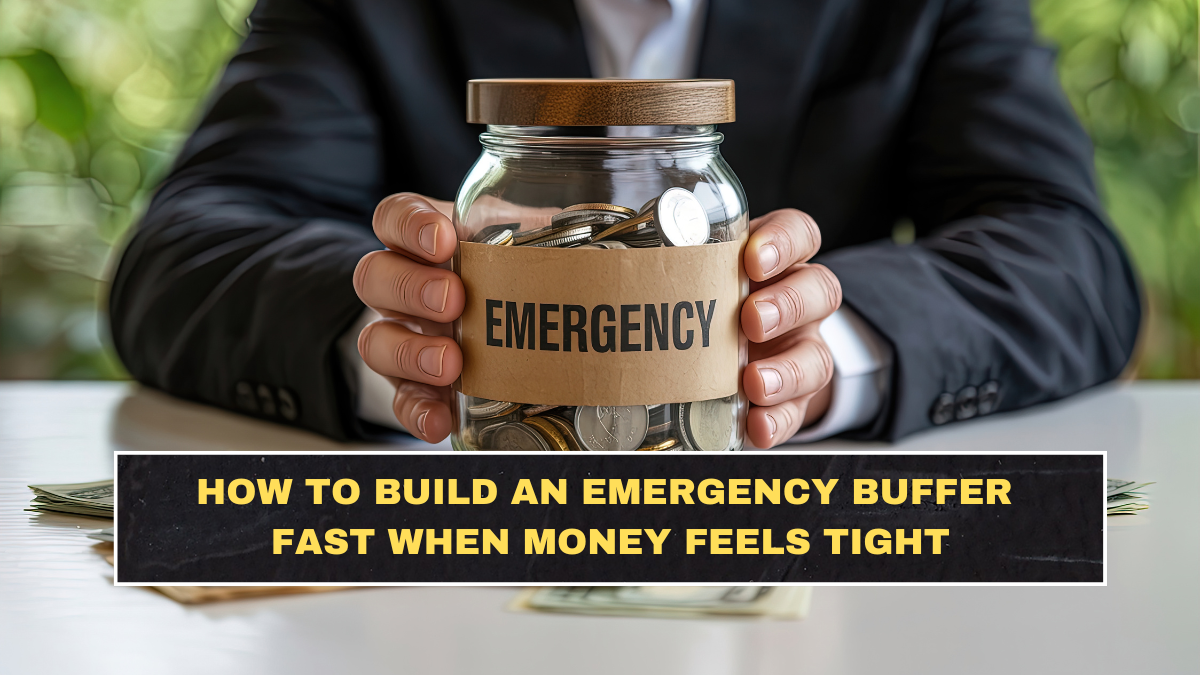
Building an emergency buffer feels hard because money is tight for a lot of people, not because they are lazy. That distinction matters. Bankrate’s 2025 emergency-savings reporting found that nearly a quarter of Americans had no emergency savings at all, while the Federal Reserve said in its 2025 report on 2024 household finances that only 55% of adults had set aside three months of expenses in a rainy-day fund. That is not a niche problem. It is a mainstream financial weakness, which is exactly why emergency-buffer content keeps performing so well.
The bad advice is still everywhere: “just save more.” That is useless. When money feels tight, speed comes from simplifying the target, automating the habit, and finding a few high-impact cuts or income patches that move cash into a separate buffer fast. NerdWallet’s 2026 savings guidance and Bankrate’s emergency-fund advice both push the same practical logic: start with something manageable, automate it, and treat the money as dedicated emergency savings, not general checking-account overflow.
Why does an emergency buffer matter so much right now?
Because financial shocks do not wait for your budget to feel comfortable. The Federal Reserve reported that 63% of adults in 2024 said they would cover a hypothetical $400 emergency expense using cash or its equivalent, which also means a large minority still could not. Meanwhile, Bankrate’s reporting keeps showing that many people feel uneasy about their savings levels, especially under inflation pressure. That creates a simple reality: if your buffer is zero, even a small emergency can push you into debt fast.
That is why the first goal should not be some perfect six-month fund if you are currently struggling to keep up. The first goal is friction reduction. You want enough cash set aside that every random problem does not immediately become a credit-card problem. Bankrate’s 2026 emergency-fund guide explicitly frames emergency savings as a cushion for sudden bills, income drops, and repairs, which is the right starting point.
What is the fastest realistic way to start?
Start smaller than your ego wants. That is usually the right answer. A starter target like $250, $500, or one mini-month of bare-bones expenses is more useful than fantasizing about a giant target you never begin. NerdWallet’s 2026 finance coverage says even small automated amounts matter and recommends getting a system in place so you do not have to think too much about money. Bankrate’s emergency-fund advice says the same thing in simpler terms: determine a minimum need and begin with a savings sprint.
That is where speed really comes from. Not motivation. Structure. If money feels tight, the faster plan is usually: pick a small target, open or designate the savings account, automate transfers, and temporarily squeeze a few spending lines harder than usual until the starter buffer exists. After that, you can shift from urgent to steady.
Which moves build an emergency buffer the fastest?
| Move | Why it helps fast | Best use |
|---|---|---|
| Set a starter goal | Makes the target less overwhelming | First 30–45 days |
| Automate a fixed transfer | Removes decision fatigue | Weekly or every payday |
| Do a short savings sprint | Creates early momentum | 2–6 weeks of tighter spending |
| Redirect windfalls | Builds buffer without cutting essentials | Tax refund, bonus, gift money |
| Park money in a separate savings account | Reduces spending temptation | High-yield savings if possible |
| Cut one or two major leaks, not ten tiny ones | Bigger gains, less burnout | Food delivery, subscriptions, impulse spending |
This is the part most people keep getting wrong. They try to save through vague intention and tiny scattered cuts instead of choosing a few moves with actual impact. NerdWallet’s 2026 “How to Save Money” guidance recommends budgeting, automation, and putting money in a savings system that runs without constant mental effort. Bankrate also recommends a separate account and a clear target.
How small should the first emergency-buffer goal be?
Small enough that you will not quit. That is the real rule. A starter emergency buffer is not meant to solve unemployment. It is meant to absorb the first few punches. Bankrate says an emergency fund can help cover unplanned expenses like car repairs, medical bills, or a drop in income. That means your first goal can be modest if modest is what gets built. A $500 buffer is weak compared with three months of expenses, but it is dramatically better than zero.
NerdWallet’s emergency-fund tools still point people toward three to six months of expenses as the longer-term target, which is sensible. But that bigger goal should not become an excuse to delay the first step. Build the starter buffer first, then expand it. That sequence is smarter than trying to leap to the final number in one mentally crushing jump.
Where should the emergency buffer be kept?
Somewhere separate, accessible, and boring. Bankrate recommends a bank account specifically set aside for emergency money, and NerdWallet’s current savings-account coverage shows that online high-yield savings accounts can still pay meaningfully more than typical brick-and-mortar savings rates. That matters because separation reduces the temptation to casually spend the money, while a decent yield lets the buffer earn something while it sits there.
The buffer should not live in your everyday spending account unless you have absolutely no better system. If it lives next to groceries, subscriptions, and weekend spending, it will keep getting mentally downgraded from “emergency money” to “available money.” That is how buffers disappear before the real emergency even arrives.
What if your income is already stretched?
Then stop pretending you need a perfect budget overhaul before you can save. Look for short-term cash redirection first. Bankrate’s “save money on a tight budget” guidance emphasizes strategic small changes and says inflation remains a major barrier, which is realistic. That means the fastest buffer-building methods are usually ugly but effective: pause nonessential subscriptions, cut delivery spending, sell unused items, redirect side-income bursts, and move any small unexpected inflows straight into savings before you “make room” for them somewhere else.
You also need to stop demanding elegance from the process. If the emergency buffer gets built through temporary frugality, a few sales, and one disciplined transfer after each paycheck, good. That still counts. People sabotage themselves by waiting for a cleaner plan than their life actually allows.
What is the fastest mindset shift that helps?
Stop treating the emergency buffer as an abstract virtue and start treating it as insulation. That makes the goal much more concrete. The Federal Reserve’s household data and Bankrate’s repeated savings reporting both show that financial resilience is not evenly distributed, which means even a modest buffer changes your risk profile in a real way. It is not about feeling financially perfect. It is about reducing how easily one bad week can destabilize the next month.
That mindset matters because urgency without clarity burns people out. If you know the buffer’s job is to prevent debt, panic, and disruption from smaller emergencies, then the early target starts to make more sense. You are not “failing” because you only have $300 saved. You are building the first layer of protection.
What is the smartest emergency-buffer plan when money feels tight?
Pick a starter number, automate something weekly, keep the money separate, and create one short-term savings sprint. Then add windfalls and any temporary extra income directly into the fund until the first target is done. After that, raise the target slowly toward one month, then toward the bigger three-to-six-month range. That approach matches the practical guidance from Bankrate and NerdWallet far better than the usual fantasy advice people get online.
Conclusion
Building an emergency buffer fast when money feels tight is not about suddenly becoming financially flawless. It is about building the first layer of protection quickly enough that small emergencies stop wrecking everything else. Bankrate’s recent reporting and the Federal Reserve’s household data both make clear that many people are still underprepared, which is exactly why the smartest path is also the simplest: start with a smaller goal, automate it, separate the money, and hit a few high-impact cuts or cash boosts until the buffer exists.
FAQs
How much emergency savings should I build first?
A smaller starter target like $250 or $500 can make sense if you are starting from zero. Longer term, many experts still point toward three to six months of expenses.
What is the fastest way to build an emergency buffer?
The fastest practical approach is to automate savings, set a small starter goal, redirect any windfalls, and temporarily cut a few high-impact expenses.
Should emergency savings stay in checking?
Usually no. A separate savings account reduces the temptation to spend it and can help it earn more, especially if the account has a higher yield.
Why does an emergency buffer matter if my income is already tight?
Because without it, even a small surprise expense can force you into debt or financial disruption. Federal Reserve and Bankrate data both show many households remain financially vulnerable.