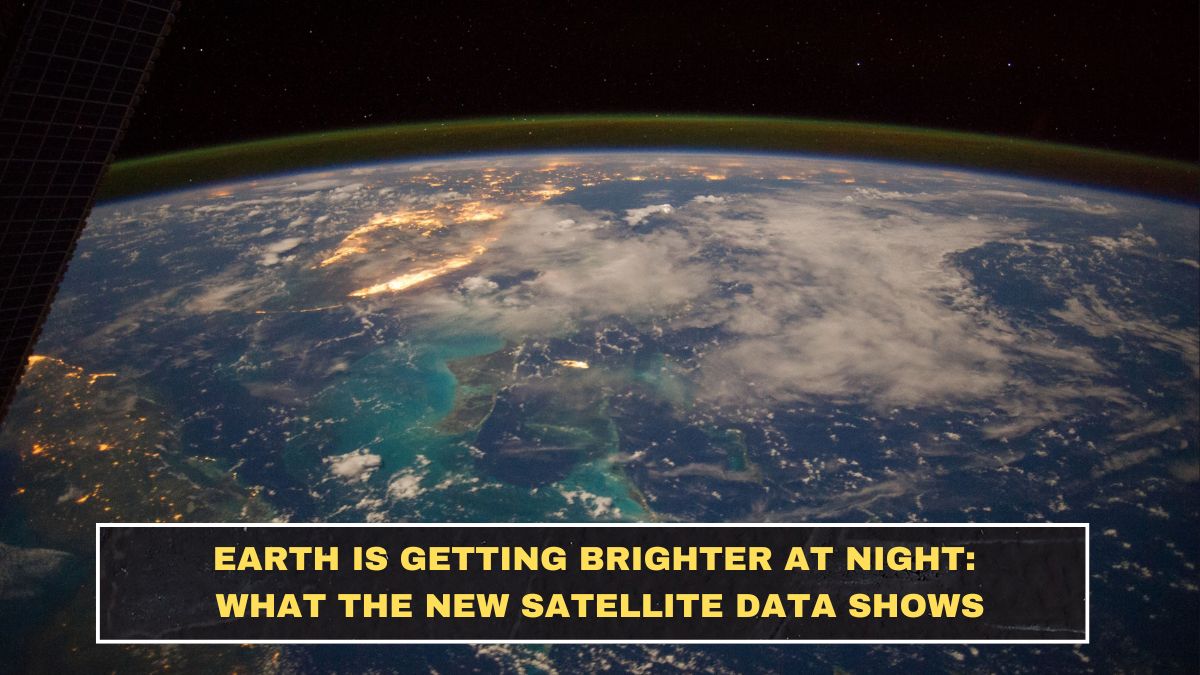
Earth is still getting brighter at night, and the new data shows the story is bigger than a simple year-by-year glow-up. A new Nature study using daily satellite imagery from 2014 to 2022 found that global nighttime light brightening added radiance equal to 34% of the 2014 baseline, while dimming offset 18%, leaving a net increase of about 16%. Reuters, summarizing the study, reported that the planet’s nightscape is not just steadily brightening. It is becoming more volatile, with rapid gains and losses happening side by side across regions.
That matters because older global light-pollution discussions often relied on annual or monthly composite images that smoothed out change. This new study used more than a million daily images from NASA-processed satellite data and found that each location experiencing change went through an average of 6.6 distinct shifts over the nine-year period. In other words, the world at night is not just brighter. It is more unstable.
What is driving the nighttime brightening?
The biggest drivers are urbanization, infrastructure growth, and rural electrification. Reuters reported that the strongest brightening showed up in emerging economies, especially in sub-Saharan Africa and Southeast Asia, where places are moving from limited electricity access into the global electric network much faster than before. The Nature paper supports that broader pattern by describing both abrupt and gradual brightening across inhabited landmasses.
This is the part people often oversimplify. Not all brightening is wasteful excess. Some of it reflects real development, grid expansion, roads, businesses, and homes gaining reliable power. But that does not make the environmental consequences disappear. More light still means more artificial light at night, and that has costs.
Which regions are changing fastest?
Reuters said the most dramatic brightening occurred in sub-Saharan Africa and Southeast Asia, led by Somalia, Burundi, and Cambodia, followed by countries including Ghana, Guinea, and Rwanda. By contrast, Europe recorded a net 4% decrease in nighttime light radiance over the study period, and the United States posted a 6% net increase with strong regional variation inside the country. Reuters also reported that the brightest countries in absolute terms in 2022 were the United States, China, India, Canada, and Brazil.
The regional pattern is not just “rich countries bright, poor countries dim.” It is messier than that. Europe dimmed partly because of deliberate policy, efficiency rules, and dark-sky efforts, while parts of the United States brightened and other parts dimmed. That is exactly why the study’s volatility finding matters so much.
Why are some places getting dimmer instead?
| Pattern | What is causing it? |
|---|---|
| Gradual dimming | Energy-efficiency policies, directional LEDs, and dark-sky conservation efforts in places such as Europe. |
| Abrupt dimming | Armed conflict, economic collapse, disasters, and grid failure in places such as Ukraine, Lebanon, Yemen, Afghanistan, Haiti, and Venezuela. |
| Mixed change | Countries like the United States show both brightening and dimming depending on local growth and lighting policy. |
This is where lazy reporting usually fails. Dimming is not always good news. In Europe, it can reflect smarter policy. In war zones or collapsing economies, it can reflect destruction, blackouts, and infrastructure failure. Treating all dimming as environmental progress would be dishonest.
Why does a brighter Earth at night matter?
It matters because artificial light at night affects more than astronomy. Reuters, citing the researchers, noted that light pollution disrupts nocturnal ecosystems, animal migrations, and human circadian rhythms. The Nature paper also frames changing nighttime light as a signal of urban evolution, energy transitions, policy effects, and ecological consequences.
So this is not just a pretty satellite-image story. Nighttime brightness reveals where economies are expanding, where conflict is destroying infrastructure, where governments are forcing energy efficiency, and where ecosystems are losing darkness. That makes it an environmental story, a development story, and a geopolitical story at the same time.
What does the new satellite data really change?
The big shift is precision. The study used NASA’s daily Black Marble night-time light product and a continuous change-detection method at roughly 500-meter resolution across most inhabited landmasses between 70°N and 60°S. That gives researchers a much finer view of how nighttime lighting expands, contracts, and jumps during both long-term development and sudden crisis.
That means the old idea that Earth is just getting steadily brighter every year is no longer good enough. The better description now is that Earth’s nights are becoming brighter overall, but in a patchy, highly dynamic way shaped by policy, electrification, war, and economic change.
Conclusion
The new 2026 satellite analysis shows that Earth is getting brighter at night overall, with a net 16% increase from 2014 to 2022, but the more important finding is volatility. Some places are brightening rapidly because of development and electrification. Others are dimming because of smarter lighting policy, while some are going dark because of conflict or collapse.
The blunt truth is this: nighttime brightness is no longer just about light pollution in the narrow sense. It is now a live map of how humanity is building, consuming, regulating, and sometimes breaking the world after dark.
FAQs
Is Earth really getting brighter at night?
Yes. Reuters reported, based on a new Nature study, that global nighttime light showed a net increase of about 16% from 2014 to 2022.
Which regions are brightening the fastest?
The strongest brightening was reported in sub-Saharan Africa and Southeast Asia, with Somalia, Burundi, and Cambodia among the leading cases.
Why is Europe getting dimmer?
Europe’s net decrease was linked to energy-efficiency mandates, directional LED adoption, and dark-sky conservation efforts, with France highlighted as a major example.
Why does nighttime brightness matter?
Because artificial light at night affects ecosystems, animal movement, human sleep and circadian rhythms, and also reveals changes in development, energy access, and conflict.