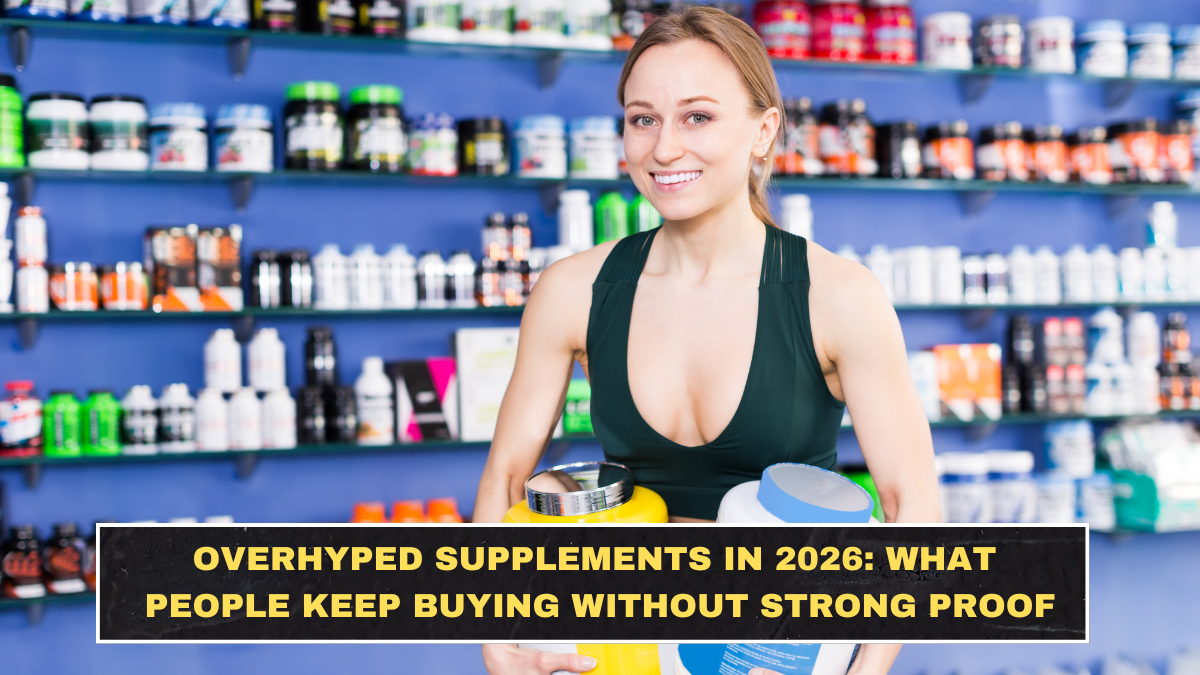
The supplement market loves one trick more than any other: sell hope first, then let evidence catch up later. That is exactly why so many longevity supplements look impressive in ads but weak in real human data. NIH’s Office of Dietary Supplements says supplements are widely used, but there is still a lot to understand about their health impacts, and NCCIH says the amount of scientific evidence varies widely from one supplement to another.
That matters because people keep buying anti-aging products as if “popular” means “proven.” It does not. In many cases, the evidence is early, mixed, based on animals, or too limited to justify the confidence of the marketing. Worse, the National Institute on Aging notes that dietary supplements do not need FDA approval for safety or effectiveness before being sold, which means flashy claims can reach consumers long before the science is settled.
Which supplements look the most overhyped in 2026?
The most overhyped group right now includes NMN and other NAD+ boosters, resveratrol, broad antioxidant stacks, and many “longevity blends” that combine trendy ingredients into one premium bottle. These products are popular because they sound scientific, but the real question is whether they produce meaningful long-term health outcomes in humans. That is where the story gets weaker.
NMN is the clearest example. It is heavily marketed for energy, cellular repair, and aging support, but the latest reporting on a new meta-analysis still describes the human evidence as small, short-term, and clinically modest. Even when measurable effects appear, experts cited in recent coverage warned that the trials are limited and do not show major real-world outcomes like fewer heart attacks, less disability, or longer life.
Resveratrol has a similar problem. It built its reputation on exciting mechanisms and animal data, but expert reviews cited in recent reporting still say human results remain disappointing and far weaker than the hype suggests. That is not nothing, but it is a long way from the miracle-aging narrative people keep buying.
Why are antioxidant supplements still oversold?
Because “fights aging” is easy marketing. Antioxidants sound clean, protective, and scientific, so people assume more must be better. But NCCIH’s guidance is much more restrained. It notes that antioxidant supplements have shown targeted value in some specific medical contexts, such as certain eye-disease formulations, but that does not mean high-dose antioxidant pills broadly improve aging outcomes for everyone.
The bigger problem is that the broad promise often outruns the evidence. A major systematic review found antioxidant supplements may even increase mortality in some contexts, which is the opposite of what longevity marketing implies. That does not mean all antioxidant use is bad. It means people should stop assuming that a capsule full of antioxidant ingredients equals better aging.
| Supplement category | Why people buy it | What the evidence problem is |
|---|---|---|
| NMN / NAD+ boosters | Energy, anti-aging, cellular repair claims | Human trials are still small and short-term |
| Resveratrol | “Longevity molecule” reputation | Human evidence remains weak compared with hype |
| Antioxidant mega-stacks | General anti-aging and protection claims | Benefits are limited or mixed outside specific uses |
| Proprietary longevity blends | Convenience and premium branding | Often combine underproven ingredients with vague claims |
Are multivitamins overhyped too?
Sometimes yes, but not in the same way. Multivitamins are often oversold as anti-aging shortcuts, yet the evidence is more nuanced. Recent coverage of COSMOS-related findings suggests multivitamins may have modest effects on biological aging markers in some older adults, but that is still not the same as proving longer life or major disease prevention.
So the honest view is this: multivitamins are not miracle longevity products, but they are also not in the same category as the most aggressively hyped anti-aging supplements. NCCIH notes that some people with dietary gaps or specific needs may benefit from vitamin and mineral supplementation. That is a much narrower and more defensible claim than “this will slow aging.”
Why do people keep buying weak-evidence supplements?
Because the marketing is smarter than the evidence. Consumers want control over aging, and supplements offer a simple, purchasable story: take this pill, protect your future. That is emotionally appealing, especially when the real evidence-based path involves boring things like exercise, sleep, blood-pressure control, strength training, and diet quality. Those work better, but they do not sell as well.
There is also a credibility illusion. Brands use scientific language, mechanisms, lab pathways, and expert-looking branding to make weak evidence feel stronger than it is. CFA-style skepticism belongs here too: a plausible mechanism is not the same as a proven outcome. A supplement can affect a biomarker and still fail to improve actual long-term health.
What should buyers do instead?
Stop asking which supplement sounds the most futuristic and ask a harder question: what human evidence shows a meaningful outcome? NCCIH says consumers should keep in mind that scientific evidence differs widely across supplements, and the National Institute on Aging reminds older adults to discuss supplements with clinicians because safety, interactions, and duplication all matter.
That means buying less impulsively and being more specific. If a supplement addresses a documented deficiency or a clearly defined medical use, that is one thing. Buying expensive “longevity” stacks because the label mentions mitochondria, inflammation, or cellular youth is usually a weaker bet.
Conclusion?
Overhyped supplements in 2026 are still being sold on the same formula: exciting biology, weak human proof, and a consumer base that wants an easier answer than lifestyle change. NMN, resveratrol, antioxidant mega-stacks, and generic longevity blends all fit that pattern to varying degrees. Some may prove more useful later. Right now, though, a lot of people are paying premium prices for possibility dressed up as certainty.
FAQs
Are longevity supplements regulated like medicines?
No. The National Institute on Aging says dietary supplements do not require FDA approval for safety or effectiveness before being sold.
Is NMN proven to slow aging in humans?
No. The recent evidence is still limited, with small and short-term trials rather than strong proof of major health or lifespan benefits.
Are antioxidant supplements always helpful?
No. NCCIH says they have some specific uses, but broad anti-aging benefits are not well established, and a major review found possible harm in some contexts.
Should people avoid all supplements?
No. Some supplements can help with deficiencies or specific medical needs. The problem is not supplements as a category. The problem is buying exaggerated longevity claims without strong proof.