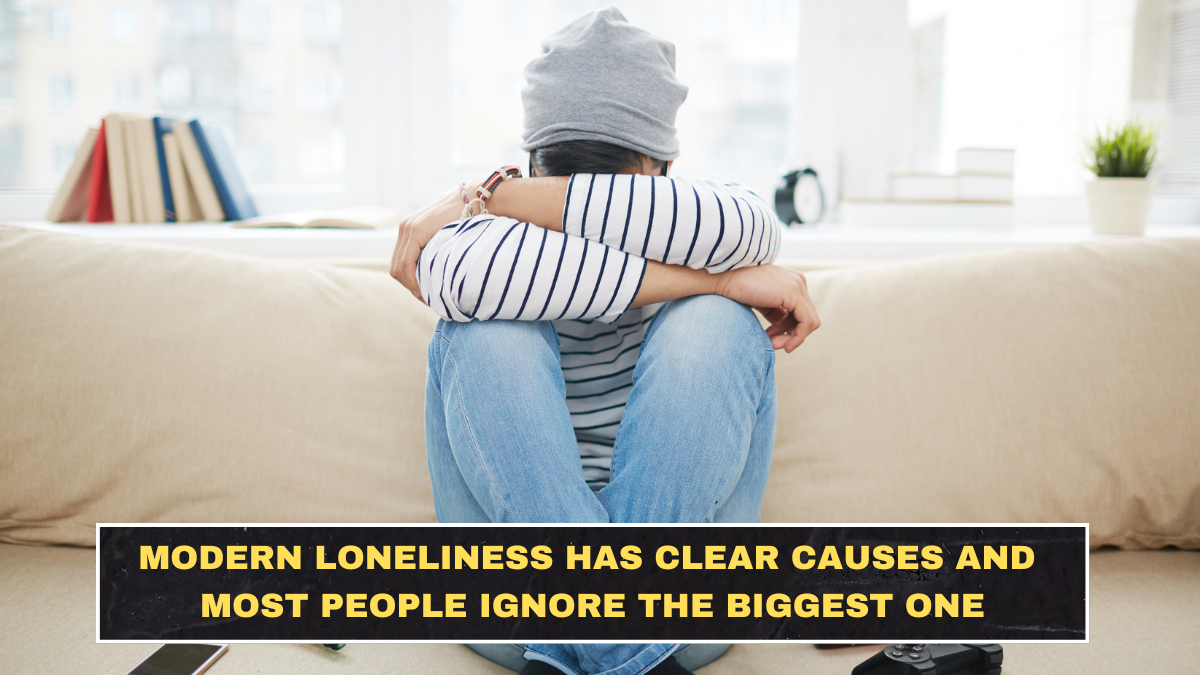
Modern loneliness is not just about being physically alone. That is the first thing people get wrong. Plenty of people are surrounded by coworkers, family, messages, and notifications and still feel disconnected. The World Health Organization’s 2025 global report says around 1 in 6 people worldwide experience loneliness, and it links loneliness and social isolation to serious effects on health, well-being, and longevity. In the U.S., APA’s 2025 Stress in America report found that 54% of adults said they had felt isolated from others, while 50% said they had felt left out or lacked companionship.
That tells you something important. The problem is not simply that people do not have enough contact. The bigger problem is that much of modern contact is thin, distracted, inconsistent, or emotionally weak. People keep blaming loneliness on one thing like phones, remote work, dating apps, or moving to a new city. Real life is messier. Modern loneliness usually grows when people lose depth, routine, and dependable support at the same time.

Why is modern loneliness still so widespread?
Because connection is easier to simulate than to build. WHO says loneliness affects people across all age groups, but it is most common among adolescents and younger adults, showing that being digitally connected all the time has not solved the problem. Pew’s 2025 social-connections survey also found that 16% of Americans say they feel lonely or isolated all or most of the time, while 38% say they sometimes feel that way. So this is not some fringe issue affecting a tiny group. It is broad, recurring, and still badly understood.
A second reason is that adult life is now built around fragmentation. People switch jobs, move cities, work odd schedules, and maintain friendships through messages instead of shared routines. That makes relationships easier to keep nominally alive but harder to deepen. Gallup has also found that fully remote employees report higher loneliness than on-site workers, with hybrid workers in between, suggesting that flexible work can help some people while quietly weakening everyday social contact for others.
What is the biggest cause most people ignore?
The biggest cause many people ignore is the loss of reliable, repeated, low-pressure connection. People obsess over dramatic causes, but loneliness often grows through the disappearance of ordinary human structure. Regular lunches, commute conversations, neighborhood familiarity, recurring meetups, and spontaneous check-ins used to give many people social glue without requiring effortful planning. Modern life strips away a lot of that and replaces it with scheduling, scrolling, and shallow updates. That is a worse bargain than people admit.
Pew’s 2025 data helps explain this. Men and women do not differ much in how often they report loneliness, but men are less likely to turn to friends for emotional support or social connection. That matters because loneliness is not only about whether people are around you. It is also about whether you actually use relationships for support, openness, and comfort. A network you never lean on is weaker than it looks from the outside.
How does digital life make loneliness worse?
Digital life is not automatically the villain, but it often turns connection into performance. People stay visible to each other without staying meaningfully involved in each other’s lives. That creates a fake sense of social participation. You can know what twenty people posted and still not have one person you can call honestly when life goes bad. APA’s 2025 report on connection found broad emotional disconnection across adults, and that fits the pattern: constant contact is not the same as felt closeness.
Digital life also increases comparison. When other people’s lives look active, attractive, and socially full, ordinary quiet life can start to feel like exclusion. That does not mean social platforms create loneliness alone, but they amplify insecurity when real-world support is already weak. For teens, Pew’s 2025 work on social media and mental health shows that online environments remain deeply tied to how young people think about mental well-being, which reinforces the broader point that digital life shapes emotional reality, not just entertainment habits.
| Modern loneliness driver | How it shows up | Why it matters |
|---|---|---|
| Loss of routine connection | Fewer repeated in-person interactions | Weakens belonging without people noticing |
| Remote or fragmented work | Less casual social contact | Raises isolation risk for some workers |
| Digital-only contact | Constant updates but low depth | Creates a false sense of closeness |
| Weak support habits | People do not ask for help or open up | Networks exist but go emotionally unused |
| Comparison and overstimulation | Feeling left out despite being “connected” | Increases emotional disconnection |
Why are younger adults often hit harder?
WHO says loneliness is most common among adolescents and younger adults, and Gallup reported in 2025 that 25% of U.S. men ages 15 to 34 said they felt lonely a lot of the previous day, above the national average of 18%. Younger adults often have unstable work, delayed partnership patterns, more online life, and less settled community structure. They may know more people loosely but trust fewer deeply. That is a bad setup for real belonging.
This also explains why loneliness can exist alongside social activity. Someone can be dating, posting, going out, and still feel unseen because the relationships around them are thin, inconsistent, or emotionally guarded. Quantity of interaction is not the cure. Quality and repeatability matter more.
What actually helps with modern loneliness?
What helps is more ordinary than people want. Repeated in-person contact, dependable routines, better friendship habits, and relationships where emotional honesty is actually used all matter. WHO’s 2025 report stresses practical action across communities and institutions, not just individual advice, because loneliness is partly structural. But at the personal level, the fix usually starts by replacing passive digital awareness with real recurring contact.
That means fewer vague “we should meet sometime” connections and more regular ones. It means asking for support instead of waiting to be noticed. It means treating friendship and community like maintenance, not leftovers after work and screens take everything. Most people ignore that because it is less exciting than blaming technology. But the boring truth is that loneliness often grows when life stops containing dependable human rhythm.
Conclusion?
Modern loneliness has clear causes, and the biggest one is not simply being alone. It is living in a world where connection is increasingly thin, irregular, and emotionally underused. WHO says 1 in 6 people globally experience loneliness, while APA and Pew show the problem remains widespread and persistent in everyday adult life. The mistake people keep making is focusing on visibility instead of depth. Modern life lets people stay in touch. It does much less to help them stay truly connected.
FAQs
Is loneliness the same as social isolation?
No. WHO treats them as related but distinct. Social isolation is about lacking social contact, while loneliness is the subjective feeling that your relationships are not enough or not meaningful enough.
Are younger people really more lonely now?
Yes. WHO says loneliness is most common among adolescents and younger adults, and Gallup found especially high loneliness among younger U.S. men in 2023–2024 data.
Does remote work increase loneliness?
For some people, yes. Gallup reported that fully remote employees were more likely to feel lonely than on-site workers, with hybrid workers in between.
What is the most ignored cause of modern loneliness?
The loss of repeated, low-pressure, dependable human connection is one of the most ignored causes. People often blame one technology or one app, but routine social structure appears to matter more than most admit.
Click here to know more