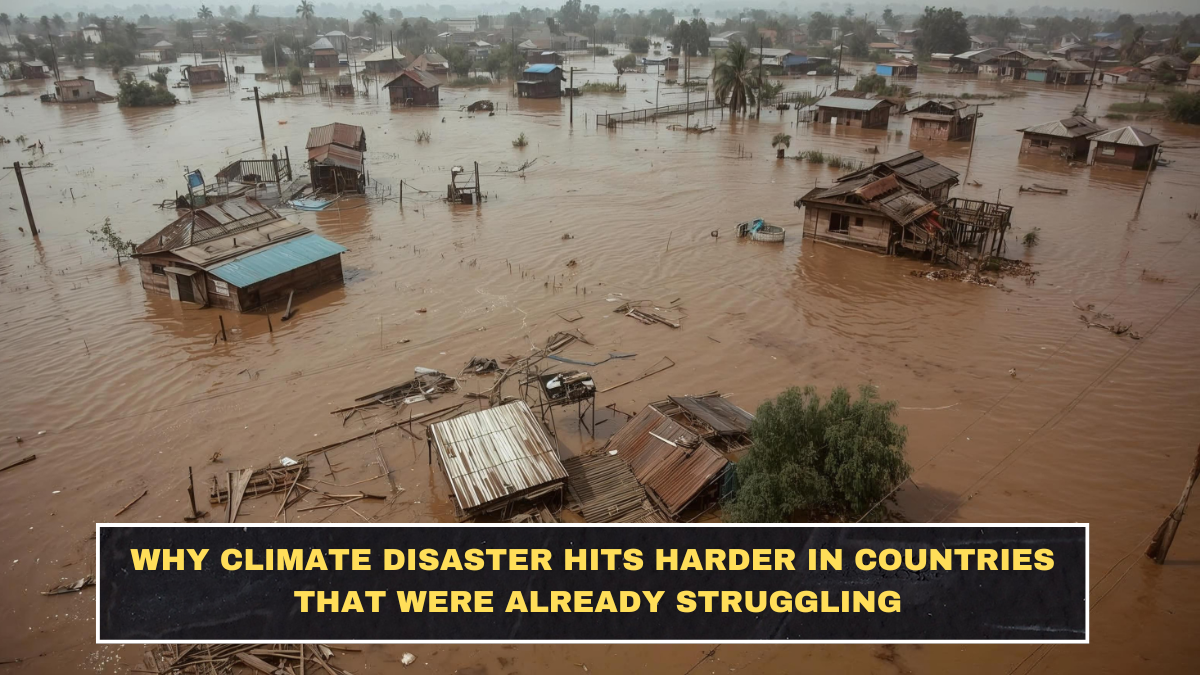
Climate disasters are dangerous everywhere, but they become far deadlier in countries that are already fragile. That is the real story. When a flood hits a place with weak roads, damaged health systems, political isolation, and shrinking aid, the weather event stops being just a weather event. It becomes a multiplier of hunger, displacement, disease, and state failure. Afghanistan is one of the clearest examples. Reuters reported in May 2024 that flash floods in northern Afghanistan killed 315 people, injured more than 1,600, damaged thousands of homes, and wiped out livestock.
Why fragile states suffer more
The basic reason is not complicated. Fragile states start from a weaker baseline. The World Bank said in a 2026 report that extreme weather events inflict more lasting economic damage in fragile and conflict-affected settings, causing an average cumulative GDP loss of about 4% after three years, compared with lower losses in other countries. That is a brutal number because it means the hit lasts long after the floodwaters or drought headlines disappear.
Afghanistan shows how the cycle works
Afghanistan is not just climate-exposed. It is climate-exposed while also dealing with conflict legacy, weak institutions, international isolation, and a collapsing aid environment. Reuters reported in 2023 that Afghanistan was already struggling with worsening drought and floods, and that around 20 million Afghans faced severe food insecurity. Reuters also reported that the Taliban takeover cut off the development aid that had formed the backbone of public finances, while the country also lost access to key climate-finance channels such as the Green Climate Fund.
That combination matters more than most lazy articles admit. If a country cannot fund irrigation, roads, emergency systems, or climate adaptation before a disaster, then the disaster will hit harder and recovery will take longer.
The humanitarian system is already overstretched
This is where the problem gets worse. The U.N. said in February 2026 that humanitarian agencies were seeking $2.9 billion to reach more than 20 million people in Afghanistan facing catastrophic needs. In March 2026, U.N. briefings described Afghanistan as one of the world’s largest humanitarian crises, with nearly 22 million people in need. That means climate shocks are landing in a country where millions were already dependent on aid before the next flood or drought even began.
Why disasters become deadlier in fragile states
| Factor | What the evidence shows | Why it makes disasters worse |
|---|---|---|
| Weak infrastructure | Reuters reported flood damage to roads, water systems, homes, and health facilities in Afghanistan. | Rescue, shelter, and recovery slow down immediately. |
| Aid shortfalls | Reuters said Afghanistan lost the development aid base that once supported government finances after 2021. | There is less money for prevention and less capacity for recovery. |
| Food insecurity | Reuters reported around 20 million Afghans faced severe food insecurity in 2023. | Households have less ability to absorb a shock. |
| Climate-finance exclusion | Reuters said Taliban-run Afghanistan could not access key U.N. climate funds, including the Green Climate Fund. | Adaptation projects get delayed or frozen. |
| Fragility effect | World Bank research says extreme weather causes around 4% cumulative GDP losses after three years in fragile settings. | The economic hit lasts longer and recovery is weaker. |
This is not only about Afghanistan
Afghanistan is the example here, but the pattern is broader. OCHA’s 2026 appeals show the same overlap in other fragile contexts: conflict, displacement, climate stress, and weak state capacity pile on top of each other rather than staying separate problems. The point is simple but uncomfortable: a flood in a stable state is a disaster response problem; a flood in a fragile state is often a systems-collapse problem.
What readers should understand clearly
A few hard truths matter:
- climate shocks do not hit all countries equally
- weak governance and damaged infrastructure raise death and displacement risks
- aid cuts and political isolation make adaptation harder before disasters happen
- recovery is slower because fragile states start poorer and less prepared
This is why the phrase “natural disaster” can be misleading. The rain may be natural. The scale of death often is not. That is shaped by politics, poverty, infrastructure failure, and whether the country was already breaking before the storm arrived.
Conclusion
Climate disaster hits harder in countries that were already struggling because fragility turns hazard into catastrophe. Afghanistan shows the pattern clearly: deadly floods, severe food insecurity, damaged infrastructure, reduced aid, and blocked access to climate finance all feed into the same cycle. The serious takeaway is not that fragile states are unlucky. It is that climate shocks become deadlier when they collide with weak systems, political isolation, and chronic humanitarian stress.
FAQs
Why do climate disasters hit fragile states harder?
Because fragile states usually have weaker infrastructure, lower emergency capacity, more poverty, and less fiscal room to recover after a shock.
What happened in Afghanistan’s major floods?
Reuters reported that flash floods in northern Afghanistan in May 2024 killed 315 people and injured more than 1,600, while damaging homes, livestock, and infrastructure.
Why is Afghanistan especially vulnerable?
Because it faces repeated drought and floods while also dealing with food insecurity, aid shortfalls, and limited access to climate finance after the Taliban takeover.
What does the World Bank say about fragile states and extreme weather?
The World Bank said extreme weather causes about 4% cumulative GDP losses after three years in fragile and conflict-affected settings.
Is this mainly a climate problem or a governance problem?
It is both. The hazard may be climate-driven, but weak institutions, poor infrastructure, and underfunded response systems make the human damage much worse.
Click here to know more