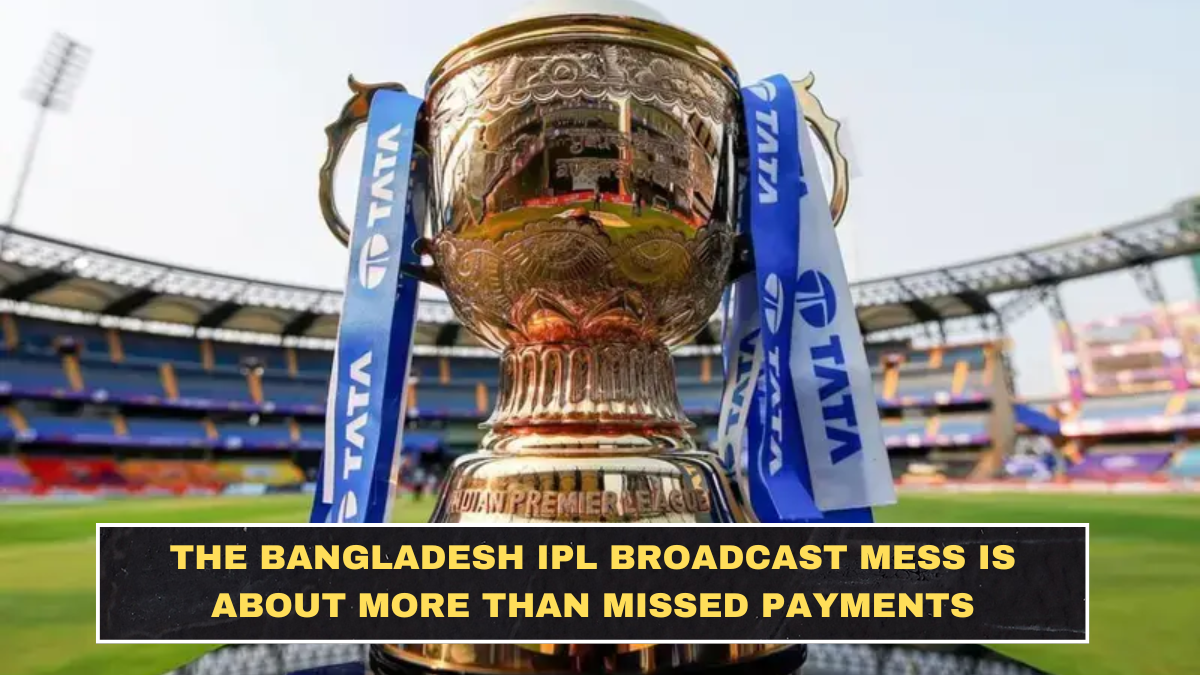
Bangladesh’s IPL broadcast problem is now bigger than a normal rights dispute. Reuters reported that JioStar, the Reliance-Disney joint venture that controls IPL media rights, terminated its Bangladesh broadcast agreements for both the IPL and the Women’s Premier League after repeated payment defaults by local partner TSports. The letter cited by Reuters was dated February 17, but the fallout is hitting now, leaving Bangladesh without a local broadcaster for IPL 2026.
The lazy version of this story is “they missed payments, deal over.” That is incomplete. The dispute now sits at the intersection of contract enforcement, cross-border media dependence, and Bangladesh’s own confusion over whether IPL telecasts should be allowed at all. Reuters said Bangladesh had been reviewing its earlier stance and was waiting for the sports ministry’s view, but the JioStar termination means that even a policy softening would not automatically restore telecasts.
What actually went wrong
The cleanest confirmed point is financial. Reuters reported that JioStar told TSports the agreement stood terminated with immediate effect because of “continued failure and default in adhering to the payment timelines stipulated under the agreement.” TSports had sublicensed the Bangladesh rights for the 2023–2027 cycle. Reuters also said the same kind of termination was issued for the WPL arrangement.
That matters because sublicensing works only when the upstream rights holder trusts the local partner to pay on time and operate reliably. Once that trust breaks, the rights holder has little reason to keep a politically sensitive market on credit. This is not about fan disappointment first. It is about risk control. That last sentence is an inference from the termination basis Reuters reported.
Why this matters beyond one missed contract payment
The Bangladesh IPL mess now has three layers, not one:
- Commercial: JioStar says the local partner defaulted on payments.
- Regulatory/political: Reuters said Bangladesh had earlier banned IPL broadcasts in January and was still reassessing the issue.
- Viewer impact: With no active local broadcaster, Bangladeshi fans are left without official IPL coverage for now.
That is why this story matters for cricket media politics. A rights market becomes unstable very quickly when business payments, national politics, and fan demand all start pulling in different directions at once.
The key facts in simple terms
| Issue | Verified detail | Why it matters |
|---|---|---|
| Rights holder | JioStar | Controls the IPL feed and sublicensing chain in this case. |
| Local partner | TSports | Was the Bangladesh broadcast partner for IPL seasons 2023–2027. |
| Reason for termination | Repeated payment defaults | This is the direct cause cited in JioStar’s letter. |
| Tournaments affected | IPL and WPL | The disruption is broader than one league. |
| Current result | No local broadcaster for IPL 2026 in Bangladesh | Fans lose official access even if policy softens. |
Why cricket media companies care
This case sends a message to every downstream broadcaster in the region. If a major rights owner feels a market is financially unreliable or politically unstable, it can pull out rather than keep negotiating from weakness. That makes future sublicensing deals harder, more expensive, or more tightly controlled. This is the part most people miss when they reduce the story to “Bangladesh can’t watch IPL.” The real issue is that media-rights trust has been damaged. That is an inference based on the reported termination and the absence of a replacement broadcaster.
It also matters because cricket rights are no longer simple local-TV arrangements. They sit inside larger regional strategies involving streaming, ad sales, premium sports inventory, and political sensitivity. If a market becomes messy, the rights holder may decide it is not worth improvising mid-season.
What happens next
Right now, the practical problem is obvious: there is no official Bangladesh broadcaster for IPL 2026. Reuters said neither JioStar, TSports, nor Bangladesh officials commented further when asked. That means there is no confirmed quick fix on record yet. So unless a new arrangement is reached, the gap remains.
Conclusion
The Bangladesh IPL broadcast mess is about more than missed payments because the termination exposed a deeper fragility in cross-border cricket media. JioStar’s move was triggered by payment defaults, but the bigger damage is to confidence. Once rights disputes collide with political hesitation and no backup broadcaster exists, a fan-access issue becomes a media-power issue. That is why this story matters beyond one season.
FAQs
Why did JioStar terminate the Bangladesh IPL deal?
Reuters reported that JioStar cited repeated failure by TSports to meet payment deadlines under the agreement.
Does this affect only the IPL?
No. Reuters said JioStar also terminated the Bangladesh arrangement for the Women’s Premier League.
Will Bangladesh still get IPL broadcasts if the government allows them?
Not automatically. Reuters reported that the termination means there is no local broadcaster in place even if Bangladesh softens its policy position.
Why is this important beyond cricket fans?
Because it shows how sports rights can unravel when payment disputes, politics, and media control collide in the same market. That is an inference from the reported termination and the current lack of any replacement broadcaster.