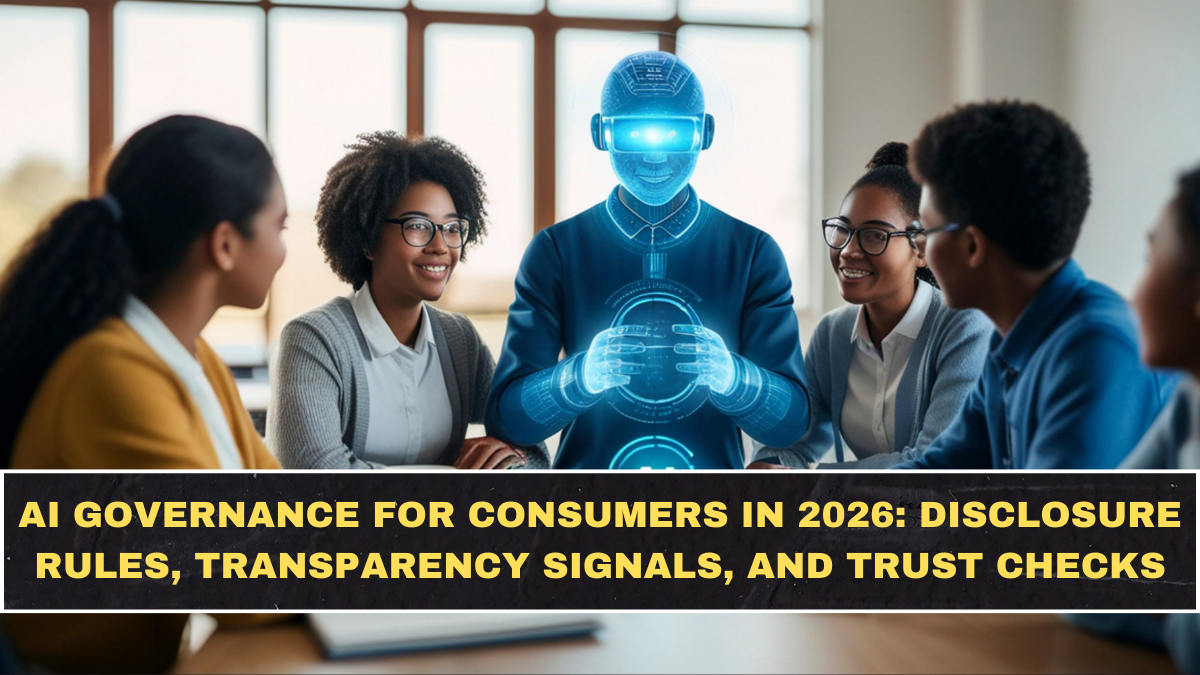
AI governance in 2026 is no longer just a government or enterprise concern. For everyday users, AI now shapes what they read, watch, buy, and believe, often without clear signals that automation is involved. From summaries and recommendations to images, voices, and reviews, AI-generated or AI-assisted content is blended seamlessly into daily digital life. This makes consumer-side governance essential, because relying purely on platforms or creators to “do the right thing” has proven unrealistic.
What makes this moment different is scale. In earlier years, synthetic content felt novel and easy to spot. In 2026, it is normal, fast, and often indistinguishable from human output at a glance. That shifts responsibility toward consumers, who now need simple, repeatable ways to assess trust without becoming paranoid or technically overwhelmed. Governance for consumers is about practical judgment, not policing technology.

Why Consumers Need AI Governance in 2026
AI-generated content is no longer limited to obvious chatbots or novelty images. It appears in headlines, product descriptions, customer support replies, videos, voice notes, and even official-looking notices.
Because AI reduces production cost, volume has exploded. This creates a credibility problem, not a capability problem. When everything looks polished, trust becomes harder to assign.
In 2026, consumers need governance frameworks to decide what to rely on, what to double-check, and what to ignore.
Disclosure: What It Is and Why It Matters
Disclosure means clearly stating when AI played a significant role in creating content, decisions, or recommendations. This includes summaries, synthetic voices, generated images, and automated advice.
Disclosure does not mean content is wrong or low quality. It simply gives users context so they can judge intent, accountability, and risk.
In 2026, transparent disclosure becomes a basic trust signal, much like author names or publication dates.
The Difference Between Helpful Labels and Useless Disclaimers
Not all disclosures are equal. Buried disclaimers in footers or vague “AI-assisted” notes do little for users.
Effective labels are visible, specific, and timely. They appear where decisions are made, not after engagement.
Consumers in 2026 learn to ignore platforms that hide disclosures and reward those that surface them clearly.
Transparency Signals Consumers Should Look For
Beyond explicit labels, transparency shows up in structure and behavior. Credible content explains limitations, uncertainty, and context.
AI-heavy content that avoids nuance, hedges responsibility, or overstates confidence deserves scrutiny.
In 2026, transparency is often visible in tone and framing, not just technical tags.
Why Verification Matters More Than Trusting Brands
Brand names once served as shortcuts for trust. That shortcut is weaker in an AI-saturated environment.
Even reputable brands use automation at scale, increasing the risk of errors, outdated information, or generic advice.
Consumers now verify key claims independently instead of assuming brand authority guarantees accuracy.
Simple Verification Habits That Actually Work
Verification does not require technical tools. Cross-checking dates, comparing multiple sources, and looking for primary references remain effective.
Pausing before sharing emotionally charged content reduces the spread of synthetic misinformation.
In 2026, slow thinking becomes a powerful defense against fast-generated content.
AI-Generated Summaries and the Risk of Oversimplification
Summaries save time, but they also remove nuance. AI tends to compress complexity into confident-sounding conclusions.
This becomes dangerous in finance, health, legal, and policy-related content.
Consumers in 2026 learn to treat summaries as entry points, not final answers.
Synthetic Media and Emotional Manipulation
AI-generated images, voices, and videos can trigger strong emotional responses, especially when paired with urgency.
Emotion is often used to bypass verification instincts. This is intentional in scams and misleading campaigns.
Recognizing emotional pressure as a red flag is a key consumer governance skill in 2026.
Platform Responsibility vs Personal Responsibility
Platforms promise safeguards, but incentives often favor engagement over caution.
Consumers cannot outsource judgment entirely to algorithms designed to maximize time spent.
In 2026, personal governance complements platform rules rather than replacing them.
Why “Perfect Content” Can Be a Warning Sign
AI-generated content often looks polished, balanced, and authoritative, even when incorrect.
Lack of rough edges, personal experience, or specificity can signal automation.
Consumers learn to value clarity and specificity over surface-level polish.
Teaching AI Literacy Without Fear
AI governance for consumers is not about avoiding technology. It is about using it consciously.
Fear-based messaging leads to disengagement, not better judgment.
In 2026, the goal is confident skepticism, not distrust of everything digital.
Conclusion: Consumer Governance Is About Judgment, Not Control
AI governance for consumers in 2026 is ultimately about restoring balance. As content production accelerates, human judgment becomes more valuable, not less. Consumers who understand disclosures, recognize transparency signals, and apply simple verification habits gain a real advantage in clarity and confidence.
Rather than banning or resisting AI, effective consumer governance treats it as a powerful tool that requires context. When users know when to trust, when to question, and when to verify, AI becomes less manipulative and more useful. In 2026, the most empowered consumers are not the most technical ones, but the most thoughtful ones.
FAQs
What is AI governance for consumers?
It refers to practical rules and habits consumers use to judge AI-influenced content.
Does AI disclosure mean content is unreliable?
No, it simply provides context about how the content was created.
How can consumers verify AI-generated information?
By cross-checking key facts, dates, and sources across multiple credible references.
Are platforms responsible for labeling AI content?
Yes, but consumers should not rely on platforms alone for judgment.
Is AI-generated content always bad?
No, it can be useful, but it requires context and verification.
What is the biggest risk for consumers in 2026?
Mistaking confident, polished AI output for verified truth.