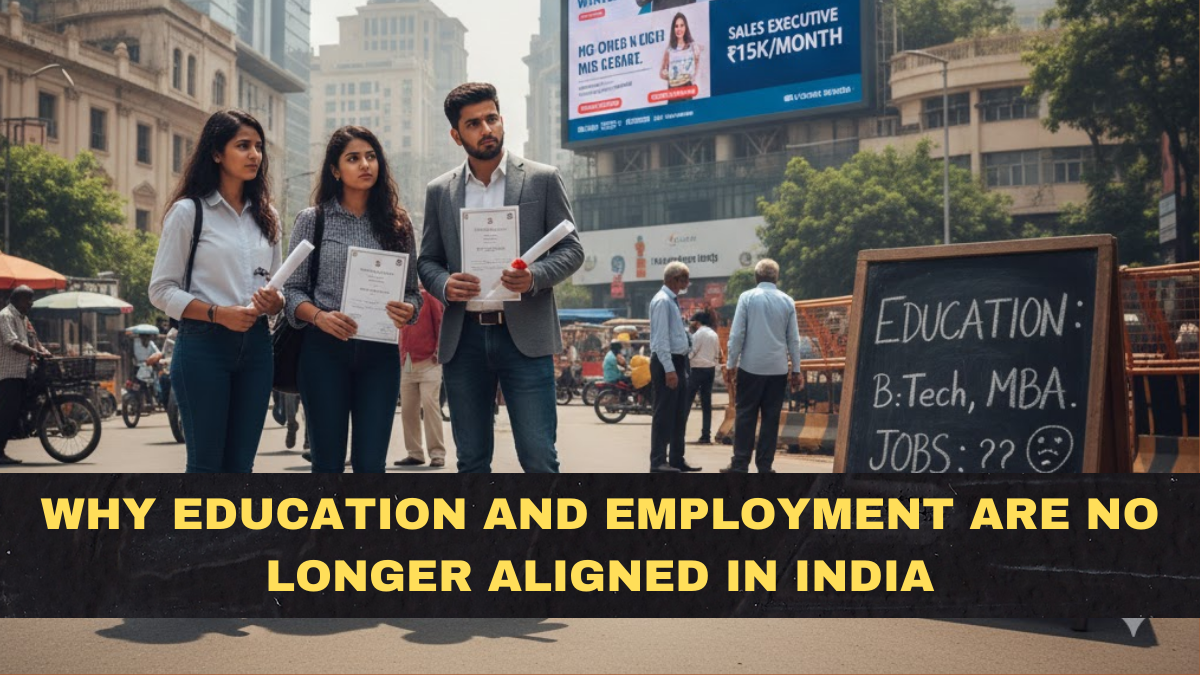
For decades, education was viewed as a direct pipeline to employment. Study hard, earn a degree, and a stable job would follow. In 2026, that equation no longer holds true for a large section of students in India. Graduates are leaving colleges with qualifications but struggling to translate them into meaningful employment, creating frustration on both sides of the hiring process.
This disconnect is not accidental. Education and employment have evolved at different speeds, shaped by separate incentives and priorities. While industries demand adaptability and real-world capability, education systems continue to emphasize completion and certification. The result is a widening gap that affects confidence, productivity, and long-term career growth.
Why Degrees No Longer Guarantee Job Readiness
Degrees certify academic completion, not workplace competence. Students often graduate without exposure to real job environments.
Employers expect immediate contribution, but graduates require significant onboarding. This mismatch creates hiring hesitation.
In 2026, degrees signal eligibility, not preparedness.
How Curricula Lag Behind Industry Reality
Curriculum updates take years, while industries change within months. Emerging tools and practices outpace academic revisions.
Students learn concepts that are no longer widely used in practice. This creates outdated knowledge at graduation.
The time gap between education and employment keeps widening.
The Overemphasis on Theory Over Application
Indian education rewards memorization and exams. Application-based learning remains limited.
Students perform well academically but struggle with execution, communication, and problem-solving.
This imbalance leaves graduates confident in theory but unsure in practice.
Why Employers Expect Skills Colleges Don’t Teach
Workplaces demand collaboration, adaptability, and decision-making under uncertainty.
These skills are learned through experience, not lectures. Colleges rarely simulate such environments.
In 2026, soft skills matter as much as technical knowledge.
The Role of Internships in the Disconnect
Internships are meant to bridge education and employment, but many are poorly structured.
Students perform routine tasks without mentorship or learning depth. Exposure replaces skill-building.
As a result, internships fail to close the gap effectively.
Why Hiring Processes Have Changed
Employers rely on assessments, portfolios, and practical tests rather than degrees alone.
They seek evidence of capability, not just credentials. Degrees have lost filtering power.
This shift leaves unprepared graduates struggling to compete.
How This Gap Affects Freshers Most
Freshers face rejection not due to lack of intelligence, but lack of readiness.
Without experience, they struggle to demonstrate value. Confidence erodes quickly.
In 2026, entry into the workforce is harder than ever.
The Cost of Misalignment for Employers
Companies spend heavily on training new hires. Productivity suffers during ramp-up periods.
Hiring becomes risky and expensive. Employers prefer experienced candidates.
The system penalizes both graduates and organizations.
Why Education Reform Feels Slow
Large systems resist rapid change. Accreditation, approvals, and standardization slow adaptation.
Colleges prioritize enrollment and compliance over employability outcomes.
In 2026, reform struggles to match urgency.
What Bridges the Gap More Effectively
Project-based learning builds confidence and competence. Real-world exposure matters.
Collaboration between industry and education improves relevance.
Continuous learning must start before graduation, not after.
Conclusion: Alignment Matters More Than Ever
The gap between education and employment is not a failure of students.
In 2026, it reflects systemic misalignment between learning and work.
Closing this gap requires shifting focus from degrees to readiness, from certification to capability. Until that happens, education alone will remain an incomplete bridge to employment.
FAQs
Why are education and employment misaligned in India?
Because curricula lag behind industry needs and focus more on theory than application.
Are degrees becoming irrelevant for jobs?
Not irrelevant, but insufficient without practical skills and experience.
Why do employers hesitate to hire fresh graduates?
Due to high training costs and low immediate productivity.
Do internships solve this problem?
Only when they are structured, mentored, and skill-focused.
What skills do employers value most in 2026?
Adaptability, problem-solving, communication, and applied technical skills.
How can students prepare better for employment?
By gaining real-world exposure, building projects, and learning continuously alongside formal education.