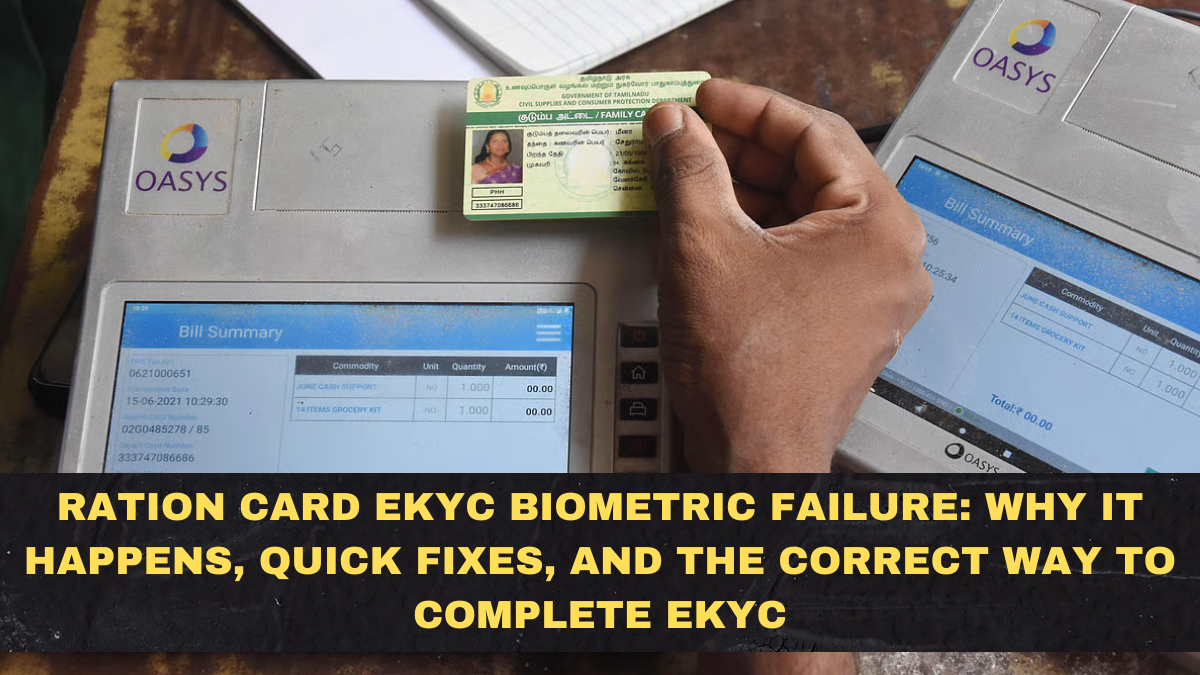
In 2026, ration card eKYC has quietly become one of the most critical digital compliance steps for Indian households. What was initially introduced as a routine identity linking exercise is now directly tied to whether a family continues to receive subsidised food grains under the National Food Security Act. Across multiple states, beneficiaries are discovering that their ration card benefits are being paused, limited, or flagged simply because eKYC could not be completed successfully.
The most common blocker is biometric failure. Fingerprints do not match. Iris scans fail. OTPs do not arrive. Devices refuse to authenticate. And when this happens, people assume something is wrong with their Aadhaar or that their ration card has been cancelled. In reality, most ration card eKYC failures in 2026 are technical and procedural issues, not eligibility problems. Once you understand why biometric authentication fails and how the system actually verifies identity, completing eKYC becomes far more predictable and far less stressful.
Why Ration Card eKYC Is Mandatory in 2026
The government’s push for ration card eKYC is driven by three goals: eliminating duplicate beneficiaries, removing ghost cards, and ensuring that subsidies reach real, living individuals. Every family member listed on a ration card must now be individually verified using Aadhaar-based authentication.
If eKYC is not completed within the deadline window, the ration card is not always cancelled immediately, but it is often placed into a restricted state. In this state, beneficiaries may receive reduced grain quantities or be blocked from lifting rations entirely until verification is completed.
Why Biometric Authentication Fails So Often
Biometric failure is not a rare edge case. It is one of the most common outcomes in Aadhaar-based systems.
The biggest reasons include fingerprint wear and tear, especially among elderly people, construction workers, farmers, and manual labourers. Over time, fingerprints become faint, cracked, or scarred, making them difficult for scanners to read accurately.
Another major factor is poor-quality biometric devices at ration shops and service centres. Cheap scanners often fail to capture clean images, especially in dusty or humid environments.
Temporary physical conditions also play a role. Dry skin, wet fingers, cuts, swelling, or fever can distort fingerprint readings enough to cause repeated mismatches.
Why OTP-Based eKYC Fails Even When Aadhaar Is Correct
Many states allow OTP-based eKYC as an alternative when biometrics fail. Yet OTP failures are also common.
This usually happens when the mobile number linked to Aadhaar is outdated, inactive, or unreachable. In some cases, telecom network delays prevent OTPs from arriving within the short validity window.
People also get blocked because multiple OTP requests trigger rate limits in UIDAI’s backend, temporarily disabling further attempts.
The Most Common Hidden Causes of eKYC Failure
These issues are rarely explained to beneficiaries.
Aadhaar demographic data mismatch with ration card records, such as name spelling or date of birth differences.
Aadhaar not yet seeded correctly with the ration card number.
Duplicate Aadhaar linked to multiple ration cards in the same household.
Backend server downtime at UIDAI or state PDS servers.
All of these can silently block eKYC completion.
What Actually Works When Fingerprint eKYC Keeps Failing
This is the part most people need.
First, switch fingers. Many scanners default to the thumb, but other fingers often work better.
Second, clean and lightly moisturise your hands before scanning. Extremely dry skin reduces scanner accuracy.
Third, try eKYC at a different centre with a better-quality biometric device.
Fourth, attempt OTP-based eKYC if your mobile number is correctly linked to Aadhaar.
Fifth, update your biometrics at an Aadhaar Seva Kendra if repeated failures persist.
How to Update Aadhaar Biometrics Correctly
Biometric data in Aadhaar is not permanent.
If your fingerprints were captured years ago, they may no longer match your current fingerprint pattern.
At an Aadhaar Seva Kendra, you can update:
• Fingerprints
• Iris scans
• Facial photo
After updating, it takes 24–72 hours for the new biometrics to sync across government systems.
What to Do If OTP eKYC Is Not Working
If OTP-based eKYC fails repeatedly, do not keep retrying blindly.
First, verify that your Aadhaar-linked mobile number is active and correct.
Second, test OTP delivery using another Aadhaar-linked service.
Third, wait a few hours if rate-limited.
Fourth, visit a ration shop or CSC centre for assisted eKYC.
Why Some Family Members Get Verified and Others Don’t
This creates massive confusion.
One member completes eKYC successfully.
Another member fails repeatedly.
This usually means biometric quality differs between individuals, or one person’s Aadhaar data is outdated or mismatched.
Each family member must be resolved individually.
When Offline Verification Is the Only Practical Solution
For elderly people, disabled individuals, or those with permanently unreadable fingerprints, offline verification is often allowed.
This may involve:
• Physical presence verification
• Manual document checks
• Local ration officer approval
Rules vary by state.
How Long eKYC Processing Really Takes
Realistic timelines in 2026:
Biometric eKYC: instant to 24 hours
OTP eKYC: instant to 24 hours
Backend sync delays: 2–7 days
Manual resolution: 7–30 days
Repeated failed attempts reset waiting windows.
Why Ration Benefits Get Blocked Even After eKYC
This is another silent failure point.
Sometimes eKYC completes, but backend mapping fails.
The system shows verified, but the ration card remains restricted.
This resolves automatically within a few days in most cases.
Conclusion: Biometric Failure Is a System Limitation, Not Your Fault
Ration card eKYC biometric failure in 2026 is not a personal error, and it is not a sign that your Aadhaar or ration card is invalid. It is a predictable outcome of ageing biometric data, low-quality scanners, network delays, and rigid backend matching logic that does not adapt well to real human variation.
The worst mistake people make is repeatedly retrying the same failing method without changing anything. That only increases rate limits, backend blocks, and frustration. The moment you shift strategy by switching fingers, improving scan quality, trying OTP verification, or updating biometrics at an Aadhaar centre, success rates increase dramatically.
For families who depend on subsidised food grains, resolving eKYC issues is not just administrative housekeeping. It is essential for continued access to benefits. Once you understand how the system actually works rather than how it is supposed to work, ration card eKYC becomes slow and inconvenient, but not mysterious or impossible.
FAQs
Why is my ration card eKYC failing repeatedly?
Usually due to biometric mismatch, poor scanner quality, or Aadhaar data issues.
Can I complete eKYC without fingerprints?
Yes, many states allow OTP-based eKYC as an alternative.
What if my fingerprints never match?
Update your biometrics at an Aadhaar Seva Kendra.
How long does ration card eKYC take to reflect?
Anywhere from instant to 7 days depending on backend sync.
Will my ration card be cancelled if eKYC fails?
Usually it is restricted first, not cancelled permanently.
What if only one family member fails eKYC?
That member must be resolved individually; others are not affected.