As scientific exploration moves beyond Earth’s boundaries, researchers are uncovering extraordinary possibilities hidden within the microgravity environment of space. One of the most promising discoveries involves microgravity-grown crystals, which form with far greater clarity, size, and structural perfection than crystals grown on Earth. These improvements offer tremendous potential for advancing science, particularly in fields that rely on precise molecular structures. Many experts believe that these space-grown crystals may play a key role in future medical breakthroughs, transforming how medicines are created, how diseases are studied, and how treatments are developed.
Microgravity eliminates many of the natural forces that distort crystal growth on Earth, such as convection currents and sedimentation. This allows scientists to observe pure crystal formation and analyze molecular arrangements that were previously impossible to study. As humanity continues to explore space-based research opportunities, microgravity-grown crystals are becoming an essential tool for unlocking new solutions in biotechnology, pharmaceuticals, and advanced medical innovation.
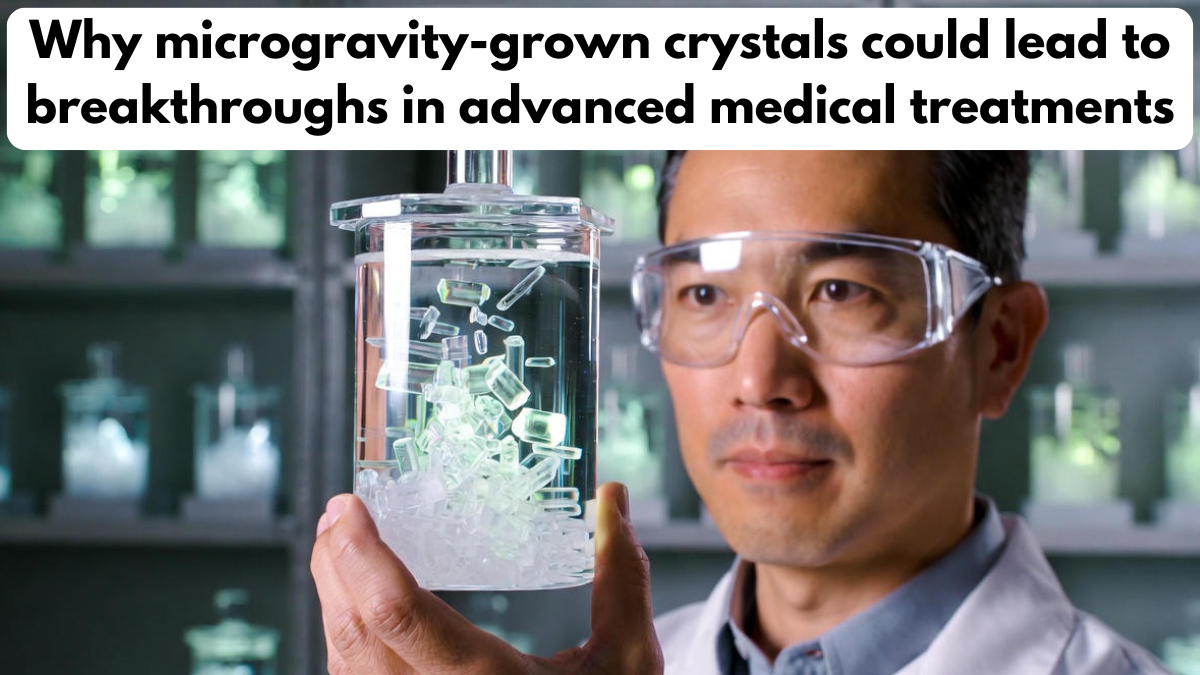
How Microgravity Enhances Crystal Growth
To understand why microgravity-grown crystals are so valuable, it is important to recognize how gravity affects crystal development on Earth. Under normal conditions, crystals experience constant pull from gravity, causing imperfections as molecules settle unevenly. Heat and fluid currents further disrupt the growth process, creating flawed or incomplete structures. These imperfections limit their scientific usefulness, particularly in medical research where accuracy is crucial.
In microgravity, however, crystals float freely without settling. This leads to slower, more uniform growth, resulting in exceptionally pure and symmetrical structures. Such improvements provide scientists with clearer molecular images, which are essential for designing targeted medications. Because structural precision is central to many medical breakthroughs, researchers rely on these perfect crystals to better understand complex proteins, enzymes, and disease-causing molecules.
Medical Applications of Microgravity-Grown Crystals
The relationship between microgravity-grown crystals and potential medical breakthroughs is profound. Protein crystals grown in microgravity allow researchers to determine molecular structures more accurately, enabling them to design drugs that interact with disease-causing proteins at specific points. This precision improves treatment effectiveness and reduces unwanted side effects.
Microgravity-grown crystals are already being used to study cancer, Alzheimer’s disease, and viral infections. For example, clearer crystal structures help scientists identify the weaknesses of harmful proteins or determine how certain molecules behave under different conditions. These insights accelerate the development of new medications and therapies. Additionally, microgravity research supports the creation of improved vaccines, enzyme treatments, and diagnostic tools, all of which expand the potential for medical breakthroughs in the near future.
Table: Benefits of Microgravity-Grown Crystals for Medical Research
| Research Area | Benefit from Microgravity-Grown Crystals | Impact on Medical Breakthroughs |
|---|---|---|
| Drug Development | More accurate protein structures | Better targeted medications |
| Disease Modeling | Clearer molecular behavior | Improved understanding of disease mechanisms |
| Vaccine Research | Enhanced antigen clarity | Faster and more effective vaccine design |
| Enzyme Studies | Higher-quality crystal samples | Stronger enzyme-based therapies |
| Diagnostic Innovation | Structural precision | Development of advanced diagnostic tools |
This table demonstrates how microgravity-grown crystals contribute significantly to accelerating medical breakthroughs across multiple fields.
How Microgravity Research Expands Scientific Understanding
Beyond direct medical applications, microgravity-grown crystals help scientists refine theoretical models and enhance their understanding of molecular behavior. In many cases, crystals formed in microgravity reveal structural details that remain hidden when grown under Earth’s conditions. This new information challenges existing scientific assumptions and pushes researchers to rethink how molecules operate at the smallest scales.
These discoveries lead to better research methods, improved laboratory techniques, and expanded opportunities for innovation. Insights gained from microgravity experiments often carry over into Earth-based studies, supporting scientific progress even outside space environments. Ultimately, this knowledge accelerates the search for medical breakthroughs, as scientists develop improved models for predicting disease behavior, drug interactions, and therapeutic outcomes.
The Growing Importance of Space-Based Biomedical Research
As international space agencies and private companies increase their presence in orbit, opportunities for studying microgravity-grown crystals are expanding rapidly. The International Space Station has become a crucial hub for biomedical experiments, offering a unique environment for scientists worldwide. Commercial spaceflight may soon open access to even more researchers, allowing for faster and more diverse experiments.
These advancements support global efforts to achieve new medical breakthroughs. Medical companies, academic institutions, and research laboratories now recognize the value of utilizing space environments for high-precision studies. As demand for advanced treatments grows, the role of microgravity research will likely continue to expand, providing essential tools for addressing some of the world’s most challenging health conditions.
Challenges and Future Potential of Microgravity Crystal Research
Despite its many advantages, the field of microgravity-grown crystals also faces challenges. Conducting experiments in space is expensive and limited by available mission schedules. Researchers must rely on specialized equipment, strict protocols, and coordination with space agencies. Additionally, not every crystal structure benefits equally from microgravity conditions, meaning some experiments may produce limited or inconsistent results.
However, technological improvements continue to reduce these obstacles. Innovations in automated research devices, miniaturized laboratories, and commercial space access are making microgravity experiments more efficient and affordable. As these challenges diminish, the future of medical breakthroughs tied to microgravity research becomes even more promising. The growing partnership between medical science and space exploration will likely lead to discoveries that fundamentally transform healthcare.
Conclusion
The study of microgravity-grown crystals represents one of the most exciting frontiers in modern science. By providing clearer, more precise molecular structures, these crystals open the door to transformative medical breakthroughs in drug development, diagnostic tools, vaccine research, and disease modeling. The knowledge gained from microgravity research strengthens our understanding of the human body and disease mechanisms, pushing the boundaries of what is medically possible.
As global demand for advanced treatments increases, space-based research will play an even greater role in shaping the future of healthcare. Microgravity offers a unique environment that cannot be replicated on Earth, making it an essential asset for scientific progress. Through continued investigation and innovation, microgravity-grown crystals may hold the key to revolutionary medical discoveries that improve millions of lives.
FAQs
Why are crystals grown in microgravity better for medical research?
They develop with fewer imperfections, allowing scientists to study molecular structures more accurately.
How can microgravity-grown crystals lead to medical breakthroughs?
Improved crystal clarity helps researchers design targeted drugs, vaccines, and advanced treatments.
What diseases can be studied using microgravity-grown crystals?
Conditions like cancer, Alzheimer’s, viral infections, and autoimmune disorders can benefit from these precise molecular structures.
Will microgravity research become more common in the future?
Yes, as space technology expands, more researchers will use microgravity environments for biomedical discoveries.
Click here to know more.